
The budget committee meets in October, the selectboard has a stack of department requests, and the warrant has to be posted before March. In a small New Hampshire town, most of this is done by volunteers in the evenings, alongside jobs and family. The town administrator or clerk, if there is one, is already stretched.
We wrote earlier about AI for small town offices. This post is narrower: the budget and warrant cycle, and where AI helps with it.
Where the hours go
Most of the work in budget season is not deciding. It is writing things down, comparing documents and answering the same questions again. Say a town clerk spends six hours a week from November through February on explanations, comparisons and report text. That is time AI can reduce, as long as the board treats its output as a draft.
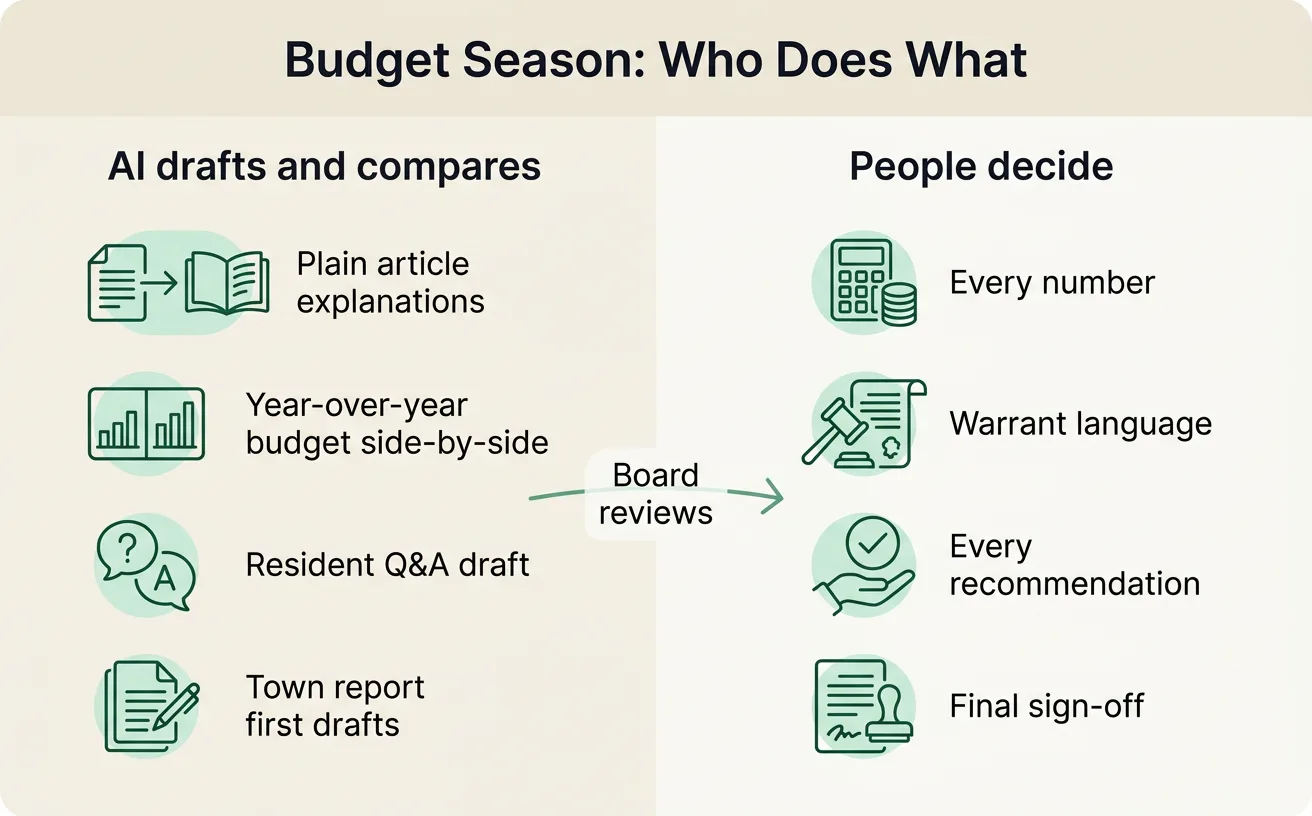
The rule we use is simple. AI drafts and compares. It does not set the budget. Every figure and every recommendation stays with the people the town elected or appointed.
What AI is good at here
Four jobs fit well.
1. Plain-language explanations of each warrant article
Warrant articles are written in legal language for good reason, but many residents will not read them closely. An AI assistant can turn each article into a short paragraph: what it asks, what it would spend or change, and what happens if it fails. These paragraphs can go in the town report, on the website and in handouts at the hearing.
2. A side-by-side of this year against last year
Give the assistant last year's approved budget and this year's proposed budget. Ask it to list every line that changed, the size of the change, and any lines that appear in one year but not the other. It is good at this kind of tedious comparison, and a complete list helps the committee see what it is deciding.
3. A resident Q&A from hearing questions
After the public hearing, feed the assistant your notes or the minutes. It can group the questions that came up (the highway department's equipment, the library hours, why a line went up) and draft short answers. The answers should point back to the town's own documents.
4. First drafts of town report sections
Department heads often send in a few rough lines, or nothing, until the deadline is close. An assistant can turn last year's section and this year's notes into a clean first draft for the department head to correct.
| Job | What you give it | What comes back |
|---|---|---|
| Article explanations | The warrant articles | One plain paragraph each |
| Budget comparison | Last year's and this year's budgets | List of every changed line |
| Resident Q&A | Hearing notes or minutes | Grouped questions, draft answers |
| Report sections | Last year's text, this year's notes | First draft per department |
Use only the town's own documents
The assistant should work from the town's documents and nothing else. That means the budget worksheets, the warrant, last year's report and the minutes. If it is asked a question those documents do not answer, the right output is “not found in the documents,” and you should tell it so in your instructions.
This matters because a language model will happily fill a gap with something that sounds right. A tax rate, a statute or a past vote that it supplies from general knowledge could be wrong for your town. Keep the sources narrow and ask it to cite the page or line it relied on.
If budget drafts or personnel details should not go to an outside service, a private setup keeps them in-house. Our one-page AI policy is a reasonable starting point for deciding what the board will and will not paste into a tool.
What people still decide
Every number is a person's. The assistant can add, compare and list, but it can make arithmetic and reading mistakes. Someone on the committee checks each total and each changed line against the source worksheet.
Warrant language belongs to the town and its legal advisors. Town counsel and the rules of the Department of Revenue Administration govern how articles are worded and posted. AI may help explain an article after it is written. It should not draft the language that goes on the warrant, and no one should rely on it for legal or filing requirements.
Recommendations are the board's. Whether the budget committee recommends an article is a judgment about your town, your neighbors and your roads. A draft can lay out the facts. The vote is the committee's.
Anything published gets read by a person first. The explanation on the website, the handout and the town report all go out under the town's name. Someone reads each one against the source before it does.
A small first step
Take last year's warrant. Ask an AI assistant for a one-paragraph plain explanation of each article, using only the text of that warrant. Then check each paragraph against the article itself, and mark anything that is wrong, vague or left out.
This takes an evening and shows you how the tool behaves with your documents. You will see where it is accurate and where you will need to watch it. If the paragraphs turn out useful, they may already be close to what you want on the website this winter.
The same habit of mapping one job before choosing a tool is covered in Map One Job Before You Buy Any AI Tool. If your board wants help setting this up, or training for the clerk and administrator, we're glad to talk it through: book a planning call. It's free, and it's 30 minutes.