
It is early October, the first cold mornings have people checking whether the furnace still works, and a small HVAC company in the Monadnock region is getting more calls than it can return by lunch. In the same week, the owner has been pitched a phone answering bot, a scheduling tool and an invoicing add-on. Each demo looked fine. None of them said which problem it would solve for this shop.
We suggest putting the tools aside and mapping one job first. It takes a sheet of paper and an hour or two with the people who do the work.
Pick one job and write it down as it really happens
Take a service call. Say the shop is five people: an owner, an office manager, and three techs. We'll walk it from the phone ringing to the invoice going out.
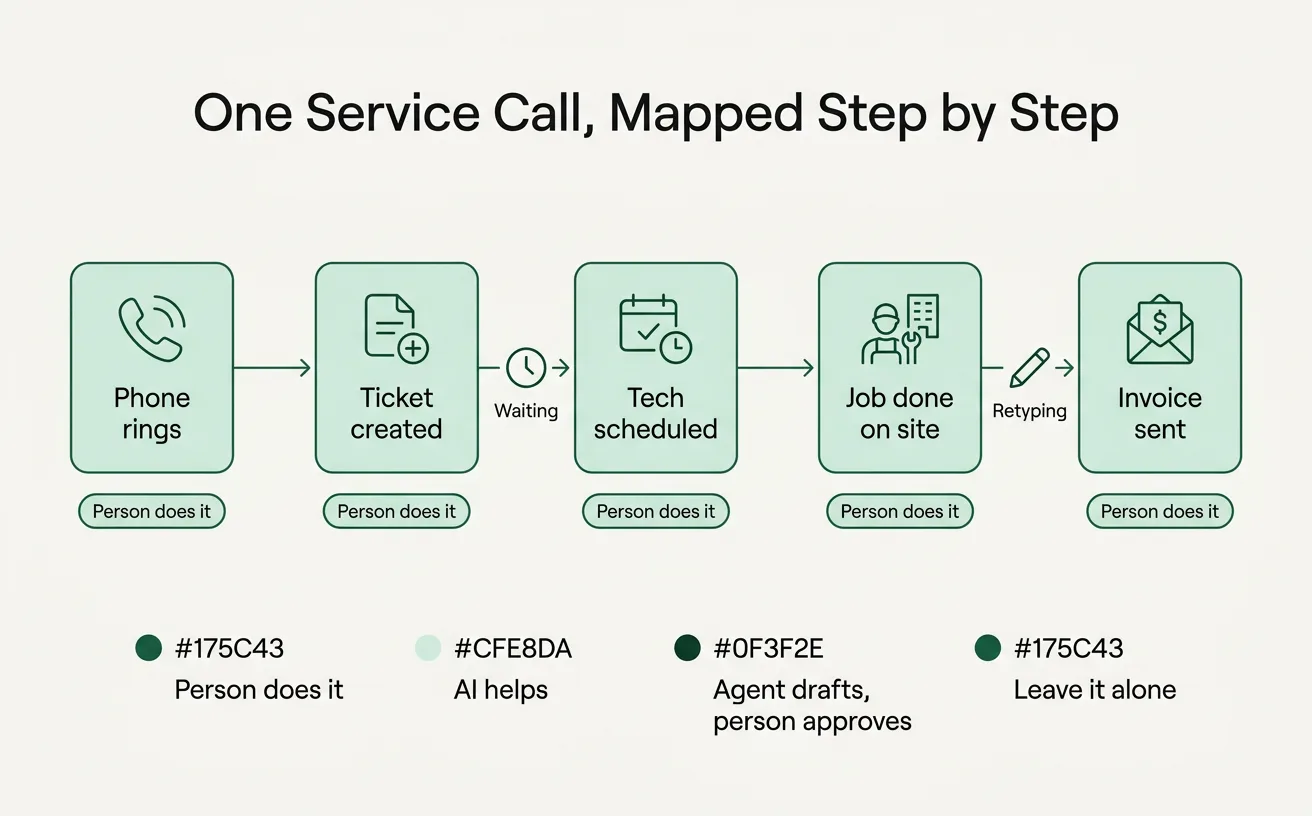
The steps might look like this:
- A customer calls (or texts) about a furnace that won't start.
- The office manager writes it on a pad, then types it into the scheduling software.
- She checks the customer's history in the invoicing system, which is a separate program.
- She texts a tech to see who can fit it in.
- The tech goes out, fixes it or doesn't, and notes the parts used on a paper ticket.
- The ticket sits in the van until Friday.
- The office manager retypes it into the invoicing system and sends the invoice.
Write the steps in the order they happen, not the order they are supposed to happen. The gap between those two is usually where the time goes.
For each step, note who touches it and where it lives
Next to every step, write two things: the person and the system. Phone, notepad, scheduling software, text messages, paper ticket, invoicing program. In our example the same information is written down three times in three places.
Now mark two kinds of trouble:
- Waiting: the job is sitting until someone gets to it. The ticket in the van, the text to a tech who hasn't answered.
- Retyping: the same facts entered a second or third time. Pad to scheduler, paper ticket to invoice.
Then put a rough number on each, in hours per week. Say the retyping from paper tickets takes the office manager six hours a week, and callbacks about "when is the tech coming" take another four. These are made-up figures, but yours will be easy to estimate once the steps are on paper. Hours per week is enough to compare steps. You don't need dollars to see which one hurts.
Sort every step into one of four buckets
Once the map is on paper, each step goes into one of four groups.
Done by a person
Diagnosing the furnace, talking to an upset customer, deciding whether to repair or replace. These stay with your people.
Done with AI helping
The person does the work and AI speeds up the writing. A tech dictates notes from the job and an AI assistant turns them into a clean summary. The tech reads it and fixes it before it goes anywhere.
Done by an agent, with a person approving
The agent does the looking up and drafting. It reads the tech's notes, pre-fills the invoice from the parts list and the customer record, and queues it. The office manager checks it and sends it. Nothing leaves without her approval. This is the kind of work we build in custom AI agents.
Left alone
Some steps work fine. If the owner calls the landlord of a rental property personally and that relationship is the value, leave it. Not every step needs improving.
Every approval needs a one-sentence rule
When an agent drafts something and a person approves it, the approval has to be something a person can actually check. We ask for a rule that fits in one sentence. For example:
- "The invoice total matches the parts list and the hours on the ticket."
- "The appointment time is one the tech has confirmed."
- "Any quote over a set amount goes to the owner before the customer sees it."
If you can't write the rule in a sentence, the step is probably not ready for an agent. It may need a person, or it may need the process cleaned up first. A rule that says "looks right" is a hope, and it won't survive a busy Friday.
What people still decide
The map is a tool for your decisions, and it doesn't make them. Two things stay with you:
- Which steps get changed at all. Maybe the paper ticket is fine and the real problem is that it sits in the van. A cheaper fix might be photographing it before the tech leaves the driveway.
- Every approval rule. Money, safety and commitments to customers (a promised arrival time, a quote, a warranty) are for a person to sign off on. The agent drafts and a person decides.
That is also how you answer the three pitches. Hold each one against the map and ask which step it touches, and how many hours per week that step costs you. If a tool doesn't land on a step you've marked, you can skip it. If two tools touch the same step, you can compare them directly.
Where this goes next
A finished map makes the next conversation short. We use the same method on a discovery call, and you can see how it works at our workflow mapping tool. If your team would rather learn to do some of this themselves, AI cowork training is where we start.
A first step for this week
Pick the one job your team complains about most. It might be the service call, quote follow-ups, or the Friday paperwork. Write its steps on a single sheet of paper, in the order they really happen, and put the person and the system next to each one. Circle the waiting and the retyping, and guess the hours per week.
If you'd like a second pair of hands going through it, book a planning call and bring the sheet.