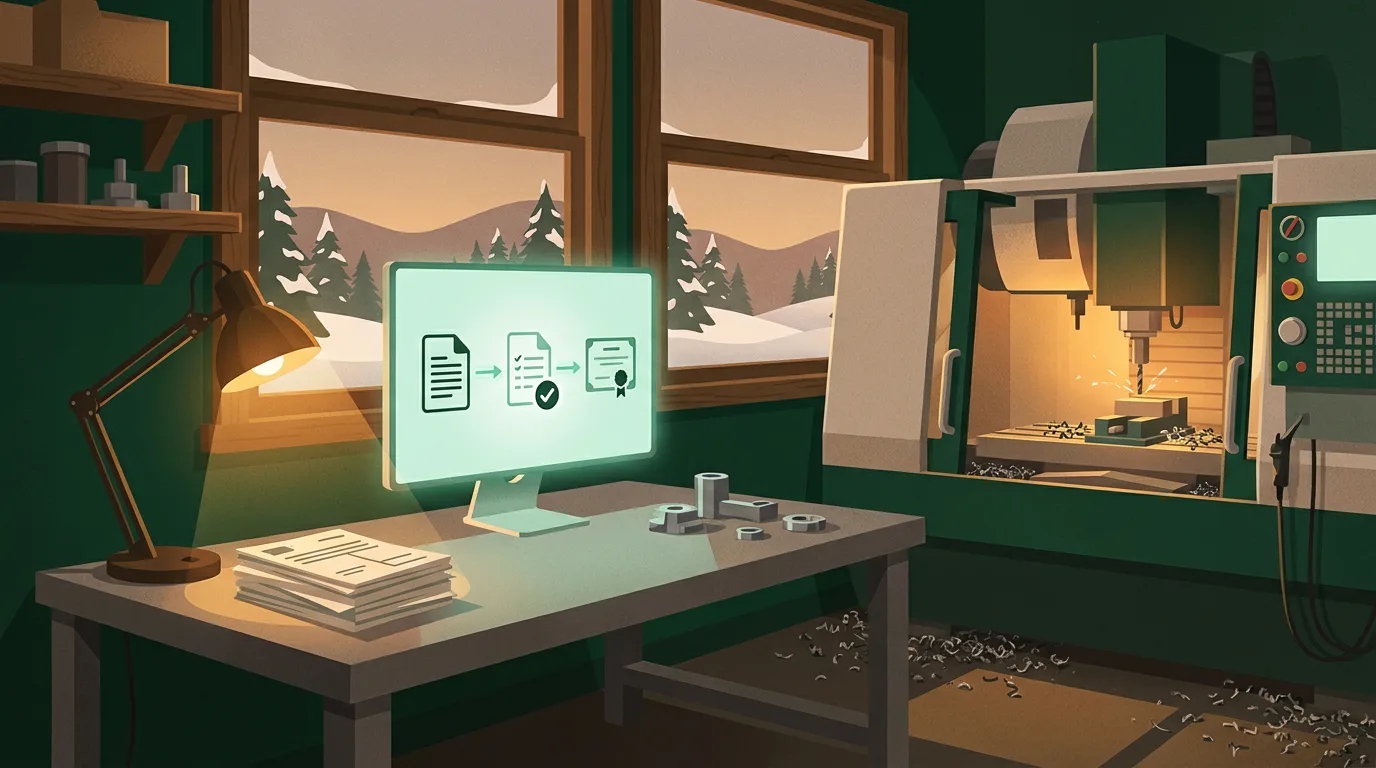
It is Thursday afternoon at a 25-person shop in Hillsborough County. A lot of brackets is boxed and waiting on the dock, the customer wants the certificate of conformance with it, and the quality manager is on the floor because a second-shift operator has a question about a fixture. The paperwork waits until the machine is running again.
In a shop this size the quality manager is usually also the person who knows the floor best. That is why the paperwork piles up: the same person is needed in two places. AI can take on the first draft of much of it. It cannot take on the signature.
Where the hours go
Most quality paperwork is assembly. The facts already exist on the job traveler, the inspection sheet, the material cert and the purchase order. Someone has to find them, put them in the customer's format and check that they agree.
Say one certificate takes forty minutes to put together, and there are six a week. That is four hours a week of looking for records and retyping part numbers, before anyone checks a single measurement.
What AI drafts
An AI assistant is good at pulling matching information from several documents and laying it out in a set format. Four jobs fit that well.
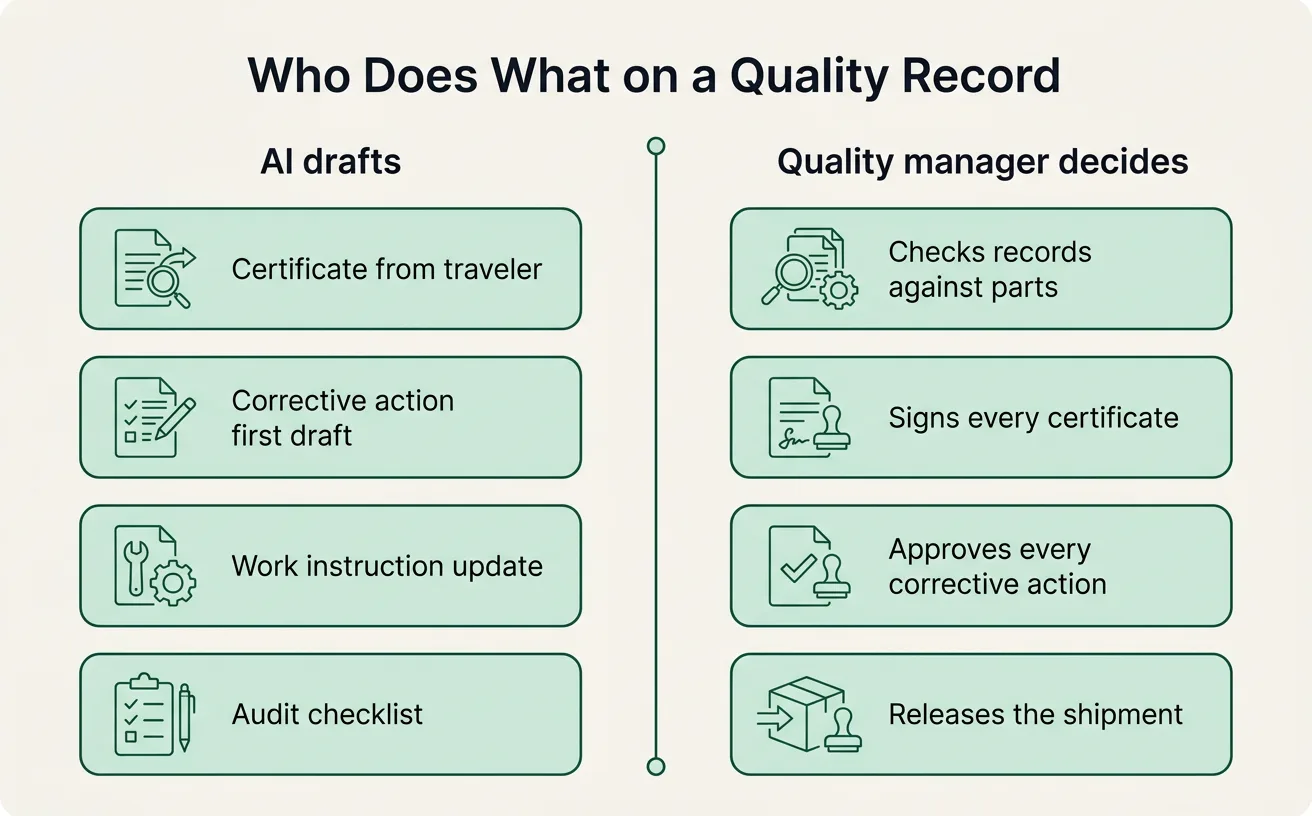
- Certificates of conformance. Give it the traveler, the inspection record and the PO. It drafts the certificate with part number, revision, quantity, lot and material, and flags anything that does not match, such as a quantity on the traveler that differs from the inspection count.
- Corrective action reports. Start from the nonconformance note the operator or inspector wrote. It drafts the description, the containment steps mentioned, and a list of questions for root cause. It does not decide the root cause.
- Work instruction updates. When a process changes (a new insert, a different fixture, a revised inspection step), it drafts the revised instruction from the old one and the change notes, with the changed lines marked.
- Audit checklists. Give it the customer's quality requirements or supplier manual and it lists what an audit will likely ask to see: calibration records, training records, the last few certificates, open corrective actions. You then check the list against what you actually have on file.
What stays with the quality manager
A certificate is a statement to your customer that the parts meet the requirements. The quality manager signs every certificate, and approves every corrective action. The draft saves typing. It does not save the check.
That check means looking at the parts or the measured data, not only at the draft. Nothing ships on an AI-written record that no one has checked against the parts. If the draft says 200 pieces and the box holds 196, the draft is wrong, however tidy it looks.
A few other limits are worth setting plainly:
- Root cause is a judgment. The draft can ask good questions, but the person who watched the process answers them.
- Whether a deviation is acceptable is the customer's call and yours, not the tool's.
- Any change to a controlled work instruction goes through your normal approval before it reaches the floor.
Keep customer drawings in private tools
Customer drawings, specifications and inspection data are often controlled, and many contracts restrict who may see them. Pasting them into a public chat tool is a bad idea. Check your customer agreements and any export or contract flow-down terms before you decide what goes where. We are not giving legal advice here, and your contracts are the authority.
The practical answer is to run the drafting on tools that keep data in-house. That can mean private GPU hosting so the documents never leave your control. A short one-page AI policy that says what may and may not be pasted anywhere also helps the whole shop.
Before the quote and after the ship date
The paperwork starts earlier than the certificate. If requests for quote reach you as a PDF and little else, we wrote about handling that in RFQs that arrive as a PDF and a prayer. Clean intake at the quote stage makes the certificate easier at the end, because the requirements were written down once.
If you want the drafts to follow your own formats and your own record locations, that is what a custom AI agent is for. It looks things up and pre-fills. You approve.
A first step: time one certificate
Before changing anything, pick one certificate of conformance and time it from start to finish. Start the clock when the job is marked complete and stop it when the certificate is sent. Write down each stop along the way: finding the traveler, locating the inspection sheet, matching the PO, retyping, checking, signing, emailing.
Do this for three or four certificates. You will see which stop eats the time, and that is usually the one worth handing to AI first. If you want help mapping it, book a planning call and we will walk through the job with you in 30 minutes, free.