The Saturday after Thanksgiving, the phone at a choose-and-cut farm in the Monadnock region starts ringing before the gate is open. Are you open? Is it going to snow? How much for a six-footer? Do you take cards? Can the dog come? The answers haven't changed since last year, and they will be asked again a few hundred times before mid-December.
That is a good fit for AI, as long as the owner stays in charge of the few answers that carry real consequences.
The same dozen questions
Most of what comes in by phone, text, Facebook message and email falls into a short list:
- Hours, and whether you're open in the snow
- Prices by size, and whether that's cut your own or precut
- Whether you take cards or only cash and checks
- Whether dogs are allowed
- Where to park, and whether the field is walkable in boots
- Wreath and greens availability, and how to preorder
If you or a family member are answering these between customers, that is time not spent at the saw or the baler. Say the questions eat ten hours a week across the season. That is a lot of hours to give to answers you already know.
Start with a one-page fact sheet
An AI assistant is only as good as what it has been told. Left alone, it will guess, and a guess about your hours or your dog policy is worse than no answer.
So write the facts down once. One page, in your own words, covering everything a customer might ask. Hours by day, how you handle snow, what you charge, what you accept for payment, where to park, what's allowed on the farm, how wreath pickup works. Put the same page on your website so customers can find it before they call.
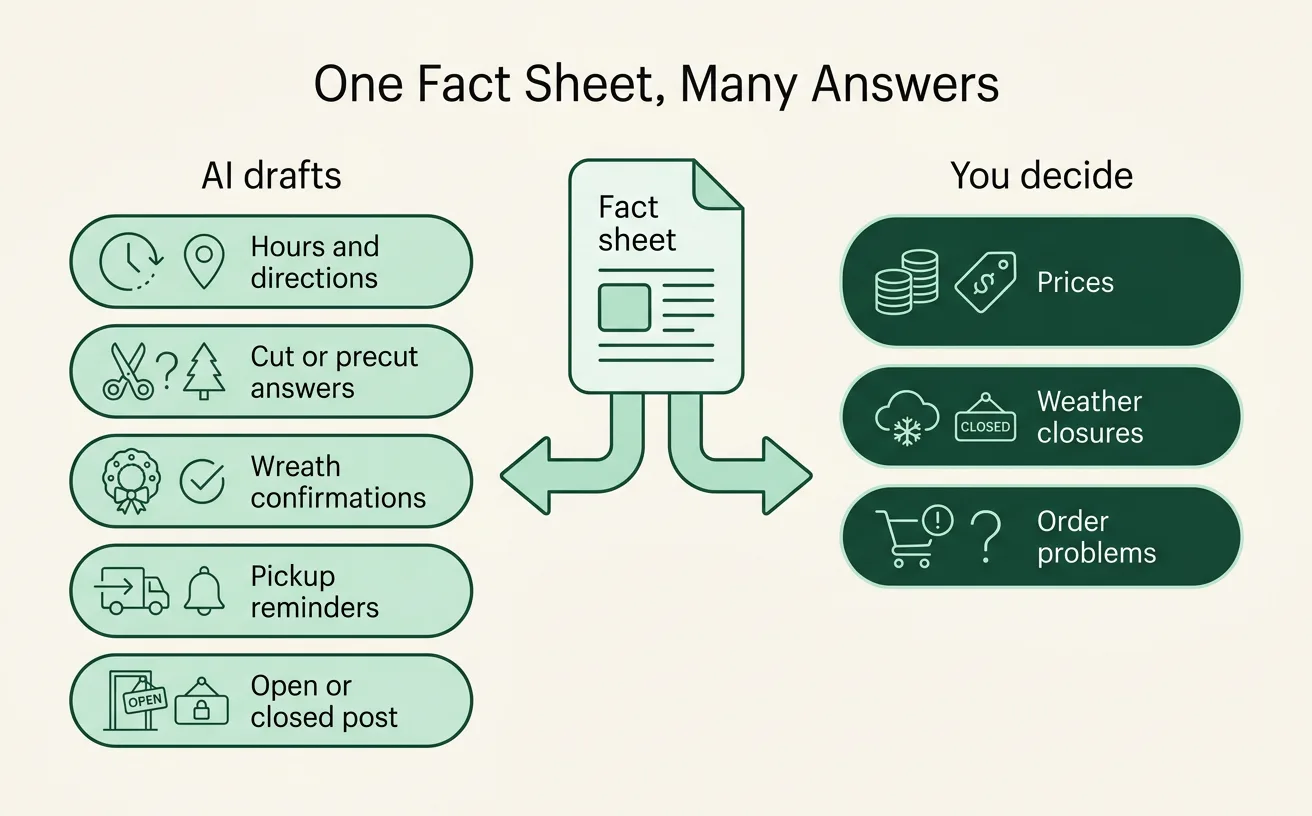
Once that page exists, an AI assistant can draft replies to incoming questions using only what is on it. If a question isn't covered, the draft says so and flags it for you instead of inventing something.
What AI drafts well
Beyond answering questions, there are a few recurring jobs worth handing over.
Wreath preorders
When someone orders a wreath, the assistant can draft the confirmation with size, pickup day and time window. A few days before pickup, it drafts a reminder. You read the list, fix anything odd, and send. For a farm taking forty or fifty preorders, that is a lot of small messages written in a few minutes.
The same-day open or closed post
On a snowy Sunday morning, customers check Facebook and your website before they put the kids in the car. A draft “We're open today, 9 to 4, trees are cut and the field is plowed” or “Closed today for the storm, back tomorrow at 9” can be ready as soon as you decide. You make the call, and the assistant writes the post for the website and social media so they match.
Wholesale inquiries
A church, a landscaper or a small store may ask about bulk trees or greens. The assistant can draft a reply asking for quantity, delivery date and location, and pull in your standard terms. You look at it, add the price you want to quote, and send it.
Where you stay in charge
Three things stay with you.
- Prices. The fact sheet holds your prices, but you set them. The assistant should never offer a discount, a deal on a bigger tree or a wholesale rate on its own.
- Weather closures. Whether the field is safe, whether the road is passable and whether to open late are your judgment. The assistant writes the announcement after you decide.
- Anything about an order going wrong. A wreath that was the wrong size, a missed pickup, a customer who says they were charged twice. Those get a person, a phone call and a straight answer. The assistant can pull up the order details so you have them in front of you, but it doesn't reply.
A simple rule helps: nothing leaves the building without someone reading it first, at least until you trust the drafts. Many farms keep that rule all season.
A few cautions
Keep customer names and phone numbers out of tools you haven't checked. A short written policy on what goes into an AI assistant is worth having, and we wrote one up in What Not to Paste Into ChatGPT: A One-Page AI Policy.
Also check each draft against the fact sheet for the first week. If the assistant gets hours or prices wrong, the fact sheet usually needs a clearer line. Fixing the page fixes every later answer.
If you want to see how a job like this gets laid out before anyone builds anything, our workmap shows how we sketch a workflow on a discovery call. For a team that wants hands-on practice with the assistant before the season, there is AI cowork training.
A first step before Thanksgiving
This week, sit down for an hour and write the one-page fact sheet. Include hours, snow policy, prices by size, cut-your-own versus precut, payment types, dog policy, parking, and how wreath preorders and pickup work. Put it on your website where people can find it, and print a copy for the barn.
That page already cuts down on calls. When you are ready, paste it into an AI assistant and let it draft replies for a week while you read each one before sending.
If you'd like help setting that up, book a planning call and we'll talk it through in 30 minutes, free.