It's the week after the transfer station switched to summer hours, and the town office phone has rung eleven times before lunch. Three callers want to know if they can bring a mattress. Two are asking what happened to the sidewalk article at Town Meeting. One is a new family from Massachusetts who wants to know everything.
None of these questions are hard. The answers already exist, in a PDF on the town website, in the posted transfer station rules, in the minutes from March. The trouble is that residents can't find them, so they call the one or two people in the building who can.
The answers are already written down
Most small New Hampshire towns run on a remarkably thin staff. A clerk who is also the tax collector, a part-time land use assistant who supports both planning and zoning boards, a selectboard that meets on Tuesday nights, and volunteers who turn over every March.
What those people spend a surprising share of their week on is re-finding and re-reading documents the town has already published. Picture a clerk whose counter and phone time on repeat questions runs to six or eight hours a week in early summer. That is time pulled away from vehicle registrations, vital records and getting the minutes posted.
AI won't fix staffing. It is good at one narrow thing that matters here: reading a pile of documents and pointing someone to the right paragraph.
What a town assistant should (and shouldn't) do
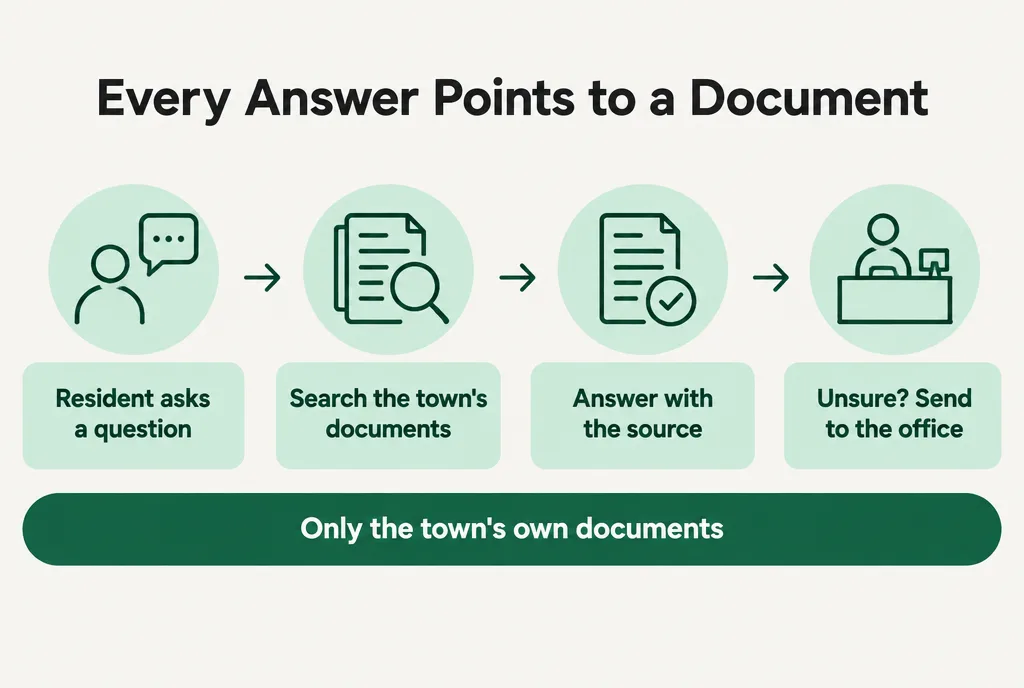
The version worth building is not a general chatbot with the town seal on it. It is an assistant that answers only from the town's own documents, and always shows where the answer came from.
That means it's loaded with the documents a resident would actually need:
- warrant articles and the results from Town Meeting
- ordinances, the zoning ordinance and site plan regulations
- transfer station rules, fees schedules and hours
- selectboard, planning and zoning minutes
- the forms and "how do I" pages already on the website
When a resident asks whether brush is accepted in July, the answer quotes the transfer station rules and links to them. When the question is outside what the documents cover, such as "Will my variance be approved?" or "Is my neighbor allowed to do that?", it says so plainly and points the resident to the right office, with the office hours.
If it can't cite a town document, it shouldn't answer. That one rule does most of the work of keeping a town assistant honest. It also makes the thing easy to check: anyone on staff can click the source and see whether the answer is right.
We've done this. You can read how we built a town website chatbot for a look at one in practice.
The second job: minutes from recordings
The other recurring burden is minutes. Many boards now record their meetings, and someone, often the clerk or a board secretary, turns that recording into minutes afterward. Long planning board hearings can take hours to write up.
This is a good fit for AI, with a clear boundary. The system transcribes the recording and produces a draft in the town's usual format: attendees, motions, who moved and seconded, the vote, and a short summary of discussion.
The clerk or secretary then does what they already do: reads it, fixes it, and brings it to the board for approval. The draft saves the typing and the rewinding. It does not decide what the record says.
A few things AI is genuinely good at here:
- flagging every motion and vote so none is missed
- keeping names and titles consistent from meeting to meeting
- matching the format the board has used for years
And a few it is bad at: knowing who spoke when voices overlap, understanding what a board member meant rather than what they said, and knowing what belongs in the minutes at all. Those stay with a person.
Records law comes first
New Hampshire's Right-to-Know law, RSA 91-A, governs public meetings and records, including minutes. Anything you add to how the town handles minutes, recordings or resident questions should be checked against it.
We're not lawyers and this isn't legal advice. But there are questions your town should put to its counsel before starting, for example:
- Are the recordings, transcripts and AI drafts themselves public records, and how long must they be kept?
- Does adding a transcription step affect the timing for making minutes available?
- What happens to resident questions typed into the website assistant, and are those records?
- Where does the data sit, and who can see it?
Answer the records questions before the technology questions. Some towns will be most comfortable with a setup where recordings and drafts never leave town-controlled systems. That's possible; a private AI setup keeps the model and the documents on hardware the town controls.
Where a person stays in charge
The pattern across both jobs is the same one we use everywhere: the AI drafts and looks things up, and a person approves anything that becomes official.
| The assistant does | A person decides |
|---|---|
| Finds the relevant ordinance or rule | Any interpretation of that ordinance |
| Quotes and links the source | Whether a permit or variance is likely |
| Drafts minutes from a recording | What the approved minutes say |
| Routes unclear questions to the office | Anything involving fees, waivers or exceptions |
The assistant never promises a resident anything on the town's behalf. It never tells someone their project is allowed. When the answer depends on judgment, it hands off to the office.
When we map a town office's week on a discovery call, we mark each step with who does it and write one sentence for each approval, such as "The clerk approves every set of draft minutes before they go to the board." That approach is described on our Workmap page.
Keep it current, or don't launch it
A town assistant is only as good as its document set. If the transfer station fees change in July and the old PDF stays loaded, the assistant will confidently quote the wrong fee, with a citation.
So decide up front who adds new documents and retires old ones. In most towns that is whoever already posts to the website. Make it part of the same step: post the new rules, update the assistant. It's a few minutes, not a new job.
A small first step for your town
Don't start with everything. Start with the transfer station.
Load the transfer station rules, hours, fee schedule and accepted-materials list, and nothing else. Put the assistant on that one page of the website for the summer. Have the clerk read a sample of questions and answers each week for the first month, and fix any document that turns out to be unclear.
If it takes a real share of the summer calls off the counter, add the zoning ordinance next, then warrant articles and results. Try draft minutes separately, with one board, for a few meetings, once counsel has weighed in on recordings.
If you'd like help working out which documents to start with, book a planning call.