
By the last week of October, the lot outside a two-bay shop in Hillsborough County fills up before nine and doesn't empty until dark. Everyone wants tires swapped before the first real snow, and everyone wants to know the same thing: is it ready yet. The phone rings between jobs, the front counter person is also the parts runner, and the mechanic under the lift can't hear it ring at all.
The Bottleneck Isn't the Work, It's the Talking About the Work
A tire swap takes maybe 30 minutes a car. An inspection rush adds diagnostic calls, calls about what a check-engine light might mean, calls asking if a car can wait until next week. None of that is hard work. It's just a lot of it, all wanting an answer right now, and answering it pulls someone away from a bay.
Most of that talking is repetitive enough to draft ahead of time. A car comes in, gets looked at, and the same three or four sentences get typed or said over and over: what's wrong, roughly what it'll take, when it'll be done. That pattern is exactly what a well-set-up AI agent handles well, without ever touching the diagnosis itself.
What AI Actually Drafts Here
Think of it as a helper that watches the shop's workflow (from the digital vehicle inspection tool or the shop management system) and writes the messages a person would otherwise type by hand.
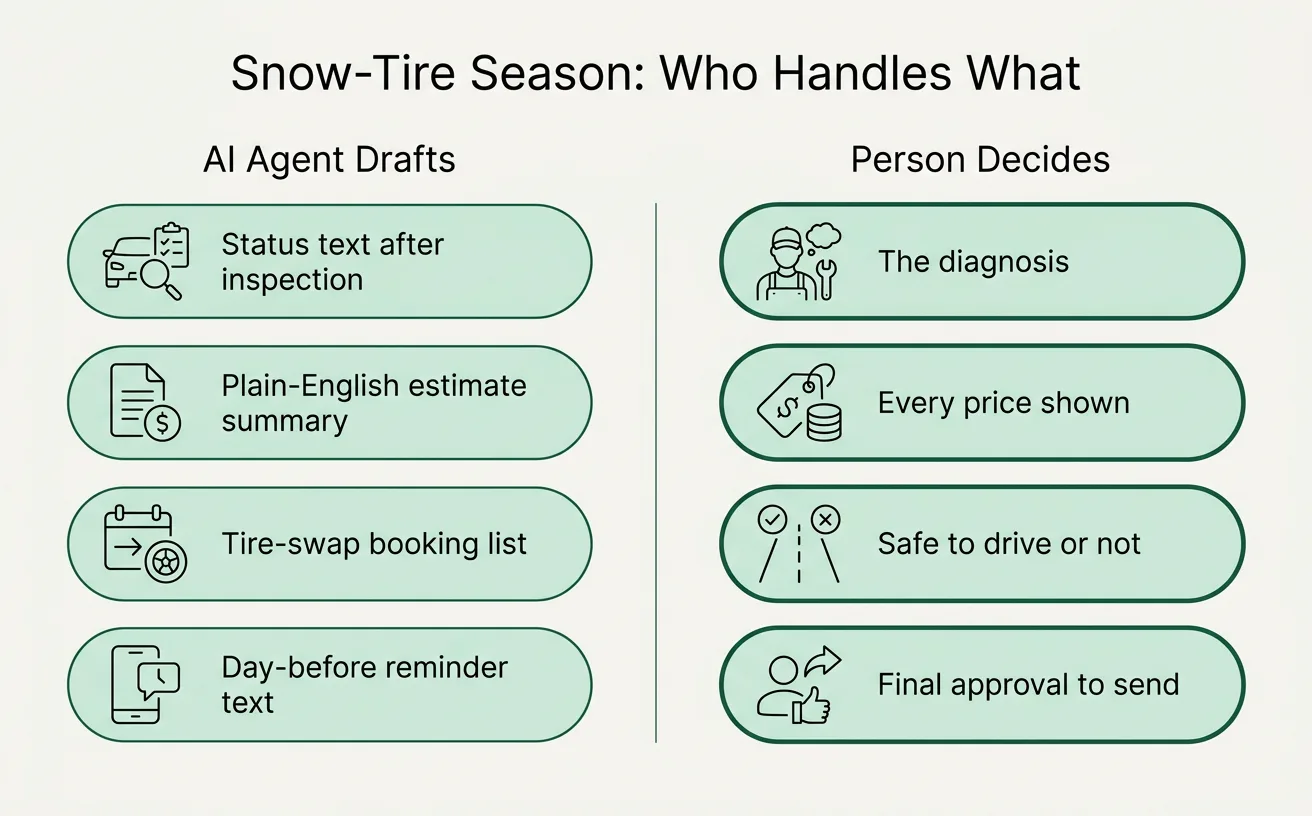
- Status texts. Once a mechanic marks a car "tires on, torque checked," the agent drafts a text: "Your Subaru's ready, snow tires are on, whenever works for pickup." A person hits send, or it goes out automatically if the shop trusts the template.
- Plain-English estimate write-ups. The mechanic notes "rear pads at 3mm, rotors scored, recommend replace" in shorthand. The agent turns that into a sentence a customer can read on their phone, without inventing a price or a part number that wasn't given to it.
- The tire-swap booking list. Instead of a paper sheet or a string of texts, the agent keeps the day's list straight: who's dropping off when, which bay, whether they're waiting or leaving the car.
- Reminder texts. The day before an appointment, a short "see you tomorrow at 8 for your tire swap" goes out on its own, cutting down on no-shows and the morning scramble to fill a gap.
None of this requires a fancy system. A shop that already tracks jobs in a spreadsheet or a basic shop management tool can have an agent read from it and draft messages, the same way custom AI agents get built around other repetitive, recurring jobs.
What Still Needs a Mechanic and a Human at the Counter
The diagnosis stays with the person who put hands on the car. An AI agent can write up what a mechanic found, but it doesn't decide what's wrong, and it shouldn't be trusted to guess at a symptom it never saw or heard.
Every price a customer sees needs a person's approval before it goes out. The agent can draft the estimate text, but someone at the counter reads it, checks the number against the actual quote, and sends it. This matters more in a two-bay shop than almost anywhere else, because word of mouth is the whole business, and one wrong number in a text erodes trust fast.
Whether a car is safe to drive is a judgment call that belongs to the mechanic, full stop. If a customer texts back "can I still drive it to Boston this weekend," that question goes to a person, not a canned reply. The agent's job is to clear the noise around that decision, not make it.
The Part That Gets Overlooked: Booking Order
October and November aren't just busy, they're front-loaded. Everyone wants their tires on before the first storm, which means the shop has maybe five weeks to do six weeks of work. An agent that keeps the booking list organized by drop-off time, car type and how long a job will realistically take can smooth that crunch, the same way a marina books its spring launch schedule around ice-out instead of first-come chaos.
A shop that's also getting slammed with inspection-rush calls in November might find it useful to think about status texts and inspection reminders as one system, not two separate headaches. The same agent that says "your car's ready" can also flag "your inspection sticker expires this month" a few weeks out, without anyone at the counter having to remember which cars are coming due.
Where This Can Go Wrong
An agent that drafts a status text with the wrong price, or sends a reminder to the wrong number because two customers share a last name, causes real damage in a business built on trust and a small town's word of mouth. The fix isn't to avoid automation, it's to keep a person reviewing anything that leaves the building until the templates are proven solid, and to keep customer data (names, numbers, vehicle history) on infrastructure the shop controls rather than a system nobody at the shop actually owns. That's part of why some shops choose to run this kind of tool on private, in-house AI infrastructure instead of a hosted service they don't fully trust with customer records.
A Narrow First Step
Before building anything, count one week of "is it ready?" calls, texts and walk-ins during peak tire season. Just tally them, at the counter or on a notepad by the phone. That number tells you whether it's worth trying status texts on one bay first, as a small pilot, before rolling it out shop-wide.
If that count looks like it's eating a real chunk of someone's week, book a planning call and we'll walk through what a first version could look like for your shop.