
By the second week of April, the phone at a small Lakes Region marina doesn't really stop. Everyone wants their boat in the water before the first good weekend, and everyone wants to know the same three things: when, how much, and can it move up. If you're the owner, you're fielding those calls between running the forklift, checking rigging, and trying to remember who already left a deposit.
This is the six-week stretch that makes or breaks how the season starts. Get the schedule tight and boats go in smoothly, slip by slip. Get it loose and you're double-booked on a Saturday with three trailers in the lot and someone yelling about a wedding they need the boat for.
The Problem Isn't the Schedule. It's the Back-and-forth.
Most marinas already have a rough launch order — by slip, by seniority, by who paid their storage bill on time. The actual time sink is the communication loop: confirming dates, answering "is it still Thursday," texting when the schedule shifts because of wind or a broken trailer axle. If that back-and-forth eats even six or eight hours a week in April, that's most of a workday gone before you've touched a single boat.
Add walk-ins and voicemails from people who missed the window and want to know if there's a waitlist spot, and the front office turns into a call center for a month. None of this requires more staff. It requires someone — or something — to handle the repetitive parts of the conversation so a person can spend that time on the water.
What an AI Agent Is Actually Good At Here
An AI agent, wired into your text line, email, or booking form, can handle the parts of launch season that are pattern, not judgment:
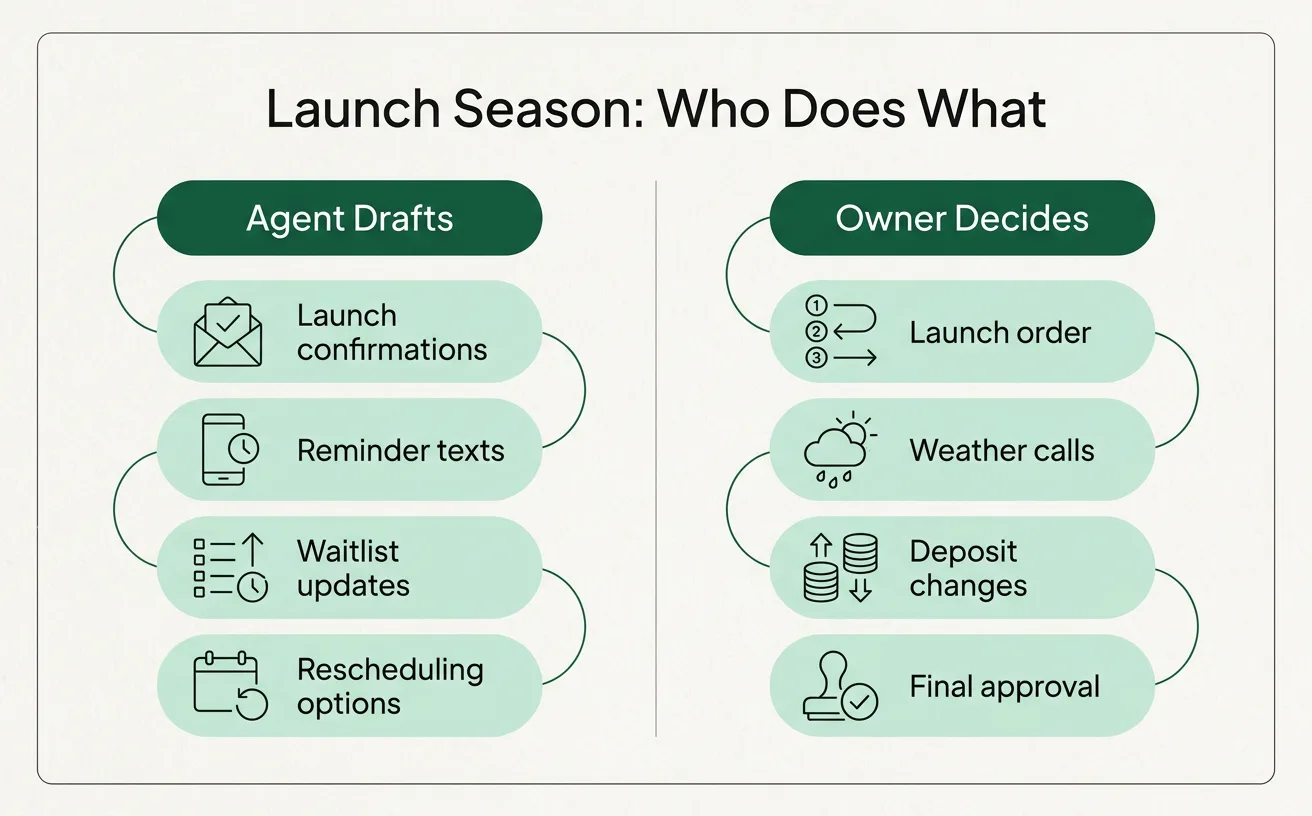
- Sending launch confirmations once a date is set, with the slip number, arrival time, and what to bring.
- Sending reminder texts a day or two ahead, cutting down no-shows and last-minute scrambles.
- Managing a waitlist, so if someone cancels, the next name in line gets an automatic offer instead of a manual scroll through a spreadsheet.
- Answering the routine questions — storage pickup, shrink-wrap removal, fuel dock hours — that come up every April without fail.
- Drafting reschedule options when a slot needs to move, so you're picking from two or three real openings instead of building them from scratch.
This is close to what we described for a propane dealer handling the first cold snap without the phones melting down — a seasonal call surge, mostly repetitive, that a trained assistant can absorb so the humans can do the physical work only they can do. A custom setup like this is the kind of narrow, recurring job we build with custom AI agents, not a general chatbot bolted onto your website.
What Stays With You
The agent drafts. It doesn't decide anything that touches money, order, or safety. That line matters more at a marina than almost anywhere else, because launch order isn't just logistics — it's fairness, and weather calls are safety.
Keep these with a person, every time:
| Decision | Why it stays human |
|---|---|
| Who launches first | Seniority, storage history, and goodwill all factor in — judgment, not a formula |
| Weather calls | Wind, ramp conditions, and lake traffic change day to day; no algorithm should ground a launch or clear one |
| Anything touching deposits or refunds | Money decisions need a person's sign-off, always |
| Final schedule approval | The agent proposes a slot; you confirm it before it goes out |
The agent can tell a customer "here are two open slots this week" — it shouldn't be the one deciding that Thursday's forecast is good enough to launch twelve boats. That call is yours, and it should stay yours.
A Small Test Before Ice-out
You don't need to automate the whole season to see if this helps. Pick one narrow piece: launch confirmations and reminder texts for the boats already on your list. Let the agent send the confirmation the moment a date is locked in, and a reminder the day before, pulling from a schedule you still control.
That's a two-week trial, not a system overhaul. If it saves even a few hours of back-and-forth, you'll know whether it's worth wiring in the waitlist and the FAQ answers next. If your team is new to working alongside an AI assistant day to day, a short team training session beforehand makes the rollout smoother — everyone knows what the agent handles and what still comes to a person.
Where to Start
If you run a small marina in the Lakes Region and April already feels like it's running you, start with launch confirmations and reminders — the two tasks that are pure repetition and zero judgment. Everything else, including who goes in the water first, stays exactly where it belongs: with you.
If you want to talk through what that would look like for your slip count and your season, book a planning call before the ramps get busy.