
A homeowner in Weare gets a lab report in the mail a week after the sample went out. It has a column of analyte names, a column of results, a column of limits, and a few values flagged in bold. They call the water company that took the sample and ask the question every company hears: “Is this bad?”
If your company tests private wells and installs treatment equipment, you answer that call dozens of times a season. Most of the answers are the same few explanations with different numbers dropped in. That is work AI can draft, and a person can check.
Why the lab report doesn't answer the question
A lab report is written for the lab's records, not for a homeowner. It lists results and limits but doesn't say what the company would do next, or how soon. People read a flagged number and either panic or file the report in a drawer.
In New Hampshire, arsenic and radon are common in bedrock wells, so many of your reports will carry one or both. Our water treatment guide covers the basics for homeowners. A letter about their own report is what finishes the job.
What AI drafts well here
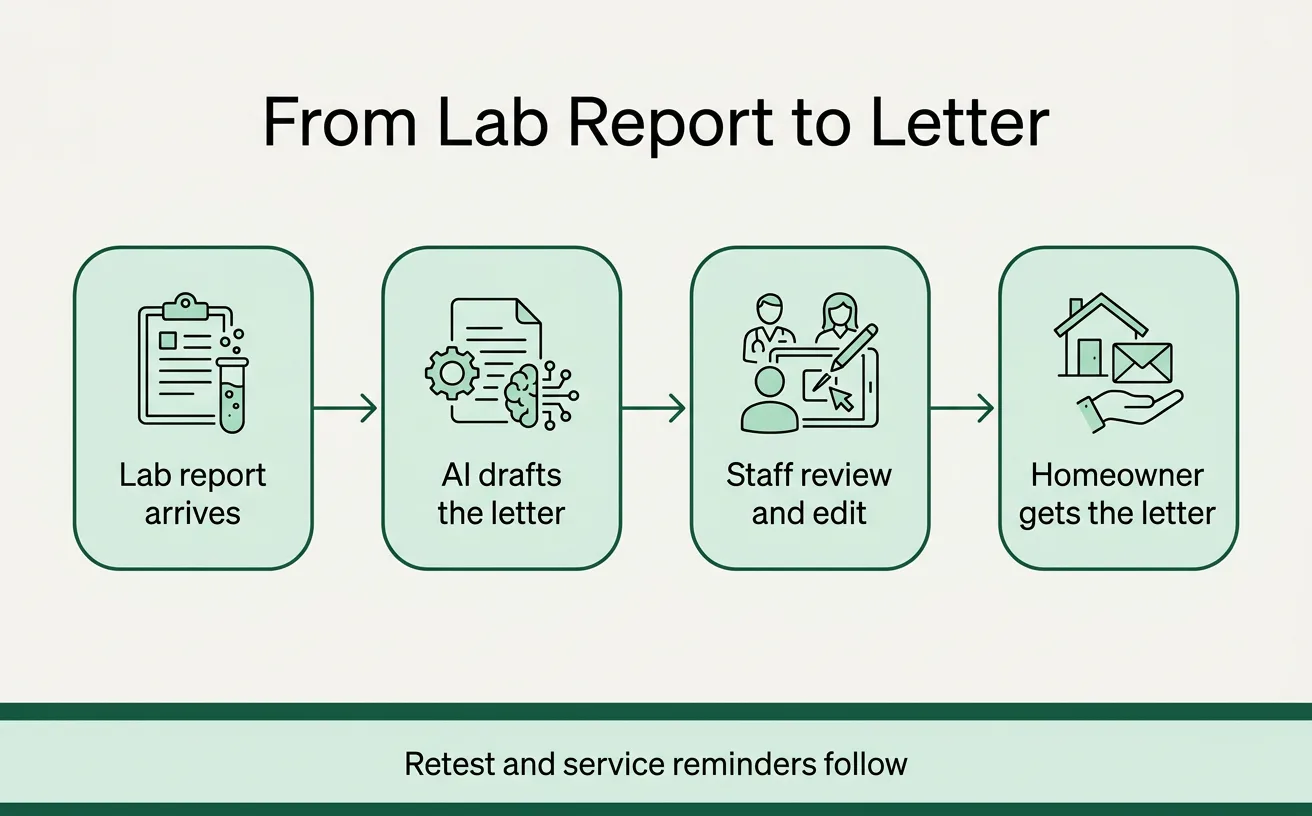
Give an AI assistant the lab results, your company's standard reference levels and your usual treatment options. It can produce a first draft of four things.
- A plain-language letter that goes through each result in order and says where it sits against the reference level your company uses.
- A treatment suggestion with the reasoning, written from your own playbook: what you would install or change, and why that fits this result.
- A reminder schedule for retesting and for filter or salt service, built from the equipment you installed.
- Draft answers to follow-up questions, such as “Can I still drink it?” (see below), “How long does installation take?” and “Do I need to retest after treatment?”
The letter is long on explanation and short on jargon. It should say what a result is, which level it is being compared with, and what the company suggests.
Using the reference levels honestly
Stick to the two reference points your guide already uses. For arsenic, New Hampshire's limit for public water is 5 ppb. For radon in water, the EPA's proposed level is 4,000 pCi/L. A private well isn't a public water system, so the letter should say these are reference points the company compares against, not a rule that applies to the homeowner's well.
If a result is above a reference level, the letter says so plainly. If it is below, it says that too, and still suggests retesting on a schedule.
Where a person stays in charge
Your company reviews every letter and every treatment recommendation before it goes out. The draft saves the typing. It doesn't replace the person who knows the well, the house and the equipment.
A reviewer should check a few things each time:
- Do the numbers in the letter match the lab report, line by line?
- Does the recommendation fit this property? A well with a failing pump or low yield may need attention first. Our well pump guide covers that side.
- Is anything in the letter a promise about results you can't make?
Health questions go to the state or the homeowner's doctor. A homeowner with a pregnant spouse, an infant, or a medical condition will ask whether the water is safe to drink. The letter shouldn't answer that. It should say the company can explain the test and the treatment, and point them to the New Hampshire Department of Environmental Services or their physician for health guidance. Build that sentence into the template so it appears every time.
If you paste customer names and addresses into an AI tool, decide first where that data goes. A one-page AI policy is a good place to settle that, and private AI hosting is an option if you want it kept in-house.
What the time savings look like
Say report letters take twenty minutes each to write by hand and you send ten a week in busy months. That is over three hours a week of typing that is mostly the same paragraphs. A reviewed draft might take five minutes. The hours are illustrative, but the pattern is common: the time goes into rewriting explanations you've already given many times.
Reminders are the other gain. A homeowner with a new arsenic treatment system needs a retest and filter service on a schedule. If nobody tracks that, the system quietly stops doing its job, and the customer blames the equipment. A reminder schedule drafted at the time of installation, and confirmed by your office, keeps you in contact without anyone remembering to call.
A first step: one model letter
Don't start with a system. Start with one letter.
Take a typical report from a bedrock well in your service area with arsenic above the reference level. Write the letter you would be proud to send: each result explained, the 5 ppb reference stated correctly, your suggested treatment and the reasoning, a retest and service schedule, and the line pointing health questions to the state or a doctor. Have the person who talks to customers most edit it until it sounds like your company.
Then use it as the template. Give it to an AI assistant along with the next report and ask for a draft in the same format. Review it, fix what's off, and note what you keep fixing so the template improves. If you'd like to see how a job like this maps out before building anything, our Workmap approach is how we do it on a discovery call.
When the template is steady, we can help turn it into a custom agent that pre-fills the letter from the lab report and queues it for review. If you want to talk it through, book a planning call, 30 minutes and free.