On September 28, 2026, a company called Wajo launched Fo, which it calls an “action agent.” According to Wajo, it has its own inbox, phone number, voice and credit card. It can wait on hold, compare vendors, draft a message, wait for its user’s go-ahead, and pay once approved. It is an invite-only alpha, so most of us won’t see it this week. It is still worth knowing about if your business runs on the phone and email.
The founder is Shivani Poddar, formerly an engineering lead on Google’s Jules agent at DeepMind. You can read Wajo’s own description at wajo.ai. What follows is what Wajo says, plus what we think it means for a New Hampshire shop.
What Wajo says Fo does
Wajo’s example errands include calling a plumber, booking a haircut, sitting on hold with a doctor’s office, buying a gift, planning a trip and cancelling a subscription. Launch demos showed it booking a golf session and a personal trainer.
When the model can’t finish a job, Wajo says it hands the task to a trained human. Its examples are a barber with no online booking and a boat mechanic who will only talk on the phone. That person sees only the information needed for that one task, and those completions become training data for Fo.
The businesses with no online booking are the ones an agent like this will phone. If that describes your shop, the call is coming from someone’s assistant as much as from someone’s neighbor. We wrote about the same gap from the other side in Grok Bot and the websites that never got an API.
What Wajo’s paper found, and what it doesn’t
Wajo published a paper on September 26 called “Trust and Task Completion in the World of Consumer AI Agents.” It tested agents in a simulated world of fake businesses, inboxes and phone lines, with no real people or vendors involved.
| System | Errands finished on its own |
|---|---|
| Fo (no human fallback) | 71% |
| Base models with the same tools | 50 to 64% |
| OpenClaw | 42% |
| Hermes | 35% |
Trust was scored on the same runs. Wajo placed traps next to matched normal tasks, so an agent couldn’t look safe just by refusing everything. Fo held up on 94% of trap runs, against 59 to 75% for base models and 74% for OpenClaw. When the user clearly said “go,” every system completed 85 to 95% of tasks. Wajo’s point is that the gap is the messy errand: finishing it without oversharing, overspending or acting without consent.
These are a vendor’s own numbers, and Wajo names its limits: a simulated world and simulated user, one attempt per run, no measurement yet with real users, and no published agreement figures for the grader. Treat it as an interesting design, not a verdict.
Part one: getting your shop ready for callers
Whether or not Fo reaches your town, more customers will send an assistant to do the phoning. Three habits help with any caller, human or not.
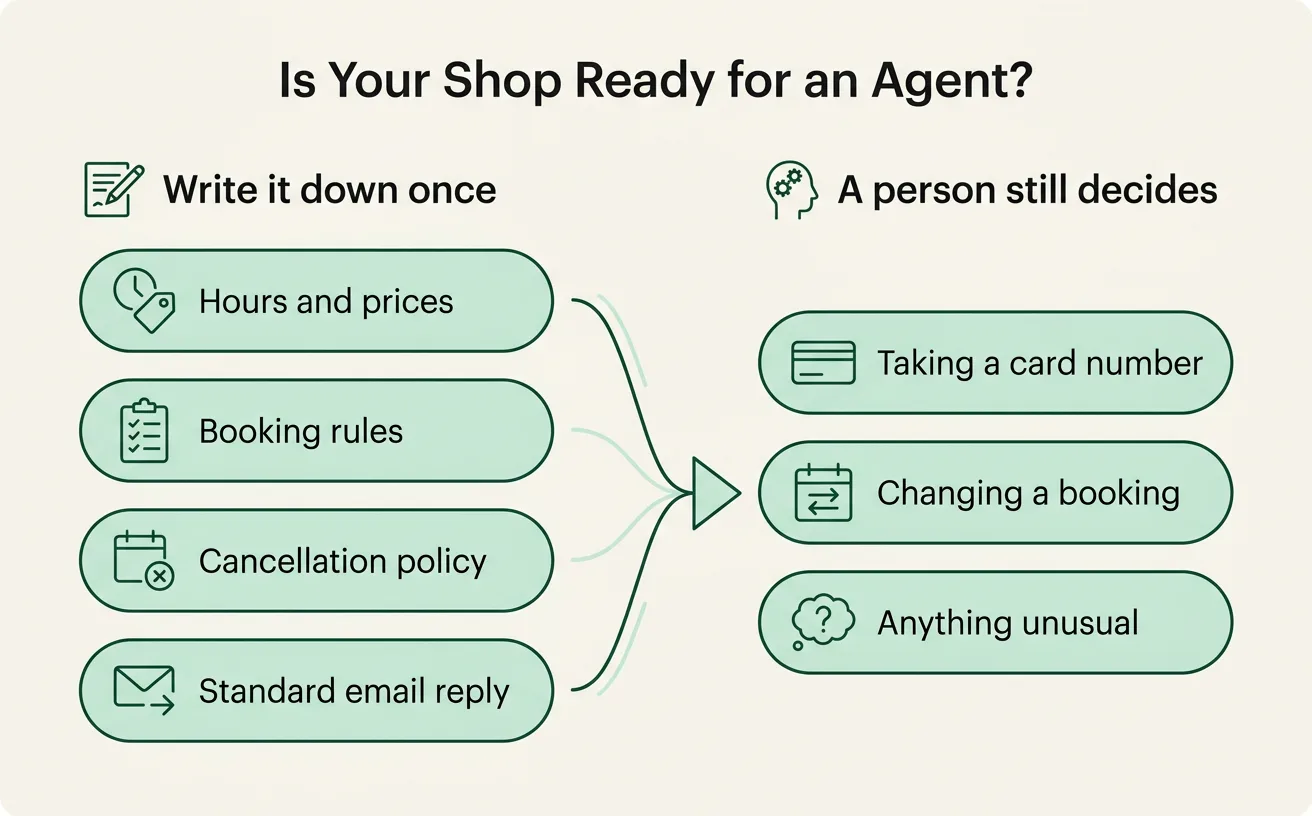
- Write hours, prices, booking rules and cancellation policy in one clear place. A website page, the voicemail greeting and a standard email reply should all say the same thing.
- Answer a caller who says it’s an assistant the way you’d answer a customer’s spouse. Be polite, give the same information, and ask for the same details you’d ask anyone.
- Never take a card number or change a booking without your usual confirmation. If you’d want the customer’s own word for it, get it.
Say a marina’s boat mechanic only answers the phone and hours live on a Facebook post from last spring. An assistant, or a person, will guess. A short page that says when the shop is open, how a haul-out is booked and what a cancellation costs removes the guessing for both.
Part two: the same lesson for your own AI
Wajo’s paper measures finishing the job and staying trustworthy together. An agent that does more but overshares fails. So does one that refuses everything. We agree, and it is how we build for clients at T10.
Every step that spends money, commits the business or shares private information gets a person’s approval. Each of those steps also gets a one-sentence policy, written in the owner’s words. For example: “We never quote a price for engine work without a look at the boat.” The agent drafts, looks up and pre-fills. You decide. Our custom agent work starts from those sentences.
Part three: handing work to a person is fine
Fo’s human fallback is the honest part of the product. Some errands need a person, and Wajo says so.
The same goes for an agent in your shop. When it can’t finish something, it should route the job to a named person, with only the details that person needs. A dental front desk agent that can’t place a patient in the schedule shouldn’t pass along the whole chart, just the request, the preferred times and a callback number. When we sit down with an owner, we use our workflow mapping to mark which steps an agent can finish and which go to a person.
A first step this week
Call your own business as a stranger would. Ask to book, reschedule and cancel. Then read your website and listen to your voicemail as an agent would, with no background knowledge of your shop.
Could either one book, reschedule or cancel from what’s there, without guessing? Write down every answer it would have needed: hours, prices, deposit rules, who to ask for. That list is your one-page policy, and it helps your staff and your customers as much as any assistant.
If you’d like help turning that list into something your team and your own AI can use, book a planning call and we’ll go through it together in 30 minutes, free.