
Every Saturday from Thanksgiving through the last mud season thaw, the same thing happens across the North Country and Lakes Region: forty units check out at 10am, forty check in at 4pm, and somewhere in between a storm rolls through and someone's flight gets delayed. If you manage rentals in Waterville Valley, Lincoln or around Winnipesaukee, you already know this isn't a scheduling problem you solve once. It repeats every week of the season, with new variables each time.
The Saturday Crunch Doesn't Get Easier With More Units
A 10-unit operation can run turnovers off a whiteboard and a group text. At 25 or 40 units, that same method starts dropping things: a cleaner shows up to a unit still occupied, a guest arrives before the heat's been turned back up, a maintenance note from last week's cleaner never makes it to anyone who can act on it. The problem isn't effort, it's that the information lives in five places and nobody has time to reconcile them every Friday night.
Add snow to it. A storm that closes I-93 for three hours changes checkout times, cleaner availability and guest check-in messages all at once. Ski season isn't just busier than summer, it's less predictable week to week.
What AI Is Actually Good At Here
The boring, repetitive parts of turnover week are exactly where an AI agent earns its keep. None of this requires guessing or judgment, it just requires someone to look at the calendar and turn it into a plan, every single week, without getting tired of it.
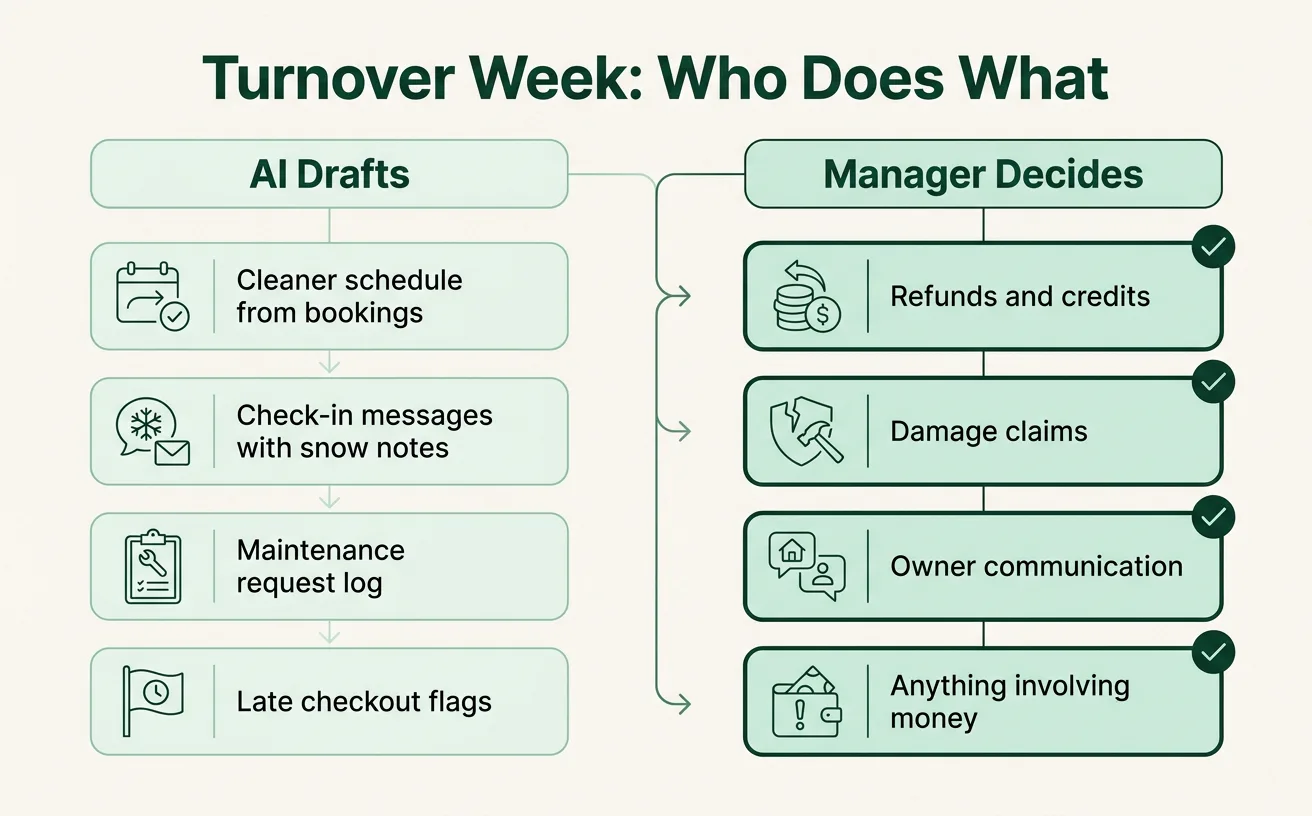
Cleaner scheduling from the booking calendar. Feed it your reservation system and it can draft a turnover schedule for the week: which units need same-day cleans, which have a buffer day, where two cleaners might need to double up on a Saturday. It won't know your cleaners' preferences or who's out sick, but it saves the hour of manually cross-referencing bookings against a roster.
Check-in messages with the specific details guests actually need. In ski season that means driveway conditions, whether the plow has been through, where to park if there's a foot of snow on the shoulder, and what the woodstove needs on arrival. A templated message drafted against that week's weather and that unit's quirks beats a generic one, and it saves you from typing the same paragraph forty times a weekend.
A running log of maintenance requests. Cleaners and guests report things constantly: a dead smoke detector battery, a dripping faucet, a broken porch light. An agent can pull those reports into one list, sorted by unit and urgency, so nothing gets lost in a text thread from three weeks ago. That's the same instinct behind how snow-tire season garages use AI to keep a service queue straight instead of relying on memory.
This is the kind of recurring, rules-based work that's worth building a custom agent around rather than trying to solve fresh every Friday. It's the same logic that works for marina launch scheduling in the spring: a predictable, repeating operational puzzle that a person still has to check, but doesn't have to build from scratch every time.
Where You Still Have to Be the One Who Decides
None of the above touches money, and that's on purpose. Anything involving a refund, a damage claim or an owner's cut stays with a person, full stop.
- A guest says the hot tub didn't work and wants a partial refund. An agent can pull up the maintenance log and flag whether there was a reported issue, but the decision to credit them, and how much, is yours.
- A cleaner reports a broken lamp and a stained rug. Whether that's normal wear or a damage claim against a security deposit is a judgment call that depends on the guest's history and the owner's tolerance, not a rule an agent can apply.
- Owner relationships run on trust built over seasons. An owner in Concord who's used to a phone call before a big repair decision doesn't want a bot message instead, even a well-drafted one.
The agent's job is to hand you a clean draft with the relevant facts already gathered. Your job is the fifteen seconds it takes to look at it and decide. That division holds up well even under storm-week pressure, because the parts that are genuinely repetitive get handled the same way every time, and the parts that need discretion never get automated past you.
If your team is new to working alongside these tools, it's worth spending an afternoon on training before ski season hits, so cleaners, owners, and front desk staff all know what the agent drafts and what still needs a phone call.
A Narrow First Step, Before the First Ski Weekend
Don't try to automate the whole turnover process at once. Instead, take next month's bookings, the ones already on your calendar for the first few ski weekends, and have an AI assistant turn that into a draft turnover schedule: which units, which cleaners, which day.
Then do what you'd normally do: build your own schedule the old way, and compare the two side by side. Look for where the draft is wrong (it will be, at least at first) and note whether the mistakes are things you can teach it to avoid, like a cleaner who never works Sundays, or things that genuinely needed your judgment, like which owner gets priority on a tight turnaround.
That one comparison tells you more about where AI actually helps in your operation than any sales pitch will. If the draft schedule saves you twenty minutes and gets eighty percent right, that's a real foundation to build on for the rest of the season.
If you want help setting that up before your first ski weekend, book a planning call and we'll walk through what a turnover agent could look like for your unit count and booking system.