It's 10:40 on a Thursday night in late May, and a message comes in through the booking site. It's in French, from a couple in Sherbrooke looking at your Columbus Day weekend. Can they bring the dog, is there parking for a small trailer, and is the Kancamagus open in October? They haven't booked. They're comparing you with two other places in North Conway, and whoever answers first probably gets them.
You're asleep. You answered almost exactly those questions three times this week already, in English, at more reasonable hours.
The questions don't change. The volume and the languages do.
Between summer, leaf season and the winter school vacations, a White Mountains property answers the same short list over and over. Write it down and, for many places, it runs to about forty items. A few of them:
- What time is check-in, and can we come early?
- Where do we park, and is there room for a trailer or a second car?
- Do you take dogs? Is there a fee, and are they allowed in the rooms?
- How far to the Flume, Cannon, the Auto Road, Story Land?
- Is the Kancamagus open? Is there gas along it?
- What's the weather going to be up top this weekend?
- Is there a grocery store nearby? Where should we eat?
- What's the Wi-Fi password?
Summer and foliage bring guests from Quebec, from all over the US and from overseas. The questions arrive by email, booking-site message and text, often late at night, and a good share come from people who haven't booked yet.
If answering them eats six or eight hours a week at the peak, that's an illustration, but you'll know whether it's close. The problem isn't that the questions are hard. It's that there are so many of them, and the answers live in your head.
The answer is already written down, or it should be
Most properties have a house book, even if it's a laminated binder in each room, a welcome email and a long note on the owner's phone. It holds your check-in rules, parking, pet policy, quiet hours, the Wi-Fi, your favourite breakfast spot and the trailhead you send everyone to.
That book is exactly what a guest-messaging assistant should work from. Grounded in your own house book, and only that, it answers the way you would, not the way the internet would. If the book says dogs under forty pounds are welcome in the two ground-floor rooms, that's what the guest hears, and not a guess.
In the guest's language
A language model handles the translation well. The couple from Sherbrooke gets their answer in French, a family from Germany in German, and you read an English copy of every exchange. The facts don't change between languages because they all come from the same book.
For the questions that change daily
Some answers aren't in any book: whether a road is open today, what the weather will do on the ridge. The assistant shouldn't invent those. It should give what the house book says ("there are no gas stations along the Kanc between Lincoln and Conway, so fill up first") and point the guest to the official sources for today's conditions, such as the state's 511 road service and the summit forecast.
On weather and trails, the rule is simple. The assistant never tells a guest a hike or a drive is safe. It shares what's known and where to check, and anything that sounds like a guest in trouble goes to a person immediately.
Where a person stays in charge
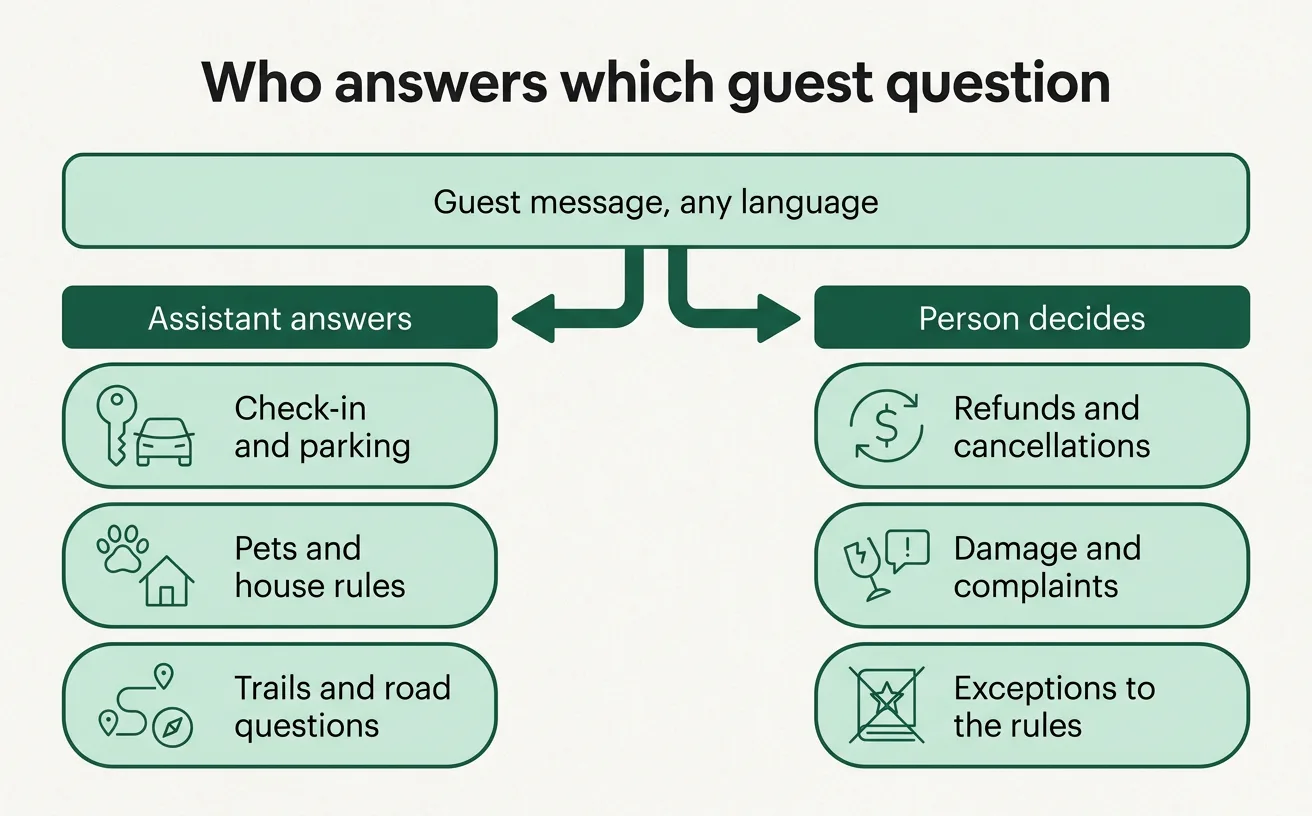
Some messages aren't questions. They're requests for a decision, and those come to you.
| Goes to a person | Why |
|---|---|
| Refunds, cancellations, deposits | Money, and your policy's exceptions |
| Damage, missing items, security deposits | Judgment, and sometimes a dispute |
| Complaints | A guest who needs a human, not a template |
| Exceptions: late check-out, a third dog, an extra guest | Commitments only you can make |
| Anything about safety or an emergency | Always, straight away |
The assistant's job with these is to recognise them, tell the guest someone will reply shortly, and hand you the message with the booking details and the history attached. You don't lose the late-night lead, and you don't wake up to a promise you never made.
Start with approval on, then earn the right to turn it off
We'd set this up with a person approving every reply at first. For the first few weeks you read each draft, fix the ones that aren't how you'd say it, and add the missing answers to the house book.
Then, question by question, you decide which replies can go on their own. Check-in time and parking can probably go early. Pet policy maybe after a week or two of clean drafts. Refunds never. You decide what the assistant may send by itself, one kind of question at a time, and you can take that back whenever you like.
We write those rules down as one-sentence policies when we map the work on a first call, such as "a person approves any reply that mentions money or an exception." You can see how that mapping works on the Workmap page. The build itself is a custom AI agent connected only to the inboxes and the house book it needs.
Seasonal staff get it too
The same assistant makes a decent handbook for the summer desk staff who started last week. Instead of texting you "where do guests park the trailer?", they ask it. A short session on how to use it well, and what it won't answer, is the kind of thing we run as AI Cowork training.
A small first step before the summer rush
Before July, write the house book properly. Take the forty questions, answer each in a sentence or two the way you'd say it to a guest, and include the local knowledge you give out without thinking: the trailhead, the diner, the gas warning for the Kanc.
Then run an assistant on that book in draft-only mode through the summer, with you approving every reply. By the time leaf season arrives you'll know which answers it gets right every time. Those can go out on their own, so the next 10:40pm message from Sherbrooke gets its answer while the couple is still deciding.
If you'd like help writing the house book or deciding where to start, book a planning call.