
The ice is still on the big lake, and your inbox already knows what Memorial Day weekend looks like. Every customer wants their boat in the water the same few days, and every one of them is writing to tell you so. In the Lakes Region, two weekends a year decide the other fifty: the rush in and the rush out.
Right now, early April, is the calm before the first of them. It's also the last moment to change how you handle it.
What April sounds like in the service office
Picture a marina in Gilford or Meredith with a few people running the office and a yard crew already uncovering boats. The messages coming in look like this:
- "Can we get in the water the Friday before Memorial Day?"
- "Any chance of a slip this year? We were on the list last year."
- "While you're at it, can you look at the bilge pump and the canvas, and something's rattling."
- "Is my boat ready?" (Sent three times, by three family members.)
Every one of those is reasonable. Together they bury the two or three people who also have to run the yard. If the inbox, the texts and the voicemails eat fifteen hours a week in April and May, that's fifteen hours not spent on the actual launch schedule. And the answers are all in the building somewhere: the service history in a folder, the slip list in a spreadsheet, the launch plan on a whiteboard.
What AI is good at here
Most of these messages are requests to be written down, sorted and answered from information you already have. That's the kind of work an AI agent does well, and it's easy for a person to check.
Launch requests into one list
Every "can we launch on…" message, whether by email, web form or text, becomes a row: customer, boat, requested window, flexibility, any service to finish first. The agent doesn't promise a date. It replies that the request is logged and that the yard will confirm, so nobody hears silence.
The slip waitlist, kept current
The agent keeps the waitlist in order, notes who has asked again, and drafts the "a slip has opened up" message when you tell it one has. You decide who gets offered what. It keeps track of who's next and drafts the message.
Service write-ups from customer emails
"Something's rattling, and the canvas has a tear" becomes a draft work order: boat, location, the issues described in the customer's own words, and, where your records have it, what was done to that boat last season. The service manager reads it, adjusts it and decides what's actually getting done. A write-up drafted from the email is a starting point, not an approved job.
"Is my boat ready?"
This is the one that wears people down. If your yard tracks status anywhere (a spreadsheet, a whiteboard someone photographs, a job board), an agent can answer from it: "Your boat has been uncovered and is waiting on commissioning. The yard will confirm your launch date." Honest, consistent, and it doesn't need to interrupt anyone.
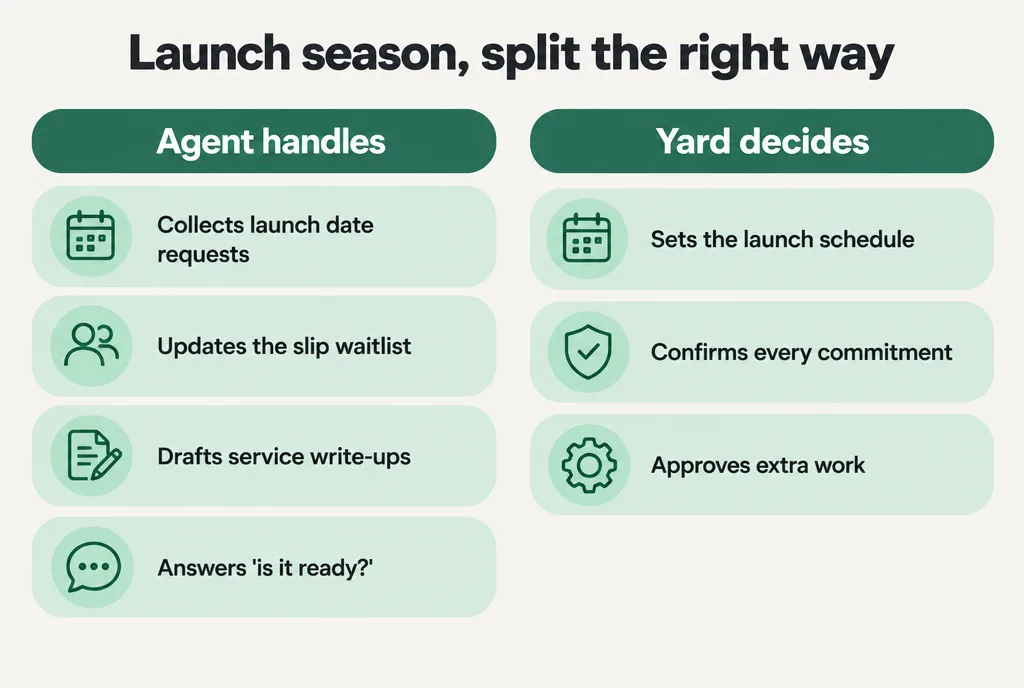
What stays with the yard
Some things don't get automated, however busy it gets.
- The launch schedule. Who goes in when depends on the travel lift, the crew, the ramp, the weather and which boats are actually ready. That's a person's call, made with the whole yard in view.
- Any commitment to a customer. A confirmed date, a slip assignment and a price for extra work are all commitments. The agent drafts; a person approves before it's sent.
- Anything about safety or condition. If a customer asks whether the boat is safe to take out, or what a noise means, that goes to someone who has seen the boat.
- Extra work. "While you're at it" items get a person's approval, and the customer's, before anyone picks up a wrench.
The rule we use everywhere: the agent drafts and looks things up, and a person approves anything that touches money, safety or a promise. Customers mostly can't tell which replies were drafted by an agent. What they notice is that they got an answer the same day.
The same goes for docks, openings and caretaking
This isn't only for marinas. Dock installers, camp-opening crews and caretakers around Winnipesaukee, Squam and the smaller lakes face the same crush on the same few weekends: everyone wants the dock in, the water on and the place opened before the first warm Saturday.
The pattern is the same. Requests go into one list, the agent answers routine questions from the schedule you keep, and a person decides the order of the route. For a caretaking business, the "is my place opened yet?" message is the "is my boat ready?" message with a different noun.
Why now, and not in May
Once ice-out is declared and the phones start in earnest, nobody has time to try a new way of working. Early April is the window: close enough to launch that you know what's coming, far enough out to set something up and test it on real messages.
It also doesn't need to be big. You don't need a new marina management system. You need the messages that are already arriving to land somewhere organised, with a draft reply waiting for a person to send.
If your team is already using ChatGPT or Copilot informally to write customer replies, that's worth building on rather than banning. A hands-on session for the office staff can turn those habits into something consistent, including what not to paste in.
A narrow first job to try
For a Lakes Region marina or seasonal service business, we'd start with the launch request log and holding reply:
- Every launch or opening request that arrives by email or web form is read by the agent.
- It adds a row to one shared list: customer, boat or property, requested window and any service mentioned.
- It drafts a short reply confirming the request is logged and that the yard will confirm the date.
- A person reviews the drafts each morning and sends them, then schedules from the list, not from the inbox.
That's a small job. It's easy to check, it's live in weeks rather than months, and it's the foundation for the next step: answering "is it ready?" from the same list. If you want to go further later, a custom agent can pull in your service history so the write-ups start with what you did last fall.
If you'd like to talk it through before the ice goes out, book a planning call. Thirty minutes, and no obligation.