
Most of us understand a machine faster by watching it run than by reading about it. A snowblower makes sense once you see the auger feed the impeller. An ice dam makes sense once you see warm attic air melt the snow from underneath. Until recently, a drawing that moved like that took an illustrator, a developer and a few weeks. Now we build them in hours with Claude Code and a skill called anatomy, and they have become some of our favorite things on this site.
A coin sorter for web traffic
We started with a problem of our own. Our site analytics were the usual bar charts, and it was hard to get a feel for them. So we asked for a machine.

Every page view is a brass coin. It drops into the hopper through one of four slots, one for each way a visitor can arrive: typing the address, a search, social media, or a link on another site. Inside, the coin turns onto a rail, rolls down it and falls through a gate into the glass tube for the part of the site the visitor was reading. Each stack's height is that section's views, and the ruler on the left counts coins. The counters on the hopper show total views and visitors, and the dial shows how many people were on the site in the last five minutes.
Replay runs the month through in about twenty seconds, in the order the visits happened. You can see the quiet weekends, the weekday mornings, and the newsletter that went out on the 15th, when the social slot stays busy for a few hours.
Some of the details we like:
- The coins roll at the speed a real disc would reach on that slope. A disc rolling without slipping speeds up at two thirds of gravity times the sine of the slope, and the page uses that number.
- Each gate opens as its coin comes up to it, and the coin turns flat inside the funnel so it can stack in the tube.
- A line on each coin turns once per trip around its edge, so you can see it roll.
- The crank on the side turns while a replay runs, and the counters tick up with every coin.
Two more from the Learning Center
The same skill drew two of our Learning Center guides.
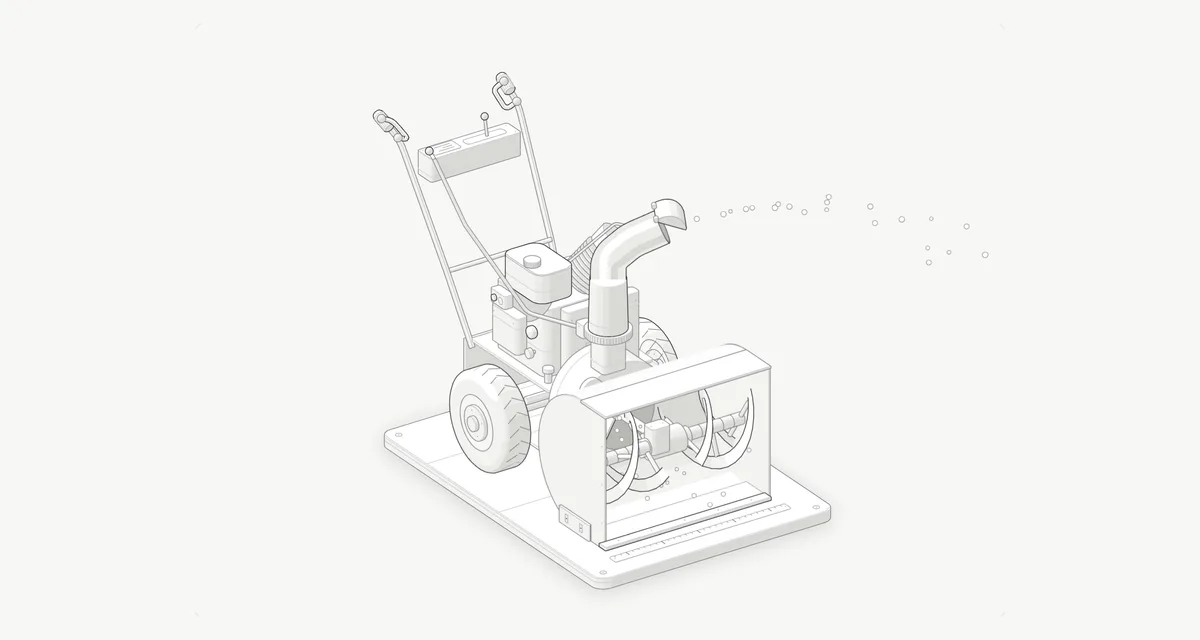
The snowblower is a 28-inch two-stage machine you can start, shift through its speeds and break six ways. The numbers behind it come from real machines: the engine runs at 3,600 rpm, the auger gearbox is 20 to 1, and the load depends on how deep and heavy the snow is. Shear a pin and one half of the auger stands still while the other half and the impeller keep turning, which is what happens on a real one.
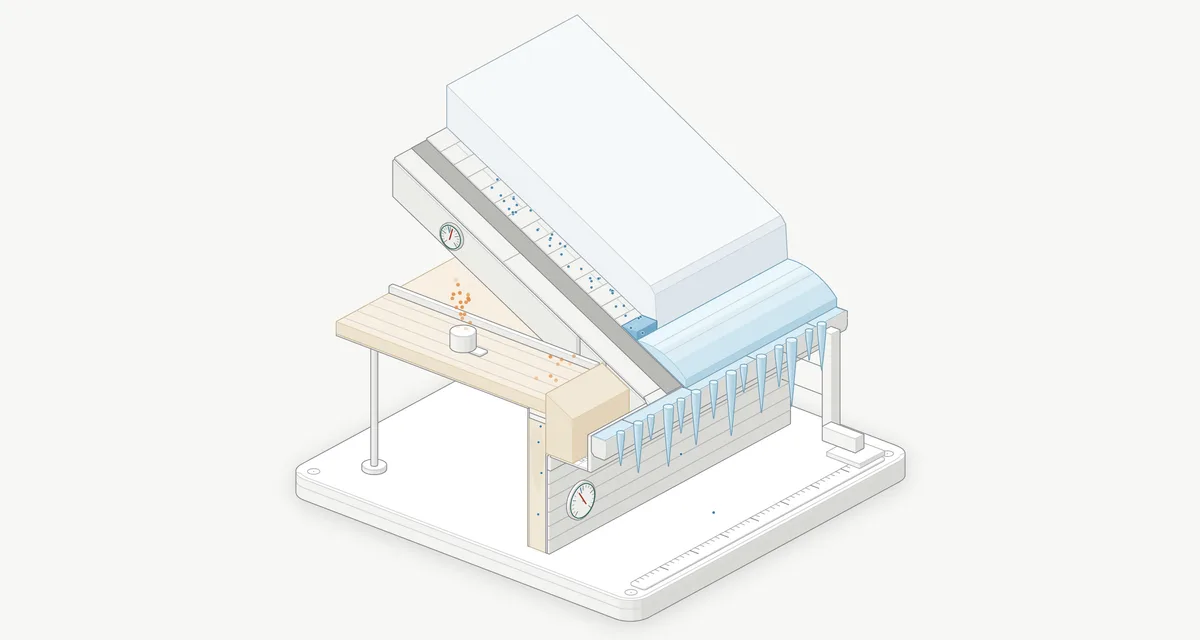
The ice dam guide is a cutaway of a roof edge. A small heat model works out how warm the attic gets from the insulation, air sealing and vents you pick, and the clock runs at four simulated hours a second. You can watch the dam grow, the water pond behind it and the ceiling start to stain, then try a roof rake or a calcium chloride sock.
What the skill does
A skill is a written set of instructions an AI assistant follows for one kind of job. The anatomy skill is a few hundred lines of rules plus a small drawing kit, and it changes what the assistant makes.
It starts from the idea. The first rule is to find a real object whose workings are the thing you want to explain, so a reader recognizes it at a glance. Web traffic became a coin sorter because sorting coins into tubes is what the numbers are doing.
It lists the parts before it draws anything. A figure needs at least 40 parts, and each one has to sit on another part: feet under the base, screws in the corners, a collar under each tube, brackets holding the rail. That is where the detail comes from.
It keeps the numbers honest. Everything the drawing shows comes from the same small model that moves the parts, so the counters, the stacks and the motion always agree.
It checks its own work. The skill takes screenshots, looks at them zoomed in, and runs a check for lines that end in mid-air. The first version of the coin sorter had 22 loose line ends, all of them tick marks. The final one has none.
The first working coin sorter took under an hour. Most of that time went to looking at screenshots and fixing what was wrong, like the hopper hiding the last tube and the funnel mouths being too dark.
Why this matters for a small business
A lot of what a small business explains every week is easier to show than to tell. An HVAC company explains why a heat pump needs backup heat on the coldest nights. A well driller explains why a pump keeps cycling on and off. A boarding barn walks a new hire through how a stall goes from the waitlist to move-in day. A drawing that moves, with numbers that are true, can do a lot of that explaining on a website, in a training session or next to a quote.
Two cautions. A drawing is only as accurate as the model behind it, so someone who knows the equipment should check the numbers. And it has to read on a phone, since that is where most customers will see it.
If there is something your customers or your staff have trouble picturing, tell us about it. We can probably draw it.