How a snowblower works
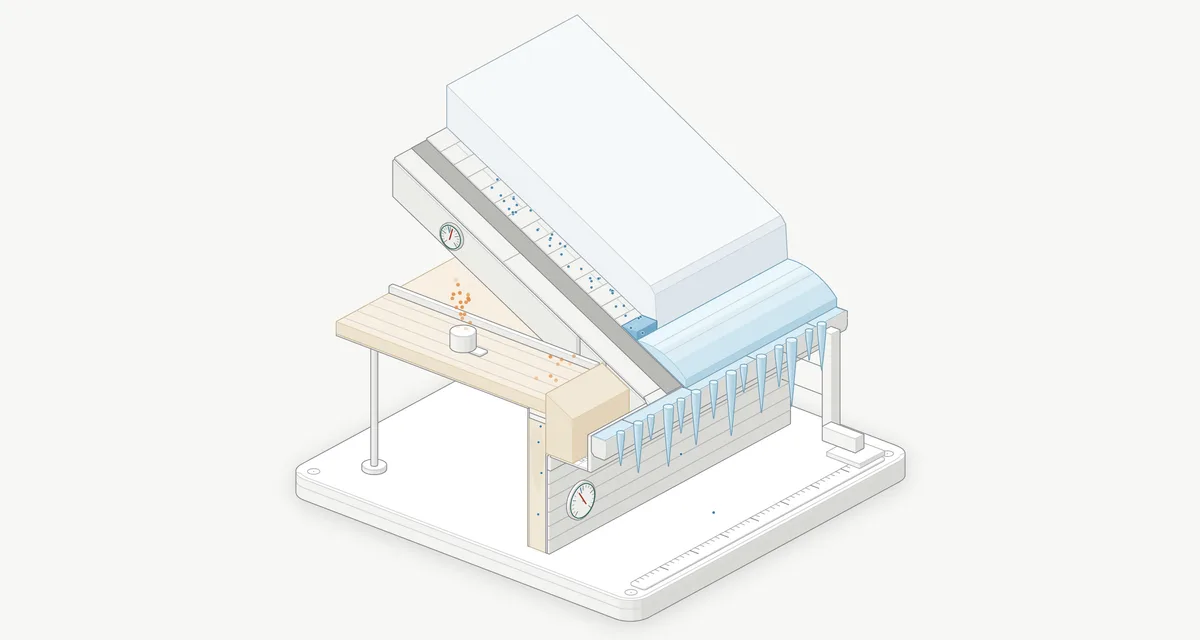
A two-stage snowblower does two jobs at two speeds: slow augers gather the snow and a fast impeller throws it. Start it up, squeeze the levers, aim the chute and change the snow, then break it the ways it breaks on the first storm.
Engine off. Start it to begin.
Right now
- Engine
- Off
- Impeller
- Still
- Augers
- Still
- Ground speed
- Standing
- Snow coming in
- None
- Throw
- None
Slow to gather, fast to throw.
A single-stage snowblower uses one fast paddle to pick up and throw the snow, and its paddle touches the pavement. A two-stage machine splits the work: the augers turn slowly enough to chew through a plow pile, and the impeller behind them turns twenty times faster to throw it. That's why it handles deep and heavy snow, and why it has a gearbox, shear pins and two belts to look after.
- About 55 rpm
The augers gather
Two steel spirals across the front, wound opposite ways, chew into the snow and push it to the middle.
- About 1,100 rpm
The impeller throws
A three-paddle fan in the drum behind them, twenty times faster, flings the snow up the chute.
- Up to about 40 ft
The chute aims
A crank on the console turns the chute, and the deflector on top sets how high and how far.
- 6 forward, 2 reverse
The drive walks it
A rubber wheel on a spinning plate sets the speed. Slide it toward the edge to go faster.
Not all snow weighs the same.
Fresh powder
About 5 lb a cubic foot. A foot of it on a driveway is easy work. Any gear works until it's deep. Throw it downwind and keep the chute aimed away from where you'll walk.
Wet, heavy snow
About 16 lb a cubic foot, three times the weight of powder. It sticks to the chute. Go slow, in a low gear, and take a narrower bite. Clear it before it freezes or another storm packs it down.
Plow pile at the road
Packed chunks at 30 lb a cubic foot or more, often with ice and gravel in it. Take it in bites from the top, in first gear. Watch for ice chunks, newspapers and gravel the plow left behind.
Never reach into the chute.
When wet snow packs the chute, the impeller is still behind it, and it can spin again the instant the clog breaks loose, even after the engine has stopped. Let go of the levers, shut off the engine, wait for everything to stop, and clear it with the clean-out tool or a broom handle.
Start and run it outdoors, never in a closed garage: the exhaust is carbon monoxide. Aim the chute away from people, cars and windows, and walk the driveway first for newspapers, rocks and dog leashes.
Six ways a snowblower quits on the first storm.
Most of them start months earlier, with gas left in over the summer or a part nobody looked at in the fall. Pick one to watch it on the drawing.
Sheared shear pin
"It runs and throws a little, but it's leaving snow on one side."
The auger hit a frozen newspaper or a chunk of ice from the plow, and the shear pin on that half snapped as designed. That half stops while the other half and the impeller keep turning, so it still throws snow, just less of it, and leaves a strip behind.
Clogged chute
"It's running but nothing's coming out of the chute."
Wet, heavy snow packs into the impeller and the chute until nothing comes out. This is the moment people reach in, and hand injuries from clearing a chute by hand are the classic snowblower injury: the impeller can spin again the instant the clog breaks free. Let go of the levers, shut off the engine, wait for everything to stop, and use the clean-out tool.
Worn auger belt
"The engine sounds fine, but the snow just dribbles out of the chute."
The belt to the impeller has stretched and glazed. The engine sounds normal, but under load the belt slips on its pulleys, the impeller slows and the snow lands a few feet away. It often squeals, and a broken one stops the augers and impeller completely.
Stale gas in the carburetor
"It won't start. It ran fine at the end of last winter."
Gas left in the tank and carburetor over the summer goes stale and leaves varnish in the carburetor's tiny jets. On the first storm it cranks and cranks, or only runs with the choke on and surges. It's the number one reason a snowblower won't start.
Slipping friction disc
"It won't go up the driveway. The engine runs, the wheels just stop."
The rubber on the friction wheel is worn or wet and glazed. The drive plate spins under it without gripping, so the machine stalls when the snow pushes back or the driveway climbs, while the engine runs normally.
Skid shoes set for pavement on gravel
"It's throwing rocks, and it chipped the car."
The skid shoes are set low, the way you'd want them on pavement, but this driveway is gravel. The scraper bar digs in and the augers feed stones to the impeller, which throws them out of the chute: a danger to windows, cars and anyone nearby.
Before the first storm
Fresh gas with stabilizer
Or run it dry at the end of the season. Stale gas is the top reason it won't start.
Oil and spark plug
Change the oil, check the plug, and keep a spare plug and shear pins in the garage.
Skid shoes for your driveway
Low on pavement. On gravel, raise them so the scraper bar rides above the stones.
Belts and levers
Look for cracks and glazing, and check that each lever stops its part the moment you let go.
Where AI helps the counter and the shop.
A snowblower shop's year turns on one morning: the first storm. The shops that do well booked their tune-ups in the fall and can answer every call that morning. Both are scheduling and phone work that software handles well.
The first storm, answered
The first snowfall brings every customer who skipped the tune-up, all on the same morning. A phone agent takes the model number off the tag, asks the questions on this page, and books a drop-off or a pickup.
AI voice agentsTune-up season that fills itself
In September an agent reminds last year's customers, offers pickup days by town, and builds the truck's route, so the shop is full in October instead of slammed in December.
Custom AI agentsParts from a photo of the tag
The counter staff photograph the model and serial tag, and AI finds the parts diagram, the belt and shear pin numbers, and drafts the work order from the customer's description.
AI Cowork training
This page shows a typical 28-inch two-stage gas snowblower, simplified for learning. Speeds, snow weights, throw distances and what the engine can clear are typical values, not specifications for any model. It is not a service manual: follow your owner's manual, and leave repairs to a small-engine shop.