It is mid-October, leaf season is winding down, and the reviews from the busiest weeks are sitting on your Google profile with no reply under them. A few are glowing. One or two are not. You meant to get to them, and then a Saturday dinner rush or a no-heat call took the whole evening.
Most owners we talk to know replies matter. People reading your profile see whether anyone answers. The problem is time, and the blank box that makes every reply feel like a writing assignment.
Why the replies pile up
Say you run a garage in Hillsborough County and get six or eight new reviews a month. Writing a thoughtful reply to each takes maybe ten minutes once you factor in finding the job, remembering the customer and choosing words. That is an hour or more a month, and it always loses to the work in front of you.
When owners do reply, they often fall back on “Thank you for your feedback!” pasted under everything. Customers notice. A reply that could sit under any review reads as if nobody is home.
What AI is good at here
A language model is good at a first draft that uses what the reviewer actually wrote. If someone mentions the brake job finished a day early and that the front desk called with an update, the draft can say so. If a diner praises the maple pie, the reply can mention the pie.
Three jobs fit well:
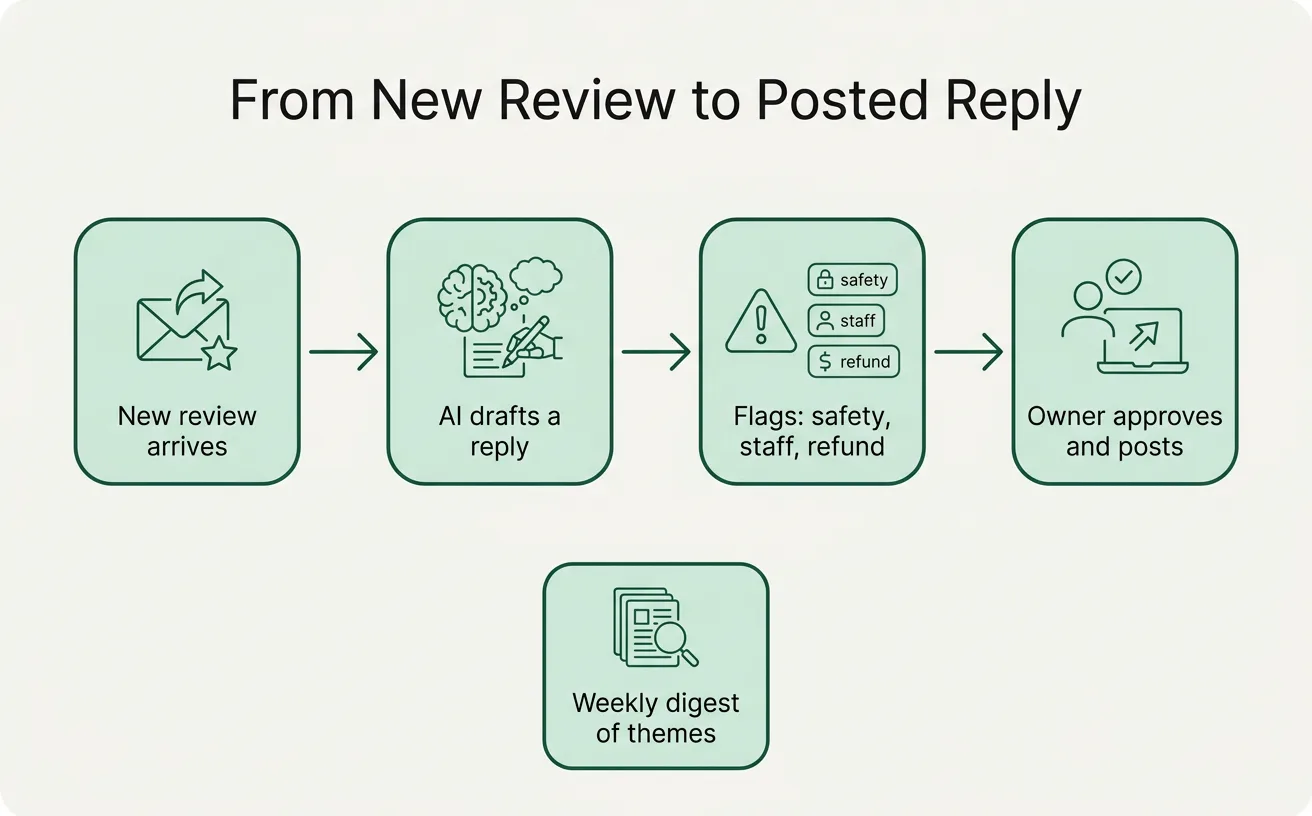
- A draft reply to each new review, in your voice. You give it a handful of replies you have written and liked, plus a few rules (how you sign off, words you never use). The drafts come back sounding like you, not like a form letter.
- A weekly digest. Once a week you get a short summary of what customers praised and what they complained about. Slow Friday service, parking, the price of a particular item: patterns show up that single reviews hide.
- Flags. Any review that mentions a safety issue, a staff member by name, or a refund gets marked so it does not get lost in the pile.
This is the kind of recurring, bounded task we build as a custom AI agent. It reads, drafts and sorts. It does not post on its own.
Where you stay in charge
You approve every reply before it posts. The draft goes to you, you read it, change what you want and publish it. Five minutes with your coffee beats an hour you never find.
Some reviews should reach you first, and the flags exist for that:
- Safety. A mention of food illness, a vehicle that failed after a repair, a wet floor. That is your decision about what to say, and possibly what to fix, and it should not be handled by a draft.
- Staff by name. Praise for an employee is good news to pass along. A complaint about one calls for a conversation with that person before anything is written publicly.
- Refunds. Anything that touches money or a promise is yours to decide.
Angry reviews deserve a person's attention first. The best public reply is usually short, acknowledges the problem without arguing, and offers to talk offline. Something like: we are sorry this went wrong, and we would like to hear more, please call the shop. Whether to make that offer, and who calls, is your judgment. A draft can get you started, but you decide what is true and what you will stand behind.
Two lines we do not cross
Never write fake reviews, and never ask an AI to. That includes glowing ones for yourself and critical ones about a competitor. Fake reviews break the platform's rules and the trust the whole system depends on. Your real customers are enough.
Never put a customer's private details in a reply. Replies are public. Do not name the job, the repair, the order, the appointment time or anything else that tells a stranger what that person did with you. A reply can say “we appreciate you coming in” without repeating their story. We set the agent up with that rule written in, and you still catch what slips past it.
If you are deciding what customer information should be pasted into AI tools at all, our one-page AI policy is a good place to start. If you would rather keep customer data on hardware you control, that is what private hosting is for.
What the weekly digest changes
Replies are the visible part. The digest may be the more useful one. Take a restaurant in the Lakes Region that reads its reviews one at a time and sees a complaint about a slow Sunday brunch as bad luck. The digest shows the same complaint four weeks running, along with steady praise for the staff. That tells you where to add a person on Sundays.
Reading the pattern is still your job. The agent counts and summarizes, and you decide what it means for your business.
A first step before any software
You do not need an agent to begin. Open your Google profile and read your last twenty reviews in one sitting. Write down the three things customers mention most, good or bad.
That list is useful on its own. It also becomes the starting point for the drafts: the details your replies should pick up, and the topics you want flagged. If you want to see how we turn a routine like this into a plan, our workflow mapping tool shows how we walk through it on a discovery call.
What we would try first
Pick one location, one profile and the next month of new reviews. Have drafts written for each, read them yourself, and post only the ones you would be glad to have your name on. Keep the weekly digest for the end of the month and see whether it tells you something you did not already know.
If you want help setting that up, book a planning call and we will talk it through in thirty minutes, free.