
Mid-May on the Seacoast is the calm with the noise already audible. The patio furniture is out in Portsmouth, Hampton Beach is waking up, and somewhere a kitchen manager is building a June schedule around a line cook who hasn't confirmed he's coming back and two servers who start after their college semester ends.
In February the same building needed a third of the staff and half the produce order. A Seacoast restaurant isn't one business. It's two, sharing a lease, a walk-in and a very tired manager.
AI won't fix the seasons. It can take a surprising amount of the admin that swells with them, as long as the right person stays in charge of the parts that matter.
The messages that arrive faster than June does
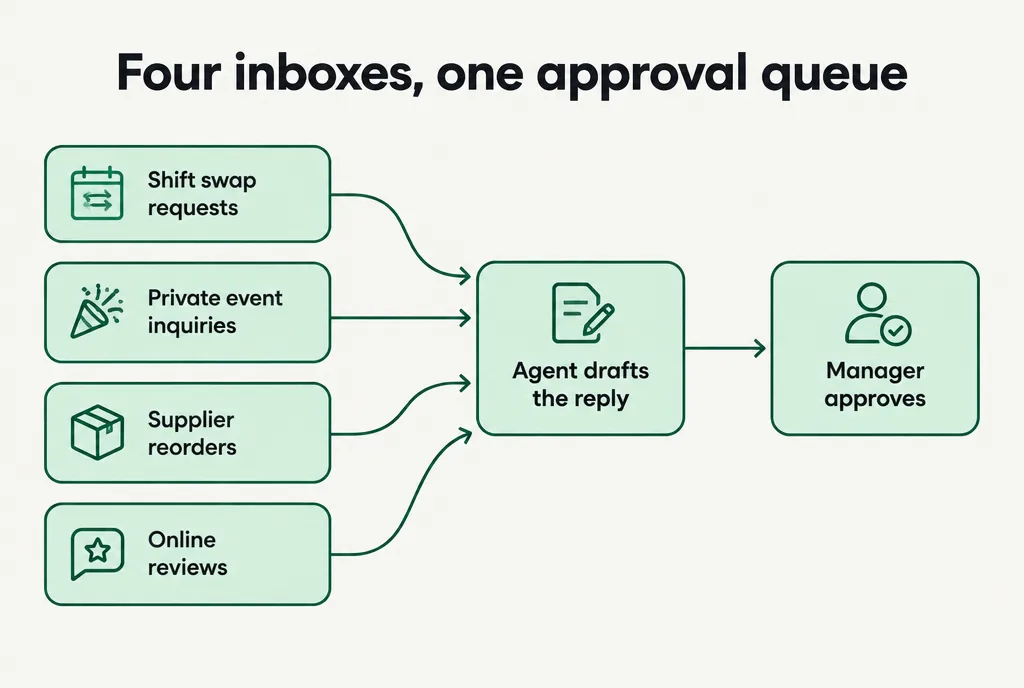
Here's what lands on a manager's phone in a typical summer week, and none of it is cooking or hosting:
- "Can anyone take my Saturday close? I'll take a Tuesday."
- "We're looking at a rehearsal dinner for 40 in September. Do you do buyouts?"
- "Party of 14 tonight, can you fit us?"
- The produce rep's cutoff for tomorrow's delivery, and a keg count that looks low.
- A three-star review that mentions a 45-minute wait and a cold burger.
Each one takes two minutes. Picture forty of them a day in August and a manager can lose several hours a week to the inbox alone, most of it on a phone between tickets. That's an illustration, not a survey, but it may sound familiar.
What an agent can handle well
Shift swaps and availability
Swap requests follow rules you already have, even if they live in your head: who's trained on the bar, who's already at forty hours, who can't close two nights running. An assistant can read the request, check it against the schedule and those rules, and put a ready-to-approve swap in front of the manager: "Jess takes Saturday close, Sam takes Tuesday; both are bar-trained, neither goes into overtime."
The manager still taps approve. The agent just does the checking that used to happen at 11pm on the walk to the car.
Private events and large parties
Event inquiries are where a slow reply quietly costs you the booking. The first reply is almost always the same set of questions: date, headcount, time, the kind of event, food and drink preferences, any dietary needs, and whether they want the whole room.
An assistant grounded in your real event menus and room capacities can draft that first reply within minutes, ask for the missing details, and hand a manager the draft with a tidy summary. It doesn't quote, hold the date or confirm a buyout. Commitments that tie up a room or a Saturday belong to a person.
Supplier reorders
Reorders are pattern work. You know roughly what a Thursday in July burns through, and your invoices already record it. An agent can compare last week's usage and the par sheet against what's on hand, then draft the order for each vendor before their cutoff.
Keep it as a draft. The chef knows the halibut is coming off the menu next week, and the software doesn't. Someone who knows the kitchen reviews every order before it goes to the rep.
Review replies
Replying to reviews matters, and it's the job most managers put off. An assistant can draft a reply to each new review in the house voice: thanks for the good ones, a plain acknowledgement and an invitation to get in touch for the rough ones.
A manager approves every one, and edits the rough ones. An agent should never offer a refund, a comped meal or an explanation of what went wrong in the kitchen. That's a judgment about a guest, and sometimes about a staff member.
Where a person stays in charge
The line is the same one we draw in every industry: the agent drafts, looks up and pre-fills, and a person approves anything that touches money, safety, commitments or judgment. For a restaurant, that looks like this:
| The agent can | A person decides |
|---|---|
| Check a swap against the schedule and rules | Approving the swap, and any overtime |
| Collect event details and share the event menus | Quoting, holding the date, confirming |
| Draft reorders from usage and par | Placing the order |
| Draft review replies | Anything offering a comp or refund |
| Draft hours and parking answers from your policies | Any allergen question beyond the posted menu |
That last row deserves its own sentence. Allergen questions are a safety matter. A drafted reply can point a guest to the menu's allergen notes, but "is the fryer shared?" or "can the kitchen make this nut-free?" goes to someone on shift who can walk back and check.
Why the setup matters more than the software
Most of these jobs need the agent to see things: the schedule, your event menus, recent invoices, the review sites. The work is in connecting those carefully, with only the access each job needs, and writing down the rules the agent follows.
That's what we do in a custom agent build, and it starts by mapping the workflow on the first call: which step is whose, and a one-sentence policy for every approval, such as "the manager approves any swap that puts someone over forty hours." You can see how that mapping works on the Workmap page.
It also helps if the whole team knows what the assistant does and doesn't do. A short session on that, built around your own staff's questions, is the kind of thing we run as AI Cowork training.
A small first step before June
Start with private-event and large-party inquiries. They're the most valuable replies in your inbox and the easiest to get slightly wrong, which makes them a good test of the approval habit.
Write down your event menus, room capacities, any minimums and the questions you always ask. Have an assistant draft the first reply to every inquiry from that sheet, collecting the details and never confirming anything, and have a manager approve each draft for the first month. By July you'll know whether it earns a place in the August crunch.
If you'd like help deciding which of your Seacoast headaches to start with, book a planning call.