
A playbook for “AI concierge” work has been circulating on X this fall. Parts of it are right, and it lines up closely with how we run AI consulting for New Hampshire businesses at T10.
What the playbook says
In short, it has five pieces:
- A 60-minute AI opportunity assessment interview that produces a roadmap.
- Two screen-share calls a month, turning the client's manual processes into Claude skills.
- An Audit, Optimize, Automate pass on each process: audit the manual steps, cut the unnecessary ones, then automate what's left.
- Async messages, with a promise to reply within 12 business hours.
- A shared log of everything built, with an AI-written update after each call saying what was done and the time saved.
That is a sensible shape for an ongoing engagement.
Where we agree
Start with the work, not the tool. An owner who begins with “which AI should we buy” usually ends up with a subscription nobody opens. An owner who begins with “which job eats my Tuesday” ends up with something used.
Cleaning up a process before automating it is most of the value. Say a small contractor's office spends six hours a week chasing signed change orders. Half of that may come from a form with confusing fields and two people keeping separate lists. Fix those first, and the part left to automate is smaller and easier to trust.
Writing down what was built and the hours it saves is what keeps a client. Owners can't weigh a tool they can't see. A plain log of what changed and how many hours a week it frees up lets them decide whether to keep going.
How we do it at T10
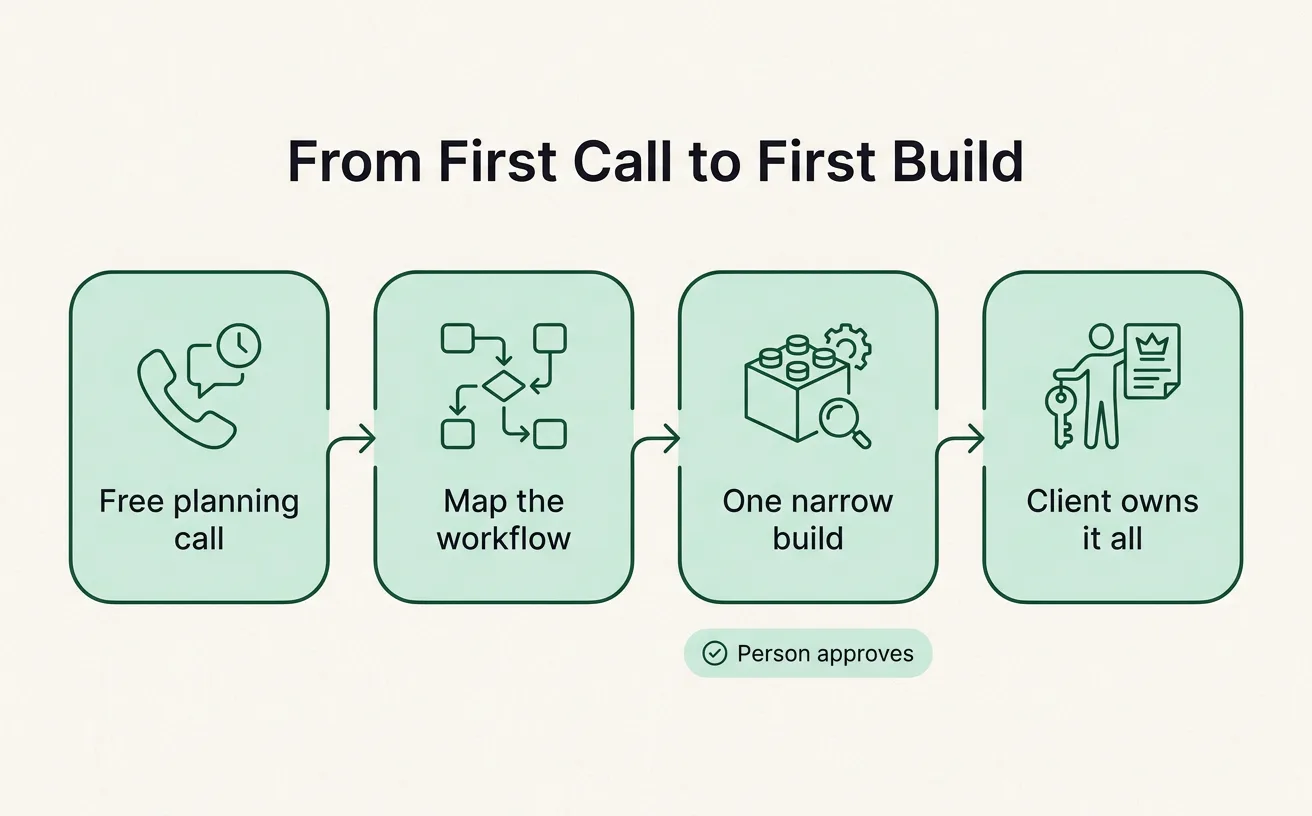
A free 30-minute planning call
It happens on the phone or over coffee. You describe your week, and we say plainly which parts AI is good at and which it isn't. Some jobs aren't worth automating, and we would rather say so on the first call than the fifth.
A discovery sprint for bigger cases
When the picture is larger, we run a 75-minute mapping session per workflow, with the people who do the work. We use Workmap to write down each step in their own words, with the hours per week it takes and a work mode:
| Work mode | Meaning |
|---|---|
| Person does it | No AI involved |
| AI assists | A person drives, AI helps |
| Agent with approval | An agent does it, a person approves |
| Fully automatic | Low risk, no sign-off needed |
Every approval gets a one-sentence policy, such as “a person reads every quote before it goes to a customer.” Ideas are then scored by the hours they take now and the risk if AI gets them wrong. High hours and low risk go first.
One narrow first build
We quote it before work begins. You see it working before anything larger is agreed. Depending on the job, it might be team training, a custom agent, or a Grok Bot set up with its own logins and approval before anything is sent, paid, deleted or submitted.
Where a person stays in charge
A person approves anything that touches money, safety, commitments or judgment. The agent drafts, looks up and pre-fills. Your office manager sends the invoice, your service tech confirms the safety call, and you sign the commitment.
This is why the one-sentence approval policies matter. They turn “a person stays in charge” from a slogan into a line anyone on the team can read and follow.
Who owns what
This is where we differ most from a monthly arrangement in which the skills live in the consultant's head or account. If the consultant leaves, or you stop paying, the work can stop with them.
At T10, you own everything: the system, the code, the configuration, and the playbooks and notes on how it runs. Nothing stops working when the engagement ends. If you later want your AI kept in-house, private hosting is there when you want it.
How we measure
We measure results in hours per week, and we write them down. If a job took eight hours a week and now takes three, that goes in the notes. If it didn't change, that goes in too.
We're in New Boston, and we work in person around New Hampshire or remotely, whichever suits the job. If you'd like to see what mapping one job looks like before committing to anything, our post on mapping one job before you buy a tool walks through it.
A first step you can take this week
Pick the one recurring job that eats the most hours in your office. Write down every step, who does it, and roughly how many hours a week it takes. Then mark which steps a person must keep, anything touching money, safety, commitments or judgment, and which could be drafted or looked up by AI.
That page is the start of a roadmap, whoever helps you build it. If you'd like to go through it with us, book a planning call. It's free and takes 30 minutes.