It's the third Saturday in September. The parking field filled by ten, the McIntosh are picked out of the near rows, and the phone at the stand has rung all morning with the same question: are you open, and what's ripe?
For a pick-your-own orchard or agritourism farm in New Hampshire, the next six weeks decide the year. Foliage season brings the leaf-peepers, the families on the way to a corn maze, the cider-donut line, and the wholesale buyers who want their bins on a certain day. The people who know the answers are out in the rows.
Where the weekend hours go
Picture a family orchard in the hills around Hollis or Wilton. Weekday mornings, the owner walks the rows, checks what's ready, and then spends too long at a laptop telling everyone about it. Weekends, the stand is packed, and every message that comes in has to wait until somebody finds a minute.
The recurring jobs look something like this:
- Capacity and ticket questions. Is Saturday sold out? Can we bring the dog? Is the maze open in the rain? Do we need tickets for the hayride?
- "What's ripe this weekend?" Asked by phone, by email, in the comments, and on every review site.
- Wholesale and CSA orders. Stores and restaurants email their orders in whatever format they like, and the CSA share list changes weekly.
- Staffing the stand. Who's on the register, who's running the wagon, who's parking cars, and who called out.
If those questions eat ten or twelve hours a week in October, that's illustrative. But it's the right order of magnitude, and it arrives exactly when nobody has ten spare hours.
One daily note, sent everywhere
The single most useful change is also the simplest. Write one short note each morning, in your own words, and let AI turn it into everything else.
The owner types or dictates a few lines after walking the rows: Honeycrisp are ready in the upper block, Macs are thinning, pumpkin patch is open, maze closes early Sunday for a private event. From that note, an AI assistant drafts:
- the "what's ripe" list for the website
- a social post or two, in the farm's voice
- updated answers for the FAQ that handles ticket and visit questions
- a short briefing for the stand staff, so the answers at the register match the answers online
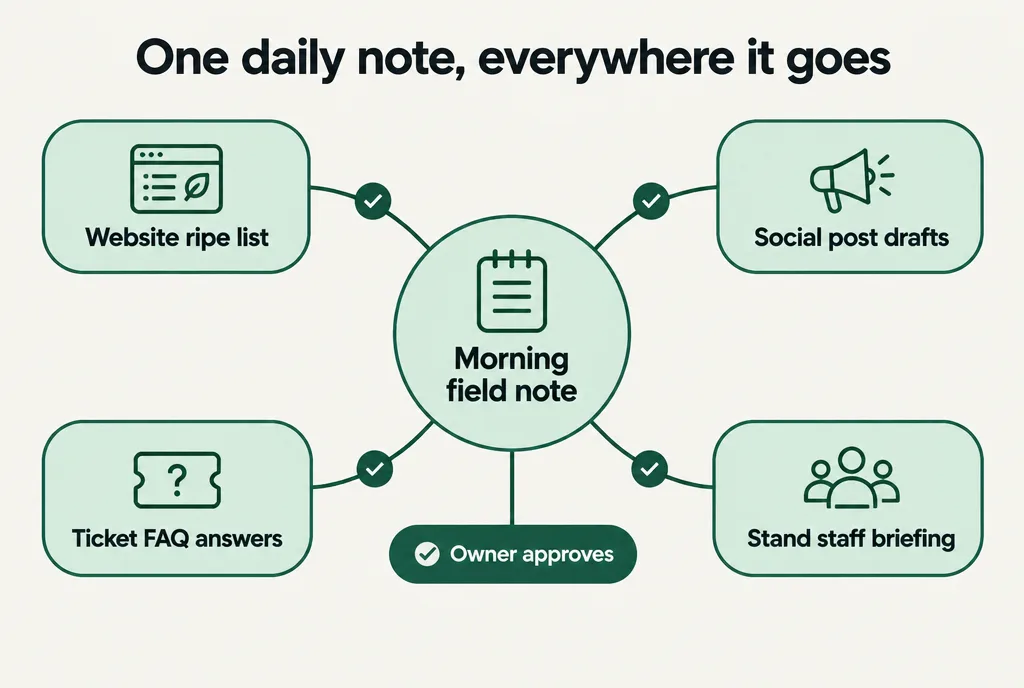
The owner reads the drafts, fixes anything wrong and posts them. That review takes minutes, not an hour, and nothing is published that the owner hasn't looked at. An assistant will happily say a variety is "ready now" if you mentioned it at all; the owner is the one who knows it isn't.
Answering capacity and ticket questions
A website assistant or a drafted-reply inbox can handle the questions that repeat all season: hours, parking, pets, pricing pages, what to wear in the mud, whether the maze is open in the rain. It works from the farm's own FAQ and that morning's note, so the answer on Saturday reflects Saturday.
Where a person stays in charge:
| The AI can | A person decides |
|---|---|
| Answer the posted hours, rules and directions | Any refund, exception or rain credit |
| Point to the ticketing page and today's availability | Group bookings, school trips and private events |
| Say what the morning note said is ripe | Anything about allergies, safety or accessibility beyond the posted policy |
| Draft a reply to a complaint | Whether and how to send it |
Money, safety and commitments stay with a person. A chatbot that promises a school group a Tuesday slot you don't have is worse than no chatbot.
Wholesale and CSA orders
The order book is where retyping creeps in. A grocer emails a list, a restaurant texts a photo of a handwritten note, and a co-op sends a PDF. An assistant can read each one into a single order list (customer, variety, pack size, quantity, pickup or delivery day), so the picking crew gets one sheet instead of five inboxes.
The same works for the CSA: the week's share contents drafted from the morning note, and a reminder email drafted for members. A person confirms quantities before anything is promised, because the tree doesn't care what the order says. For a longer-lived version of this, a custom agent can be built around the farm's actual order formats.
Staffing the stand
Seasonal crews are mostly students and weekend regulars, and the schedule changes daily. AI won't pick who works, but it can help with the paperwork around it: turning availability texts into a draft schedule, writing a one-page briefing for new staff on what to say about tickets, varieties and parking, and drafting the "we need someone Saturday" message.
The owner still makes the call on who's on and who's trained for the register. That's judgment about people, and it stays human.
Booking and ticketing portals
Many agritourism farms sell tickets or timed slots through an outside booking site, and updating it (closing a sold-out Saturday, adding a rain date, changing hours) means logging in and clicking through the same screens. Since August 2026, Grok Bot, a beta product from SpaceXAI, can sign into a website like that and learn a routine by being shown it once.
If you try it, keep it narrow: a dedicated login with only the access the job needs, and approval before anything is changed, cancelled or refunded. A beta tool shouldn't be the only thing standing between you and a double-booked Columbus Day weekend.
A first step for this season
Start tomorrow morning with the daily note. Walk the rows, write five lines about what's ripe, what's open and what's changed, and ask an AI assistant to turn it into the website update, one social post and a staff briefing. Read all three before anything goes out. If that saves you an hour by the end of the week, add the ticket FAQ next. If you'd like your team to build these habits together, our AI Cowork training can run on site before the rush or after it.
When the last bins are in and you want to plan next year, book a planning call.