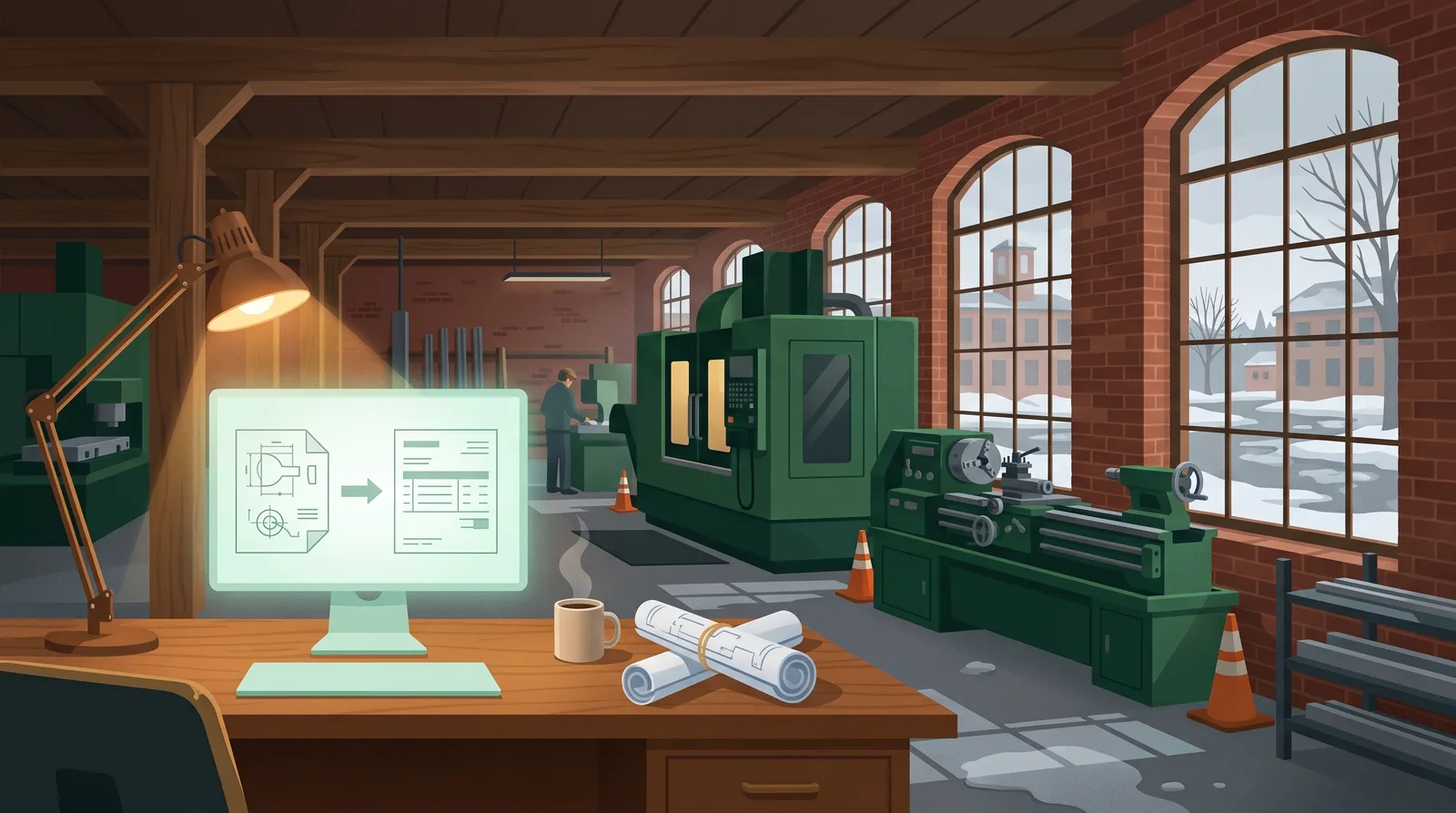
It's Thursday afternoon at a shop in Hudson. An email lands with a zip file: eleven drawings, a scanned PO template, a spreadsheet of quantities and a note that says "quotes due Monday." Your estimator already has six of these open. The one that gets answered first is usually the one that gets the work, and the one that sits until Tuesday usually doesn't.
Anyone who has run a job shop or contract manufacturer in the Merrimack Valley knows this rhythm. The machining is the part you're good at. The bottleneck is reading.
The real cost of an RFQ is the reading
Before anyone can put a number on a part, somebody has to go through the package and pull out the facts:
- Part number and revision, for every drawing
- Material and any specified condition or spec
- Quantities, including breaks and any annual usage
- Critical tolerances, finishes and callouts that change the process
- Required certifications, inspection reports and material certs
- Due dates, delivery terms and anything unusual in the notes
That list lives across a title block, three general notes, a PO template and an email thread. If one package takes an estimator an hour just to read and transcribe, and a busy week brings in a dozen, that's a good part of a week spent typing before any real estimating starts. The skilled part, deciding how you'd make it and what it's worth, gets squeezed into whatever time is left.
What an agent can do with the package
This is work AI is actually good at: reading messy documents carefully and putting what it finds into a consistent structure. It doesn't get tired on drawing nine, and it doesn't skip the general notes.
Here's the shape of it:
- Read everything in the package. Drawings, PDFs, spreadsheets, the email body. Scanned pages included, within reason.
- Fill your quote worksheet. One row per line item, with part number, revision, material, quantity, key tolerances, finish and required certs, in the columns you already use, whether that's a spreadsheet or your ERP's quote screen.
- Point to the source. Every value links back to where it came from ("Sheet 2, note 4"), so the estimator can check it in seconds.
- Flag what's missing or odd. No material called out. A revision on the drawing that doesn't match the PO. A tolerance that's unusually tight for the feature. Two drawings with the same part number.
- Find similar past jobs. If you've cut something close before (same material, similar size and features), the agent surfaces it so the estimator can start from what you actually know.
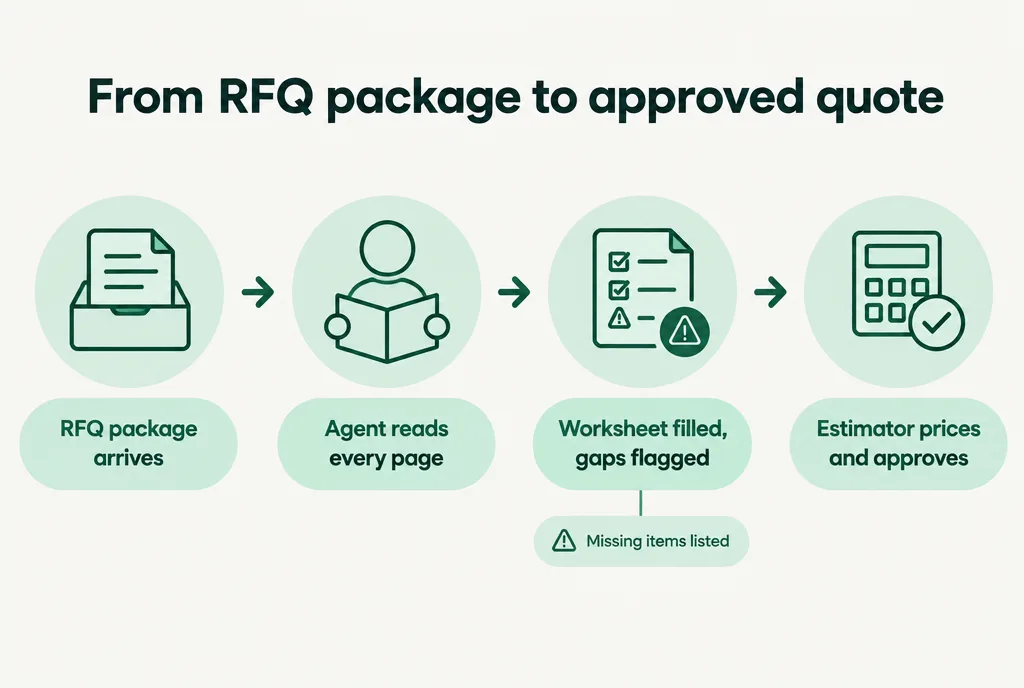
The flags are the most valuable part. A clean worksheet saves time. A worksheet that says "drawing 3 has no material callout, ask the customer" saves you from quoting the wrong job.
The estimator sets the price. Always.
We're firm about this, and we think most shop owners would be too. The agent does not decide what a part costs, how you'd fixture it, what machine it goes on or whether you want the work at all.
| The agent | The estimator |
|---|---|
| Reads and transcribes the package | Decides how the part gets made |
| Fills the worksheet, with sources | Sets every price and lead time |
| Flags gaps and conflicts | Decides what to ask the customer |
| Finds similar past jobs | Decides whether to bid at all |
| Drafts the clarification email | Approves anything sent out |
Nothing goes to a customer without a person approving it. That includes the quote itself, a "no bid," and the email asking for the missing material spec. A quote is a commitment, and commitments stay with people.
That's also what makes this safe to try. If the agent misreads a tolerance, the estimator sees it next to the source and fixes it. The worst case is a correction, not a bad quote in a customer's inbox.
Where do the drawings go?
For many shops this is the first question, and it should be. Customer drawings are confidential, and some of the work around here involves defense programs, where drawings may be export-controlled or carry handling requirements. We're not going to tell you what your obligations are for a given contract; your customer's terms and whoever advises you on compliance decide that.
What we can tell you is that you don't have to send drawings to a public AI service to do this. The same kind of reading agent can run on a machine in your own building, on your network, with nothing leaving it. For a shop with controlled work that's often the only acceptable setup, and it's a perfectly practical one for a task this size.
For shops whose work doesn't carry those restrictions, a business-grade service with clear data terms can be fine. We'll help you decide which fits, and write down where the data goes either way.
Start with the worksheet, not the price
Some vendors will pitch AI that "quotes parts automatically." We'd be cautious. Pricing in a job shop depends on things that live in your head: which machine is free, which customer pays on time, which material your supplier can actually get this month. A model guessing at that isn't saving you time; it's giving you something else to check.
Start with the reading and the flags. It's measurable (is the worksheet right?), it's easy to check, and it gives the estimator back the hours that were going into typing. Once you trust it, suggesting a first-pass number from similar past jobs is a reasonable next step, still with the estimator correcting it.
A narrow first job to try
If you run a precision machining or contract manufacturing shop in Nashua, Manchester, Hudson or anywhere along the river, here's what we'd try first:
- Pick one customer or one type of RFQ that arrives often and in a consistent format.
- Gather ten or twenty past packages along with the worksheets your estimator filled for them.
- Have an agent built around those examples, and test it against them before it touches a live RFQ.
- Run it alongside your estimator for a few weeks. They review every row, and you keep a simple tally of what it got right, what it flagged and what it missed.
If that tally looks good, widen it. If it doesn't, you've learned something cheaply and nothing went out the door wrong.
If you'd like to talk through what your RFQ inbox looks like, book a planning call. It's thirty minutes, and we'll tell you plainly whether this is worth doing for your shop.