
A caregiver texts at 5:50 a.m. that her car won't start, and the client she was due to see at eight needs help getting out of bed and taking morning medications. The coordinator is already awake, looking at a map where the next closest qualified person lives forty minutes away over a back road. In rural New Hampshire, a call-out is a puzzle about distance and credentials as much as availability.
What the first hour looks like now
Most coordinators we talk with do this from memory and a spreadsheet. Who has worked with this client before? Who is certified for what this client needs? Who lives in Colebrook versus Lancaster, and who is already on the road?
Then come the calls and texts, one at a time, while the clock runs toward the visit. Somebody also has to tell the family. The hard part is rarely the decision. It is the half hour of lookup and typing before you can make it.
What AI is good at here
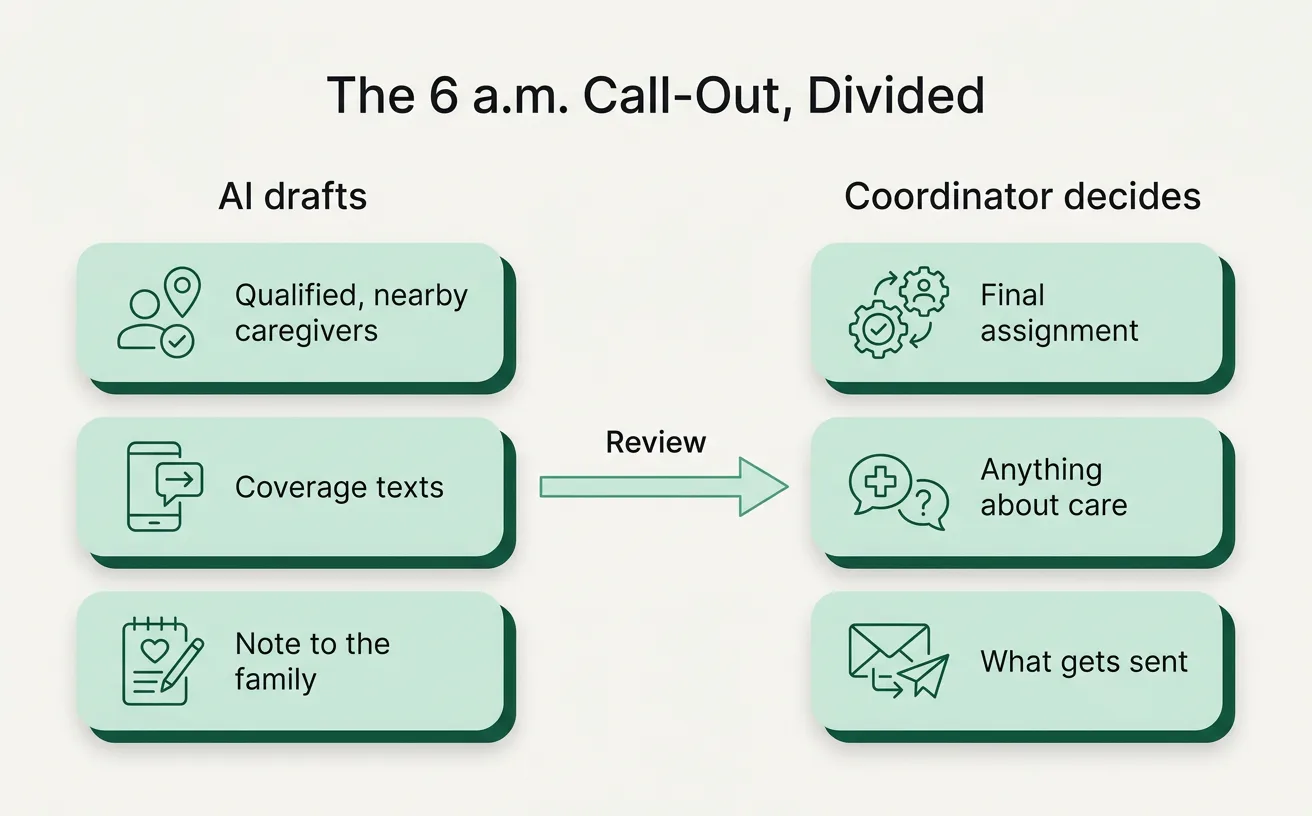
An AI assistant can do the lookup and the drafting quickly, and that is where the time goes. Given your caregiver roster, client needs and a rough map of where people live, it can produce three things.
- A short list. Caregivers who are qualified for this client's needs and close enough to reach the visit in time, with approximate drive times and a note on who has worked with the client before.
- Coverage texts. A message to each person on the list, written in your usual voice, with the visit time, area and length. They are ready to send once you approve.
- A note to the family. A short, plain message saying the regular caregiver is out, who is coming instead (once confirmed), and when.
Say a coordinator spends forty-five minutes on a typical call-out morning. If the lookup and typing drop to ten, the rest of that time goes to the phone and to the client.
Where the coordinator stays in charge
The agent proposes. The coordinator makes the final assignment, because she knows things a roster doesn't. She knows that one caregiver is stretched thin this week, or that a client gets anxious with unfamiliar faces.
A few things stay with a person every time:
- The final assignment of who goes to which client.
- Anything about the client's care, such as medications, mobility, changes in condition or what a substitute needs to know.
- What is sent to caregivers and families. Nothing goes out until she has read it.
- Any exception to your own rules on credentials or hours.
If a draft names someone who isn't qualified, or a family note says more than it should, she catches it before it leaves. That is the arrangement we build, with drafting handled by the agent and decisions by the person.
Client information stays in the building
A roster with client needs, addresses and care details is sensitive. Before you paste any of it into a general-purpose tool, decide where it is allowed to go. We wrote about the same idea for professional offices in paperwork that never leaves the building.
For many agencies the answer is a setup where client details stay on infrastructure you control, which is what our private GPU hosting is for. Whether any particular arrangement meets your obligations around health information is a question for your own compliance advisor, not something we can promise. Giving staff clear rules on what they may and may not paste into an AI assistant is a good start, and that is part of team training.
A first step: look at last month
You don't need software to start. Pull up last month's call-outs and write down how each one was covered.
| Call-out | Who covered | How you found them | Minutes from call to confirmed |
|---|---|---|---|
| Example: Tuesday, 6 a.m. | Name | Texted three, two no answer | Time it |
Time each one, from the first message to a confirmed replacement and a note to the family. Add a column for how many people you contacted before someone said yes.
Most agencies find a pattern within a week or two. The same three caregivers get asked every time, or the family notes take longer than the scheduling. That pattern is what an agent should be built around, and it is the kind of recurring work we map on a discovery call with our workflow mapping tool.
One narrow job to try
Start with the shortlist and the texts, and leave the family note for later. Have an AI assistant draft the three nearest qualified caregivers and a text for each, using a roster with no client names, only needs and locations. Review every draft yourself and send it yourself. After a month, compare your timing to last month's.
If you'd like help setting that up or deciding where the data should live, book a planning call and we'll go through it together in thirty minutes, free.