
It's the first week of August, and the renewal stack for the fall is already on the corner of every desk. Somewhere in that pile is a contractor's package with a changed deductible, a restaurant whose carrier has quietly rewritten an exclusion, and a landlord who needs a certificate for a new tenant by Friday.
Most independent agencies in New Hampshire don't need another piece of software to get through that. They need their customer service reps to be good at using the AI tools they probably already have, with rules everyone agrees on. That's a training problem, not a purchasing one.
Where the renewal hours actually go
Talk to a CSR in Concord or Nashua about renewal season and the same three jobs come up. None of them is hard. All of them are slow, and all of them are mostly reading and rewriting.
- Explaining what changed. The carrier sends a renewal with a new form edition, a different limit or an added endorsement. Someone has to read both versions and turn the difference into a plain-English letter the client will actually read.
- Comparing quotes. When a renewal comes in high, the agency remarkets. Three or four quotes arrive in three or four layouts, and someone builds the side-by-side by hand.
- Answering certificate requests. A general contractor emails at 4:40 asking for a certificate naming a new additional insured. The reply, the checks and the follow-up questions repeat all year, but they spike when projects start.
If those three jobs take a CSR eight or ten hours in a heavy week, that's illustrative, but it's the right shape. The work is language work, and language work is what AI assistants are genuinely good at.
What a hands-on session looks like
Our AI Cowork training isn't a tour of features. Before the session, we gather real (redacted) examples from the agency: an old renewal pair, a set of quotes, a typical certificate email. Then the team practises on their own work.
Summarising policy changes for the renewal letter
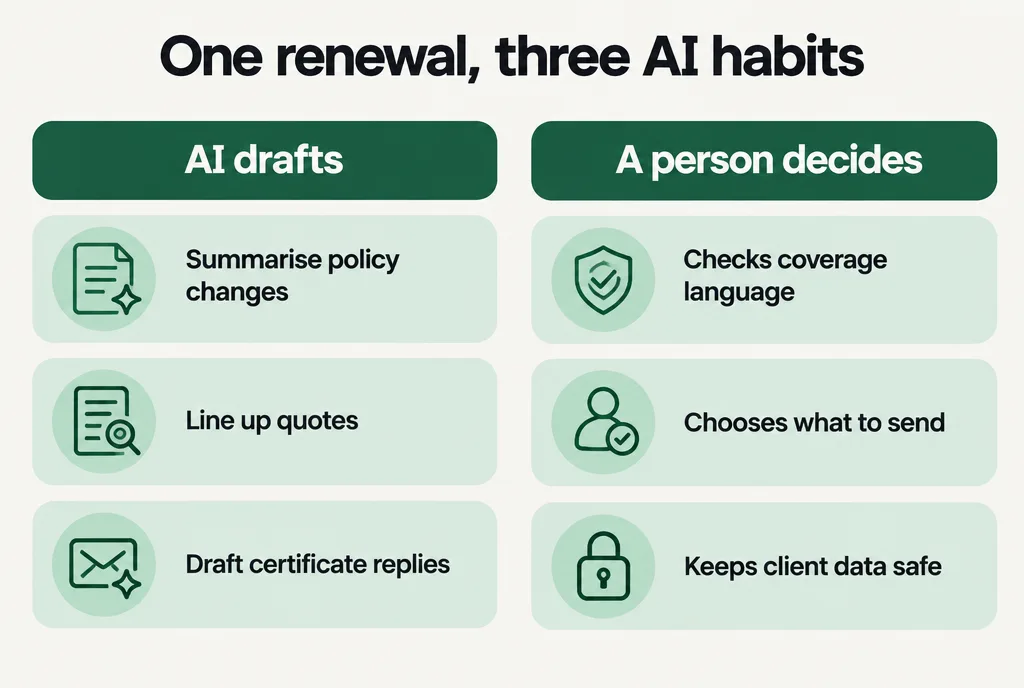
The CSR gives the assistant the expiring and renewal declarations or the change summary, and asks for a list of differences: limits, deductibles, forms, endorsements added or removed. From that list, the assistant drafts the paragraph for the renewal letter in the agency's tone.
The habit we teach is simple. The assistant's list is a starting point, not a finding. The CSR checks every item against the documents before a word goes to the client, because a model can miss a changed form number or describe an endorsement more broadly than it reads.
Comparing quotes side by side
Given three quotes, an assistant can build a comparison table in a minute: premium terms, limits, deductibles, notable exclusions, carrier conditions. What used to be an hour of copying becomes a first draft the producer can review over coffee.
The table stays internal until a licensed person has reviewed it. Where quotes use different forms, the right answer is often "these aren't directly comparable", and that sentence has to come from someone who knows the forms.
Drafting certificate-request replies
Most certificate emails need the same things: confirm who the holder is, what the contract asks for, whether additional insured or waiver wording is needed, and when it's due. An assistant can read the request and draft a reply that asks the right follow-up questions, or a note for the CSR listing what to check in the policy before issuing.
Issuing the certificate, and deciding whether the policy actually supports the wording the contract asks for, stays with a person. The assistant drafts the email; it doesn't decide coverage.
The rules that make it safe
Agencies hold a lot of personal information: driver details, property addresses, claims history, sometimes more. The most useful thing a training session produces is a short set of rules the whole team follows, not one early adopter's private habits.
| Question | A sensible agency rule |
|---|---|
| Which AI tool? | Only the business account the agency has approved, never a personal login |
| What can go in? | Policy wording, forms, quotes and the client's business name; strip personal identifiers the task doesn't need |
| What never goes in? | Anything the agency's own privacy policy or carrier agreements say stays in the management system |
| Who checks coverage language? | A licensed person, every time, before it reaches a client |
| What can the AI say to a client? | Nothing directly. It drafts; a person sends |
Your agency's rules will differ, and anything touching your state licensing obligations or carrier contracts is worth checking with your own compliance advisor. We're not giving regulatory advice here. What we can do is help the team write the rules down and practise following them on real tasks.
Where a person must stay in charge
Across all three jobs, the line is the same. AI can read, compare and draft. A person decides anything that describes coverage, commits the agency or reaches a client.
That means no AI-written sentence that says a client "is covered" for anything goes out unreviewed. No certificate is issued because an assistant said the policy allows it. And no quote comparison reaches a client until a producer has signed off on what it implies.
This isn't caution for its own sake. Errors-and-omissions exposure sits on exactly these sentences, and your team already knows how to review them. The training just moves their review to the end of a faster draft, instead of the end of a slow one.
Why train rather than buy
There are agency tools with AI features built in, and some are worth a look later. But a team that hasn't built the habits (what to paste, what to check, when to stop) won't use a new tool well either. Training first tells you which tasks are ready for AI help, which might one day justify a custom agent, and which should stay fully human.
It also spreads the skill. In many agencies one CSR has quietly figured out how to use an assistant, and nobody else knows what they're doing or whether it's safe. A shared playbook turns one person's trick into the agency's practice.
A first step for your agency
Pick one job before the fall renewals peak: the policy-change summary for renewal letters. Collect five recent renewals with the expiring and renewal documents, redact the personal details, and have two CSRs draft the change summary with an approved AI assistant. Then have a licensed producer check each draft against the documents and note every miss. After a week you'll know how much time it saves, what the assistant gets wrong, and what your written rule should say.
If you'd like help running that session with your own documents, book a planning call.