
A framing carpenter finishes the last punch list the week before Christmas, and in the second week of January the bookkeeper asks for a W-9 from a sub who moved to Maine in March. Nobody has his current address. That scramble is avoidable, and most of it can be done in December while subs still answer their phones.
This is a small-contractor version of the problem we described in tax-season triage for small accounting firms. Your accountant gets buried in January. The more organized the paperwork you hand over, the less of that time goes to chasing you.
Why January goes badly
A contractor with a dozen subs, a few landscaping crews and a long list of suppliers pays people all year from a truck, a job site or a phone. Paperwork gets collected on the first job and rarely again. By year-end, the W-9 might be in an email thread, a text photo, or nowhere.
Say the owner spends eight hours in January matching payments to files and writing "can you send me that form again" emails. Most of those hours are lookup and drafting work, which is the kind of task AI handles well.
What AI drafts
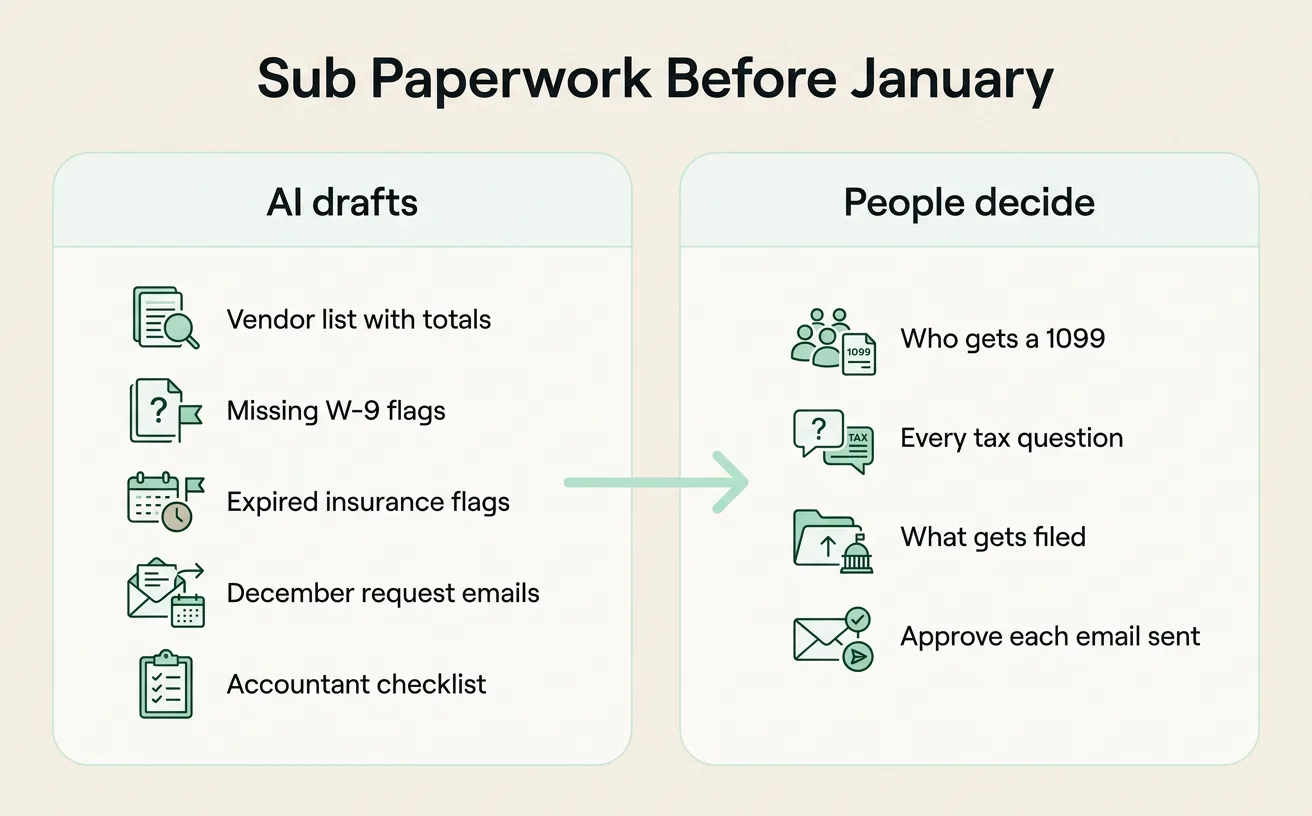
With an export from your bookkeeping system, an AI assistant can produce these pieces in minutes:
- A vendor list. Every payee for the year with totals, pulled from the export and sorted by amount.
- Missing-paperwork flags. Next to each sub, a note on whether a W-9 is on file and whether the certificate of insurance is current or expired.
- Request emails. A short, polite message for each sub who is missing something, naming exactly what you need and a date to send it by.
- A checklist for the bookkeeper or accountant. What was exported, what is still outstanding, and which questions the owner has.
The agent works from your files and your numbers. It doesn't guess at totals, and any line it can't match is marked for a person to look at.
What people still decide
The list the AI builds is a starting point. Whether a payee gets a 1099 is a decision for you and your accountant. It depends on facts the export doesn't show: how the person was paid, what the payment was for, and how the business is set up.
Every tax question goes to the accountant. That includes anything about what counts, what doesn't, and what the filing looks like. We don't give tax advice and an AI assistant shouldn't either.
A person also approves each email before it goes out, and a person decides what gets filed. The agent drafts and checks, and you sign off.
Keep taxpayer ID numbers out of public chatbots
A W-9 carries a Social Security or employer ID number. Those numbers should never be pasted into a public chatbot. Keep them in your bookkeeping system, your accountant's portal, or a private AI setup that runs on infrastructure you control.
The flagging job doesn't need the numbers anyway. It only needs to know whether a form exists. If you want AI working directly on the documents, private hosting keeps them in-house. A one-page AI policy that lists what never gets pasted is a good companion.
A December timeline that fits a trades schedule
| When | Task |
|---|---|
| Early December | Export the year's vendor payments, flag missing W-9s and insurance |
| Second week | Owner reviews the list and approves request emails |
| Mid-December | Emails go out, replies get filed as they arrive |
| Last week | Updated list and checklist go to the accountant |
The weather helps here. Exterior work slows, the crews are around, and subs are easier to reach than they will be in the thick of a January thaw or a mud-season rush.
Who sets this up
The export-and-flag job is a good fit for a short training session. Our team training shows an office manager how to run it with their own files. If you want the flags and email drafts to run every December without anyone rebuilding the steps, a custom agent can do that. Either way, we like to map the workflow first so we know where each form actually lives.
A first step for early December
Export the year's vendor payments from your bookkeeping system. Then go down the list of subs and check which ones have no W-9 on file. That is the whole job for the first pass, and an AI assistant can do the comparison if your forms are in one folder.
Send the short list of gaps to your accountant and ask what else they want collected. Then start the request emails while it is still December.
If you would like help setting that up, book a planning call and we will talk it through for thirty minutes.