It's the first week of March, and the return you could finish in forty minutes has been sitting for three weeks because one brokerage 1099 never showed up. Multiply that by a few dozen clients and you have the real shape of tax season at a small firm. The bottleneck usually isn't the preparing. It's everything that has to happen before you can start.
We talk to owner-run accounting, bookkeeping and tax-prep offices across New Hampshire, and the story is remarkably consistent. The skilled work fits in the day. The chasing, sorting and reminding eats the evenings.
Where the hours actually go
Picture a three-person firm in Concord or Keene. Between now and the April deadline, a typical day might include:
- Scrolling the client portal to see who uploaded what, and whether "scan0041.pdf" is a W-2 or a property tax bill
- Comparing each client's uploads against what they sent last year, to spot what's missing
- Writing the fifth polite email this month to the same client about the same form
- Sending out engagement letters to the clients who still haven't signed one
- Keying last year's answers into this year's organizer so the client only has to confirm them
None of that needs a CPA's judgment. All of it needs care, because a mislabelled document or a reminder sent to the wrong person is a real problem. If that pile eats eight or ten hours a week per person in March, that's the time you'd rather spend reviewing returns, or sleeping.
What AI is genuinely good at here
This kind of work is where current AI assistants and agents do well: reading documents, comparing lists and drafting routine messages in a consistent voice. It's also where they're easy to check, because every output is something a person can glance at and confirm.
1. Sorting the portal pile
An agent can open each new upload, work out what it is (a W-2, a 1099, a mortgage interest statement, a daycare receipt), rename it to your firm's convention and file it in the right client folder. When it isn't sure, it says so and leaves the document in a "needs a look" pile rather than guessing.
2. Knowing what's missing
The single most useful thing an agent can do in March is compare what a client sent this year with what they sent last year. If last year's file had two W-2s, a brokerage statement and a 1098, and this year's has one W-2 and a 1098, that's a short, specific list of what to ask about. It doesn't decide the brokerage account still exists. It just notices the gap.
3. Drafting the chase emails
From that gap list, the agent drafts a reminder in your firm's tone: which documents, where to upload them, and when you need them to stay on schedule. The same goes for engagement letters that haven't come back, and for the "we have everything, you're in the queue" note clients love to get. The drafts wait for a person to approve them before anything goes out.
4. Pre-filling organizers
Last year's answers (dependents, addresses, bank details for refunds, recurring items) can be carried into this year's organizer, so the client confirms and corrects instead of starting from blank. Every carried-forward answer is marked as carried forward, so nobody mistakes it for something the client just told you.
Where the preparer stays in charge
This part isn't negotiable, and it's the part we spend the most time on with clients.
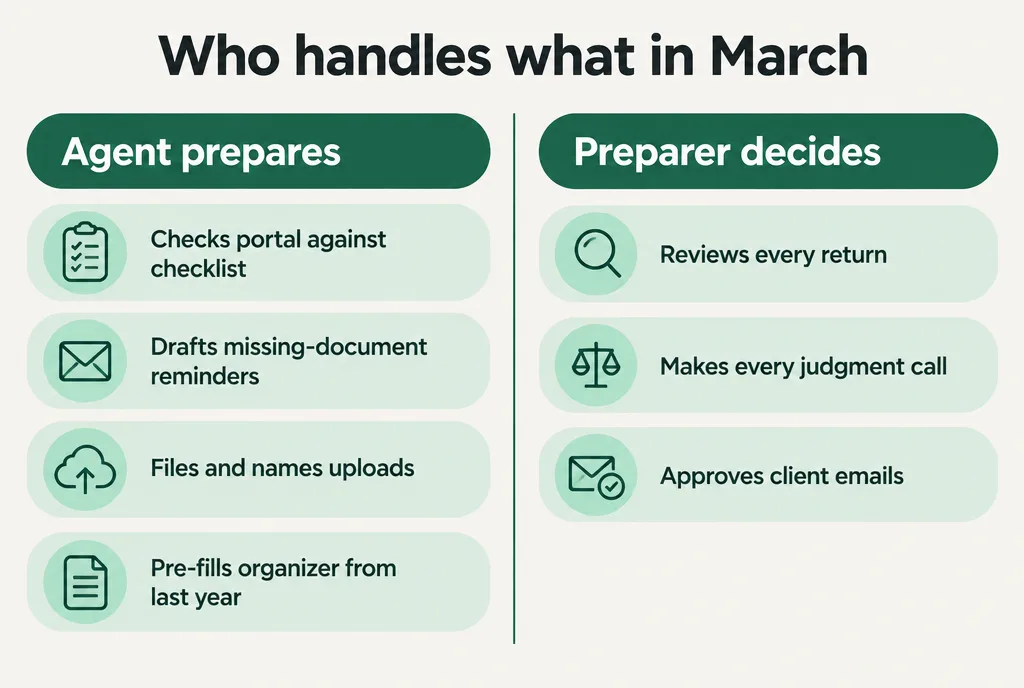
| The agent can… | The preparer always… |
|---|---|
| Notice a document is missing | Decides whether it matters |
| Flag something unusual versus last year | Decides what it means for the return |
| Draft a reminder or status email | Approves it before it's sent |
| Pre-fill an organizer | Reviews the return, line by line |
Anything that is a tax judgment stays with a person: what's deductible, how something is treated, whether a client needs a conversation instead of an email. The agent doesn't give advice to clients, doesn't answer tax questions on your behalf and doesn't file anything. It gets the folder ready so the person who does all of that can start sooner.
The same rule applies to anything touching money or commitments. An engagement letter goes out when a partner says so. A client asking "can I deduct my home office?" gets routed to a person, not answered by a chatbot.
"Can we even put client documents through AI?"
It's the right question, and the answer depends on how it's set up rather than on AI in general. Client tax documents are about as sensitive as data gets in a small office. Your professional obligations and any engagement terms you've agreed with clients should drive the decision, and it's worth checking with whoever advises you on those before anything goes live.
Practically, there are two paths. One is a business-grade AI service with clear terms about how your data is handled and retained. The other is keeping it entirely in-house: the same kind of assistant, running on hardware you control, where documents never leave the building. We'll walk through the trade-offs honestly. For some firms the first is fine; for others only the second will do.
What we'd steer you away from is staff pasting client documents into a free consumer chatbot to "save time". That's a real risk, and it's usually a sign the team wants help and hasn't been given a safe way to get it. A short, role-specific training session fixes that faster than a policy memo.
Why start now and not in May?
It's tempting to say "we'll look at this after the season." But March is when the problem is visible. You know exactly which clients you're chasing, which uploads are a mess and which emails you've written a dozen times. That's the evidence an agent needs to be built and tested against.
You don't need to automate tax season. You need to take one repetitive job off the pile while you can still see what the pile looks like. Whatever gets built can be tested properly over the summer, on real examples, and be ready for next January.
A narrow first job to try
If we were picking one thing for a small New Hampshire firm, it would be the missing-document check and reminder draft:
- Each morning, the agent compares new portal uploads against each client's prior-year document list.
- It produces a short list per client: received, still missing, and "not sure what this is".
- For anyone missing something, it drafts a reminder in your firm's voice.
- A person reviews the list, edits or approves the drafts, and they go out.
It's narrow, it's easy to check, and it gives back the hours that tax season takes first. It also teaches you, on low-risk work, how far you trust the tool before you give it anything bigger. If it goes well, a custom agent can take on the organizer pre-fill next year.
If you'd like to talk through what that would look like in your office, book a planning call. It's free and takes thirty minutes.