The after-hours no-heat call
The equipment guides show how a heating system works. This one shows the office side: what happens between the phone ringing at midnight and a truck pulling in. Follow a call from the phone line to the dispatch note, then break it the ways these calls go wrong.
Right now
- Clock
- 11:40 pm
- Inside the house
- 58°F
- Where the call is
- The caller
- On-call tech
- Asleep
- Truck
- Parked
- How it ends
- Call in progress
The call
- 11:40 pmCallerThe house is at 58°F and falling, it's 4°F outside, and the office closed at 5. The owner calls the service number.
The dispatch note
- Customer
- Blank
- Equipment
- Blank
- Model
- Blank
- Symptom
- Blank
- Answers
- Blank
- Tried on the phone
- Blank
- History
- Blank
- Priority
- Blank
- Bring
- Blank
Every question comes from a part.
The intake questions are written from the equipment guides. Each one asks about something the caller can see or hear, and each answer points the tech at a part. A question that doesn't change what the tech brings or when they come doesn't belong on the list.
Heat pump
"Does the thermostat say Heat, Cool or Auto?"
A heat pump left on Cool blows cold air all night. It's fixed on the phone.
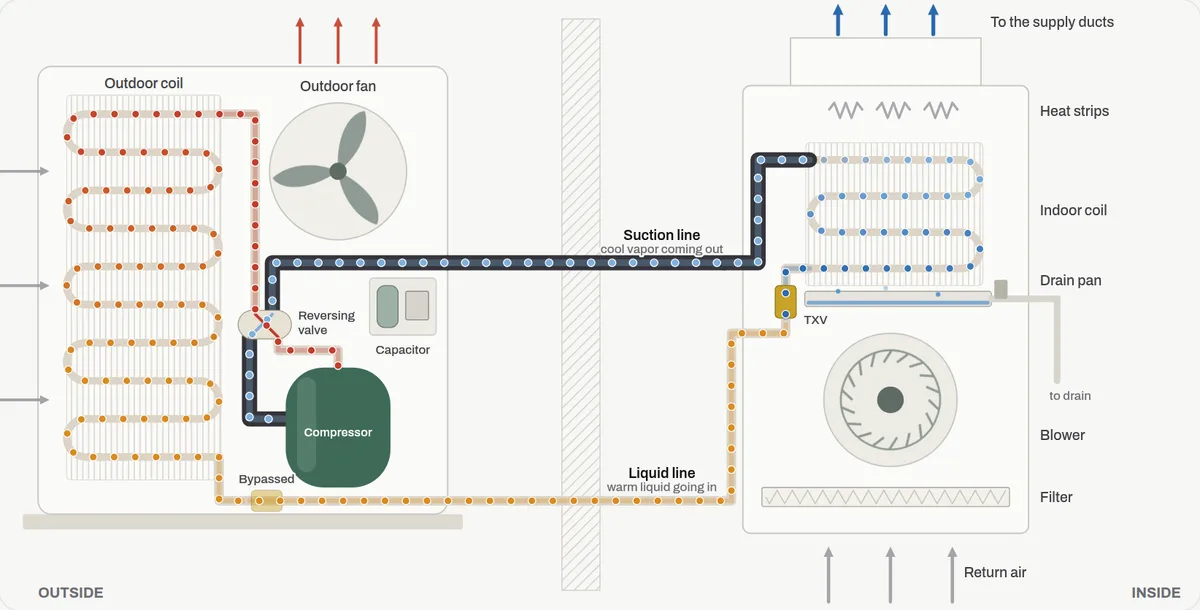
The reversing valve in the split system guide"Is the fan on top of the outdoor unit spinning?"
Humming with no spin points to the fan motor or its capacitor, and decides what goes on the truck.
The outdoor fan in the split system guide"Is the outdoor unit iced over?"
Some frost is normal and defrost clears it. A solid block means defrost can't keep up.
The outdoor coil in the split system guide"Does the thermostat show Aux or Emergency heat?"
Tells the tech whether the house can stay warm until morning.
The backup heat in the split system guide
Oil boiler
"Is the thermostat on Heat, and the switch at the top of the stairs on?"
A dead battery or a switch flipped off by mistake looks like a broken boiler.
The thermostat in the oil boiler guide"Is the red reset button popped up? How many times was it pressed?"
One press is fine. More can flood the chamber with oil.
The primary control in the oil boiler guide"What does the gauge on the tank read?"
Rules out running dry, the most common no-heat call for oil.
The oil tank in the oil boiler guide"What nozzle size is on the burner tag?"
Nozzles come in dozens of sizes. The right one on the truck saves a second trip.
The oil burner in the oil boiler guide
Written for a tech reading a phone at midnight.
The on-call tech decides from the note whether to drive out now, wait for morning or call the owner back. A good note is short and always in the same order, and a blank field says it's blank.
- 1The equipment and model, from the record or a photo
- 2What the caller saw, in their words
- 3What they already tried, and what changed
- 4Any visit in the last 30 days
- 5A suggested priority, for the tech to approve
- 6The parts that match the answers
Four ways the call goes wrong.
Each one is a small gap in the intake that turns into a second trip, a cold night or an angry customer. Run it without the check, then with it.
- Heat pump
Missing outdoor-fan answer
"I don't know, it's dark and it's freezing out there."
The caller doesn't know whether the outdoor fan is spinning, and the agent moves on. That answer picks the parts, and it would have told the agent to put the house on backup heat.
The check: A question that picks the parts gets a second try with an easier way to answer. If it's still unknown, the note says so in red.
- Heat pump
Heat and cool mixed up
"My air conditioner is blowing cold air all over the house."
The caller says the AC is blowing cold. The agent files it as a cooling call, which waits for the office, while the heat pump spends the night in cooling mode.
The check: A heat pump customer who says "AC" in winter gets the heating questions, starting with the thermostat mode.
- Oil boiler
No model number
"The heat's off. The boiler's not running at all."
The customer record has no burner details and the agent doesn't ask. The tech arrives without the right nozzle.
The check: When the record has no model, ask for a photo of the tag or data plate, and save it to the record.
- Oil boiler
Callback in 30 days
"The heat's off. It ran fine all week, then it quit tonight."
The boiler was cleaned 9 days ago. Nobody checks, so a problem the cleaning caused goes out as a new emergency call and gets billed like one.
The check: Any call within 30 days of a visit on the same equipment is a callback. The note says what was done, and the morning review gets it.
This is what a custom agent does.
The call on this page is how we build an after-hours agent: your equipment, your questions, your on-call rules, and a note your techs trust at midnight. The agent asks the questions and writes the note, and your on-call tech makes the decisions.
An intake agent on the after-hours line
It answers every call, asks the questions for the equipment on file, walks the owner through the safe checks, and hands the on-call tech a note in the same order every time.
Custom AI agentsThe on-call tech still decides
The agent suggests a priority, and the tech approves it from the note under a rule the company writes in one sentence. A gas smell or a CO alarm skips the agent and pages a person.
Custom AI agentsMapped from your own calls first
Before we build anything, we map how your office handles these calls today, in your team's words, and mark which steps the agent takes and which stay with people.
How we map it: Workmap
This page shows a simplified after-hours call for learning. The company, the customers and the model numbers are made up, and it isn't a script for any particular business. If you smell gas or smoke, or a carbon monoxide alarm sounds, leave the house and call 911 from outside.