
It's the middle of February in Jaffrey. The taps are in or nearly in, the evaporator has been cleaned, and everyone is watching the forecast for the first run of freezing nights and forty-degree days. In a few weeks you won't have time to answer an email for a month.
The orders won't stop to wait for you. The inn in Peterborough wants its usual case of quarts. A co-op in Keene is asking about pints for spring. Three web-shop customers want to know when last year's dark syrup is back in stock. And the one person who knows the answer to all of it is out in the sugarbush checking lines.
The mismatch at the heart of a sugarhouse
Maple is a strange business to run. Production happens in a burst; sales happen all year. The same is true, more or less, for plenty of small Monadnock food producers: the orchard, the creamery, the jam maker with a stand on Route 101.
Picture a family sugarhouse with a farm store, a small web shop and a dozen wholesale accounts: general stores, inns, a couple of restaurants, a co-op. The work outside the sugarhouse looks something like this:
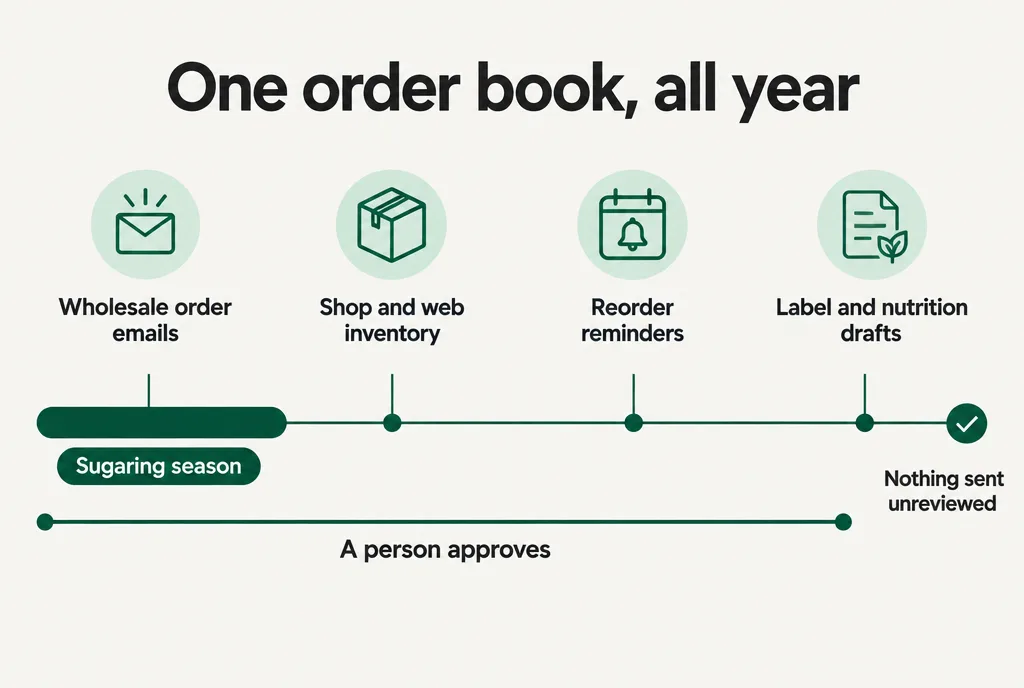
- Wholesale orders by email, each in its own format. One sends a PDF purchase order, one types it into the body of the email, one replies to last year's invoice with "same again, plus two cases of pints".
- Inventory split three ways between the farm store shelf, the web shop and whatever's in the back room, counted by whoever remembers to.
- Reorders that slip. The general store that usually orders in October didn't, and nobody noticed until December.
- Labels and nutrition paperwork, drafted from scratch each time you add a size or a new product like maple cream or sugar.
If that paperwork eats six hours a week in a normal month, it doesn't shrink during sugaring. It just goes undone.
What AI is actually good at here
None of these jobs needs a new system. They need something that reads what arrives, puts it in one place, and drafts the reply.
Reading order emails into one list
An AI agent can read each wholesale email or attached PO, however it's written, and turn it into the same few fields: customer, product, grade, size, quantity, requested ship date. Every order lands in one list, whatever shape it arrived in. It flags anything unclear, like "same as last time" when last time was two different orders, instead of guessing.
Keeping one inventory count
If your farm store and web shop keep separate counts, the agent can reconcile them against what's been ordered and shipped and tell you where they disagree. It can warn you when a size is running low on the web shop before someone orders a jug you don't have.
Nudging the accounts that usually reorder
From your own order history, an agent can spot the accounts that normally reorder around now and haven't. It drafts a short, friendly note in your voice ("We're about to start boiling, can we put you down for your usual?") and puts it in front of you to send or not.
Drafting label and nutrition paperwork
When you add a new size or product, an assistant can draft the label copy and pull together the ingredient and nutrition information you already have into the format you need, from your previous labels and your own notes. It can also make a checklist of what the label needs to show. It drafts; it doesn't decide what's compliant. Food labeling rules, including when small producers are exempt from nutrition facts, are specific, and they change. Your final label should be checked against the current rules or by someone who knows them.
Where you stay in charge
Across all of this, the rule is simple. The agent reads, sorts and drafts. A person approves anything that commits you to a customer or goes on a jar.
| The agent can | A person decides |
|---|---|
| Turn an order email into a line in the order list | Whether you can fill it, and when |
| Draft a reply confirming the order | Sending it |
| Flag an account that hasn't reordered | Whether to reach out, and what to offer |
| Draft label and nutrition copy | What's printed and whether it meets the rules |
| Warn that a grade or size is running low | Whether to hold stock back for wholesale |
That last row matters in a short-crop year. If the season comes in light, deciding who gets the dark syrup is a judgment about relationships, not a sorting problem. An agent can show you who ordered what last year. It shouldn't be the one to tell a fifteen-year customer you're out.
Pricing stays with you too. The agent can put last year's order next to this year's request, but what you charge a wholesale account is your call.
Why February is the time
It's tempting to leave this until the season's over. We'd suggest the opposite, for one practical reason: the weeks before the sap runs are the last quiet stretch you'll get until after Maple Weekend. Setting up an agent to read order emails takes a few sessions of showing it real examples and checking what it produces. That's much easier at a kitchen table in February than in a steaming sugarhouse in March.
We'd start by mapping your order book with you: where each kind of order comes from, who touches it, and where it tends to go wrong. On a discovery call we put that on one page in Workmap, with every step marked as yours or the agent's, and a one-sentence rule for each approval. The build follows the map.
A narrow first job to try
For a sugarhouse or small food producer, we'd start with reading wholesale order emails into a single order list, and nothing more. No replies sent, no inventory changes, no labels. Just every PO, however it arrived, turned into the same row in a spreadsheet you already use, with anything unclear flagged for you.
Run it for the rest of February on real orders. Check each row against the email. When you trust it, add drafted confirmations for you to send. Reorder nudges and inventory come after the season, when you have time to look at them properly. If you'd like to build the habit yourself first, a short team training session covers exactly this kind of email-to-list work; if you'd rather have it built, that's our custom agents work.
If the order book is already stacking up before the first boil, book a planning call and we'll look at it with you.