
It's a Saturday in late April and you've got three showings in Goffstown, an open house in Bedford, and a phone that has buzzed eleven times since breakfast. Four of those messages ask what the property taxes are on the Colonial you listed Tuesday. The taxes are on page two of the listing packet. You answered the same question twice yesterday.
Spring is when New Hampshire real estate earns its year. The snow's gone, the mud is mostly gone, and buyers who waited all winter move at once. The work that piles up isn't the selling. It's the repeating.
Where the hours actually go in April
Ask most independent agents where their week disappears and the answer isn't showings or negotiation. It's the layer of routine writing and chasing around them:
- Listing descriptions. You walked the house, took notes on your phone and shot sixty photos. Now you need 200 good words by tonight.
- Buyer questions. Taxes, lot size, heating fuel, well or town water, septic or sewer, the age of the roof, whether the basement has ever had water, what the HOA covers. Most of the answers are already in the packet.
- Transaction housekeeping. Inspection deadlines, financing commitment dates, appraisal, the closing date, and the lender, attorney and inspector who each need a nudge.
If those three together eat ten or twelve hours a week in the spring rush, that's an illustration, but the shape will probably feel familiar. And none of it is the part of the job you got licensed to do.
What AI is actually good at here
A first draft from your notes and photos
A language model is a capable first-draft writer when you give it real material. Hand it your walkthrough notes ("sunporch faces west, wide pine floors in the front rooms, boiler replaced a few years ago, stone wall along the back line") and the photos, and it will produce a description in your voice, at the length the MLS wants.
It won't be perfect. It will be a draft you edit in five minutes instead of a blank box you stare at for thirty. The model writes from what you gave it; it should never add features you didn't mention. Tell it that plainly, and check that it listened.
Answering the routine questions from the packet
Most buyer questions have one factual answer that already sits in a document you control: the listing sheet, the tax card, the seller's disclosure, the HOA summary. An assistant grounded in that packet, and only that packet, can answer "what are the taxes?" or "is it on town sewer?" in seconds, with a pointer to where the answer came from.
The honest version of this tool says "I don't have that, I'll ask the agent" when the packet doesn't cover it. That line matters more than any clever answer.
Keeping the transaction checklist moving
Once a property is under agreement, the dates in the purchase and sales agreement become a checklist. An agent can hold that checklist, remind you three days before the inspection contingency runs out, and draft the "just checking in on the commitment letter" email to the lender. You read it, you send it.
This is quiet work, and it's the kind that prevents a missed deadline at the worst possible moment. It's also a good first project for a custom AI agent, because the job is narrow and the right answer is easy to check.
Where the licensee has to stay in charge
Real estate has more lines that software must not cross than most industries, and they're the same lines a good agent already watches.
Property condition and disclosures. "Has the basement ever flooded?" is not a routine question, even when the disclosure answers it. What gets said about condition, defects, water, radon, the septic or the well is a representation, and it belongs to the licensee. An assistant can find where the disclosure addresses it and draft a reply. A person reads it and decides what to send.
Fair-housing-sensitive questions. "Is it a good neighborhood for families?" "What are the schools like?" "Who lives on the street?" Buyers ask these all the time, and the answers can steer people in ways the fair housing rules forbid. The assistant should never try. Anything touching neighborhood character, demographics or who a home suits goes to you, unanswered. You already know how to handle these conversations; the software's job is to recognise them and step back.
Price, negotiation and advice. What the seller would take, whether to waive an inspection, whether an offer is strong: that's judgment, and it's yours.
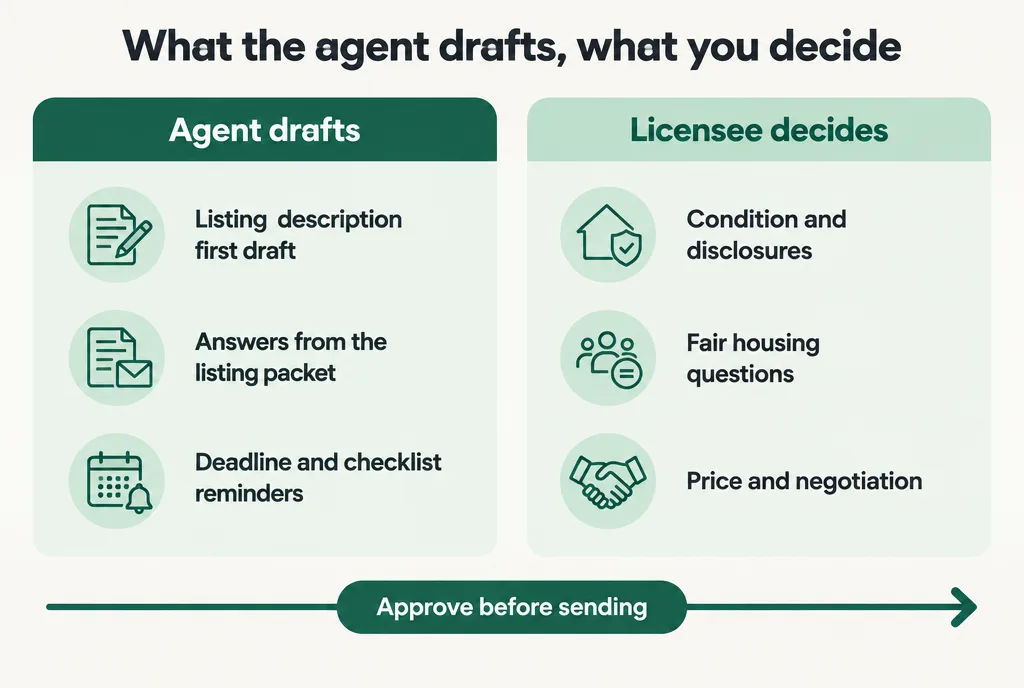
Anything that leaves the building. In the setup we'd build, nothing reaches a buyer, a seller or another agent without a person approving it. The agent drafts, looks up and pre-fills. You press send.
A note on your clients' information
Listing packets, pre-approval letters and signed agreements carry personal and financial details. Before any of it goes into an AI tool, know where that tool keeps it and who can see it. Consumer chat apps are fine for polishing a paragraph about wide pine floors; they're the wrong home for a buyer's pre-approval letter.
This is the kind of boundary we set with teams in AI Cowork training: what goes in, what never does, and how to check what comes out.
Three jobs, ranked by how safe they are to start with
| Job | Risk if it's wrong | Good first project? |
|---|---|---|
| Deadline reminders from the P&S dates | Low: you see every reminder | Yes |
| Listing description drafts | Low: you edit before it goes live | Yes |
| Answering buyer questions from the packet | Moderate: every answer is a statement to a buyer | After the first two, with approval on every reply |
Notice the pattern. The safest projects are the ones where the output comes to you first, not to a buyer.
A small first step for this spring
Start with the transaction checklist. Take the three deals you have under agreement right now, list every date and every party, and have an assistant hold them: a morning summary of what's due this week, and a drafted nudge for each person who owes you something. You approve and send each one.
Run it through May. If it saves you a Sunday night of calendar-checking and catches one deadline you'd have caught late, move on to listing drafts, then to packet questions with you approving every reply.
When we map a workflow like this on a first call, we write down which steps the agent handles and the one-sentence rule for each approval, such as "the licensee approves any reply that mentions condition". You can see how that works on the Workmap page.
If you'd like to talk through which part of your spring to start with, book a planning call.