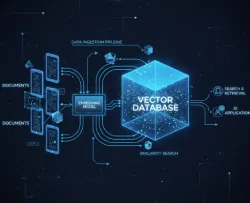
Two years ago, the AI engineering world lost its collective mind over vector databases. Pinecone raised a $100M round, Weaviate went open-source viral, and every startup pitch deck had some variation of “Chroma + OpenAI embeddings = solved forever.”
Fast-forward to 2025, and the sober reality has arrived exactly as the more battle-scarred practitioners predicted: slapping a vector database under an LLM with naive retrieval-augmented generation (RAG) is necessary… but nowhere near sufficient for production-grade performance.
At T10 Consulting, we learned this the expensive way — by shipping real systems for real enterprises and watching supposedly “state-of-the-art” vector-only RAG crumble under basic real-world requirements.
Our Wake-Up Call: asknb.t10.net
In early 2025 we launched asknb.t10.net — a public-facing chatbot that lets anyone query everything we’ve ever published: blog posts, case studies, pitch decks, internal wikis, even Slack threads.
The naive v1 architecture was textbook 2024:
- Chunk all content → OpenAI text-embedding-3-large → Pinecone
- User asks question → retrieve top-k chunks → stuff into GPT-4 context → profit
Result? It hallucinated confidently, missed obvious answers that were literally in our docs, and completely failed on anything requiring multi-hop reasoning (e.g., “Which clients used CrewAI agents with a knowledge graph backend?”).
So we did what any self-respecting engineering team does: we layered on a knowledge graph.
The difference was night and day.
Why Vector-Only RAG Collapses at Enterprise Scale
-
Relationships vanish in high-dimensional space
Embeddings are brilliant at semantic similarity but terrible at preserving explicit relationships. Two documents can be semantically close yet contradict each other on a critical entity relationship (pricing, ownership, timeline). Vector search will happily return both. -
The “lost in the middle” problem is unsolvable with pure cosine similarity
Research from Liu et al. (2024) confirmed what we already felt in production: LLMs pay dramatically less attention to documents buried in the middle of retrieved context. Re-ranking helps marginally; structural awareness helps completely. -
Entity disambiguation is basically impossible
Try asking “What did Apple announce last week?” when your knowledge base contains Apple the company, Apple the internal codename at three different clients, and actual fruit-related content from a grocery client. Vector search alone will drown you in noise. -
Recency, authority, and provenance get flattened
A random Slack message from an intern and an official signed contract become indistinguishable 1536-dimensional points.
The Hybrid Architecture That Actually Works
Here’s the stack we now ship to every enterprise client at T10:
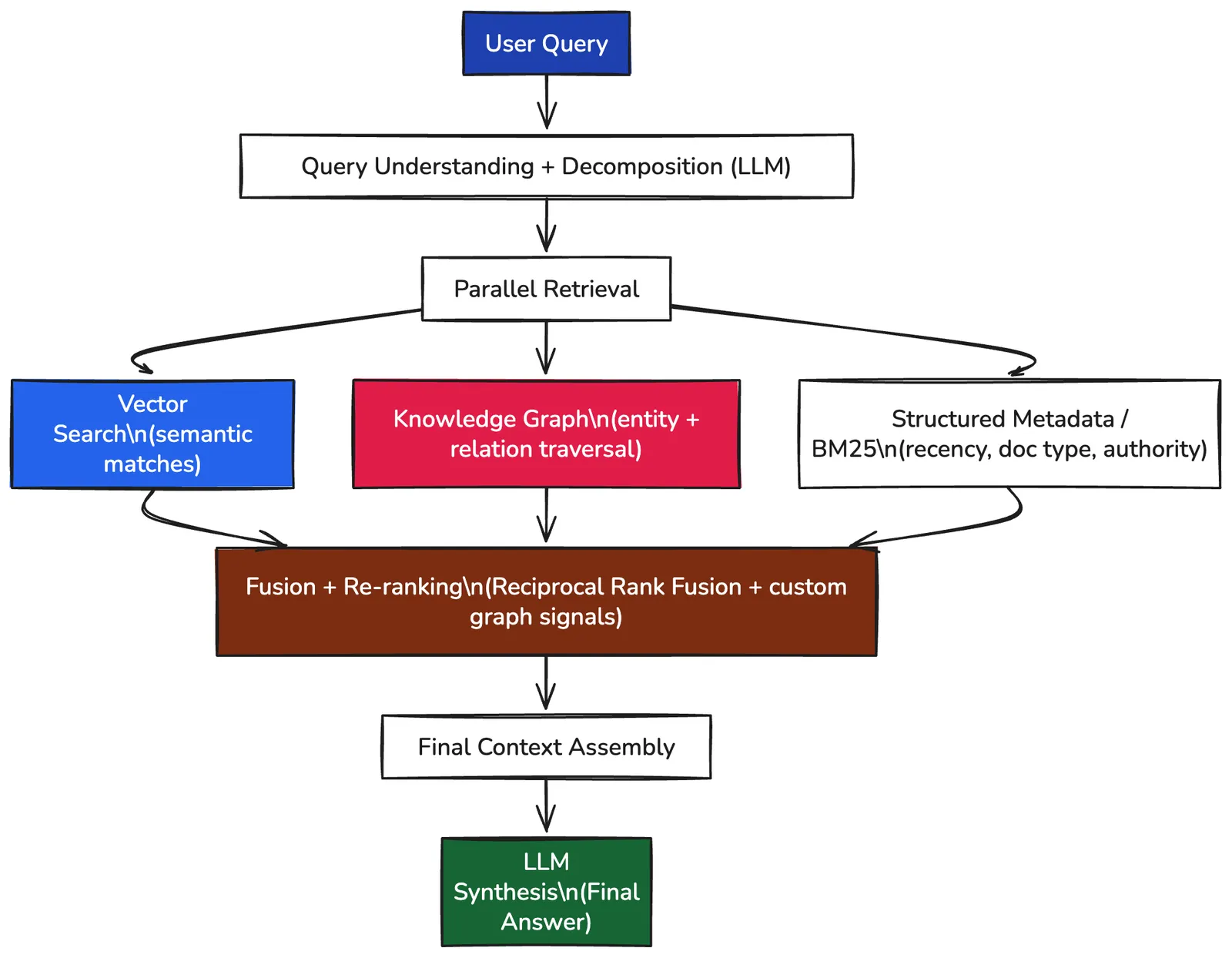
The knowledge graph (usually Neo4j or Memgraph, sometimes Amazon Neptune) becomes the source of truth for:
- Entities (Client X, Project Y, Technology Z)
- Relations (Client X → engaged → T10 in 2024-Q3, Project Y → uses → CrewAI + KG-RAG)
- Provenance & lifecycle (document authored by, approved by, expires on)
This lets us do things that are literally impossible with vectors alone:
- “Show me every automotive client where we deployed multi-agent systems after January 2024”
- “Which insurance carriers are still on the legacy LangGraph implementation vs. the new CrewAI + KG version?”
- “Compare the architecture we proposed to Prudential vs. the one we actually shipped to Allstate”
Real Numbers from asknb.t10.net
Before knowledge graph (vector-only):
- Answer accuracy (human eval): ~61%
- Hallucination rate: 28%
- “Unable to answer” (refusal): 11%
After adding knowledge graph + hybrid retrieval:
- Answer accuracy: 94%
- Hallucination rate: <4%
- Refusals: <1%
That’s not incremental improvement. That’s the difference between a toy demo and something you can put in front of paying customers.
The New Standard in 2025
The industry is quietly converging on what we’ve been preaching (and shipping) for 18 months:
- Vector databases are still mandatory — they’re unbeatable for fuzzy semantic retrieval.
- Knowledge graphs are no longer “nice-to-have” — they’re table stakes for anything beyond simple FAQ bots.
- Hybrid retrieval (vector + graph + metadata) is the minimum viable architecture for enterprise.
Companies that raised $200M telling you “just use our vector DB” are now quietly adding graph layers themselves (look at the recent Pinecone + Neo4j partnership announcements if you want a laugh).
The Bottom Line
If you’re still building RAG systems in 2025 with nothing but a vector database and a dream, you’re already behind.
The winners aren’t the ones who adopted vector databases fastest two years ago.
The winners are the ones who recognized the limitations fastest — and built the hybrid systems required to actually deliver reliable, auditable, enterprise-grade AI applications.
At T10, we stopped treating vector databases as the destination. We started treating them as one essential tool among many.
The “shiny object” phase is over.
Welcome to the sober, graph-augmented future.