Why Context-Aware Chunking Matters
Retrieval-Augmented Generation (RAG) systems have become foundational in enterprise AI, powering everything from internal knowledge assistants to regulatory compliance tools. But even the most advanced RAG pipelines face a common challenge: how to split large documents into manageable pieces without losing context.
Enter Context-Aware Chunking — also known as Contextual Chunking — a smarter, structure-preserving strategy that transforms how LLMs like GPT-4 and GPT-5 process and retrieve knowledge.
“Chunking is no longer just about size—it’s about meaning.” —Some smart person somewhere..
From Fixed to Contextual: The Evolution of Chunking
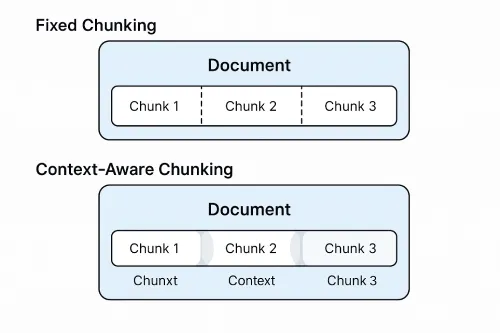
Traditional RAG setups rely on fixed-size chunking, breaking text every 500–1,000 tokens. While simple, this approach often slices through sentences or tables, disrupting the semantic flow and reducing retrieval accuracy.
Context-Aware Chunking solves this by using embedding-based boundary detection to identify where one idea ends and another begins. Instead of arbitrary splits, it maintains semantic integrity—ensuring that related concepts stay together.
How It Works: The Anatomy of Context-Aware Chunking
-
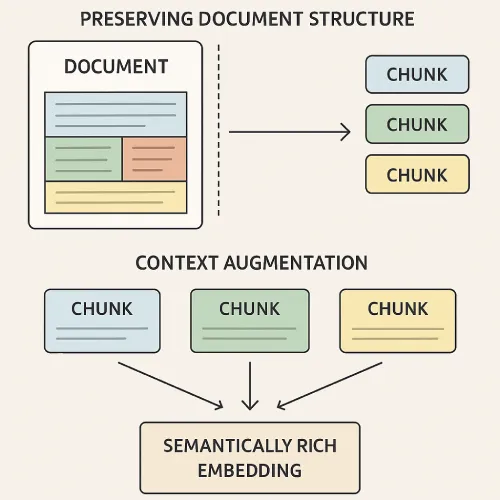
Preserving Document Structure Embedding models analyze sentence similarity to find natural breakpoints (e.g., section headers, paragraph ends). This ensures each chunk represents a complete thought rather than a fragment.
-
Context Augmentation Each chunk is enriched with summaries or embeddings of neighboring chunks, creating richer, contextually aware vectors that enhance retrieval performance.
-
Hybrid and Content-Aware Extensions
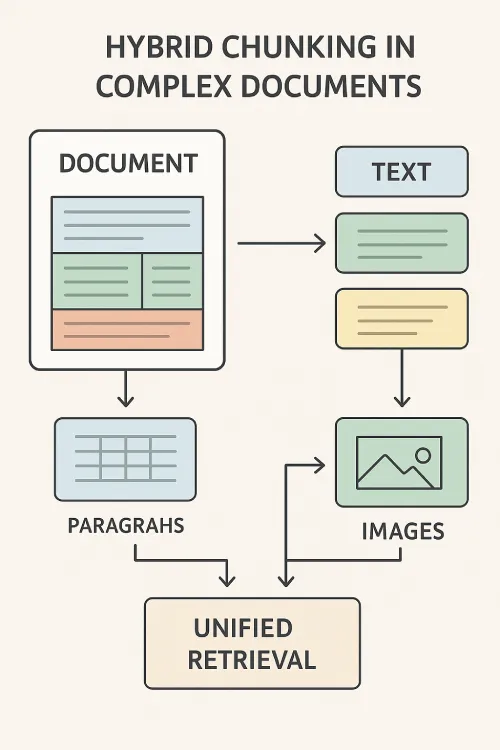
- Hybrid Chunking combines techniques—splitting narrative text by paragraphs while treating tables and images separately.
- Content-Aware Chunking adapts based on document type, ideal for technical manuals or mixed-format datasets.
In Practice: ContextualRetriever and Conversational RAG
At T10 Consulting, our RAG architectures go beyond static document retrieval. For conversational search, we use a specialized retriever—ContextualRetriever—that encodes the entire dialogue history before selectively extracting embeddings from the current query.
This ensures that when a user asks, “What was the previous compliance update?” the system understands what came before without being overwhelmed by irrelevant context.
The Trade-offs: Complexity vs. Clarity
While context-aware methods deliver higher semantic accuracy, they also come with higher implementation complexity. Compared to fixed-size chunking, these methods require:
- Additional embedding passes
- Boundary detection models
- Context-weighted indexing strategies
However, the ROI is clear: up to 60% fewer irrelevant retrievals in enterprise-scale deployments, according to our benchmarking at T10.
T10’s Implementation Philosophy
At T10 Consulting, context-aware chunking is part of our larger strategy for intelligent retrieval optimization within AI-native systems. By integrating it with hybrid vector-graph indexing (GraphRAG) and secure data pipelines, we deliver RAG implementations that are:
- Context-grounded: preserving document meaning
- Compliance-ready: aligned with GDPR and internal governance
- Scalable: capable of handling 2025-scale enterprise knowledge graphs