In the rapidly evolving world of AI, terms like "agentic AI" are buzzing everywhere. Recently, Femke Plantinga, Growth Lead at Weaviate, shared an insightful post on X clarifying the often-confused concepts of agentic architectures and agentic workflows. At T10 Consulting, where we specialize in AI engineering solutions such as AI agents, N8N workflows, and Retrieval-Augmented Generation (RAG) implementations, we couldn't agree more with her breakdown. Understanding this distinction is crucial for building efficient, scalable AI systems that drive real business value.
Let's dive into the key points from Femke's post and explore how T10 leverages these concepts to empower companies with cutting-edge AI solutions.
The Core Distinction: Workflows vs. Architectures
As Femke aptly points out, while people often use "agentic architectures" and "agentic workflows" interchangeably, they represent different layers of AI system design:
-
Agentic Workflows: These focus on the "what" – the sequence of steps an AI agent follows to accomplish a goal. Think of it as a recipe: planning, task decomposition, tool usage (e.g., web searches or data retrieval), reflection, and iteration. For instance, in a customer support scenario, the workflow might involve analyzing a query, retrieving relevant knowledge, generating a response, and refining based on feedback.
-
Agentic Architectures: This is the "how" – the underlying technical structure that enables the workflow. It includes components like one or more AI agents with decision-making abilities, integrated tools, and memory systems (short-term for immediate context and long-term for persistent knowledge). Architectures can vary from simple single-agent setups to complex multi-agent systems, allowing flexibility in implementation.
Why does this matter? The same workflow can be executed across different architectures, much like cooking the same dish in various kitchens. This modularity allows for optimization based on specific needs, such as scalability or cost-efficiency.
At T10, we design agentic systems that align workflows with robust architectures, ensuring seamless integration into your enterprise environment.
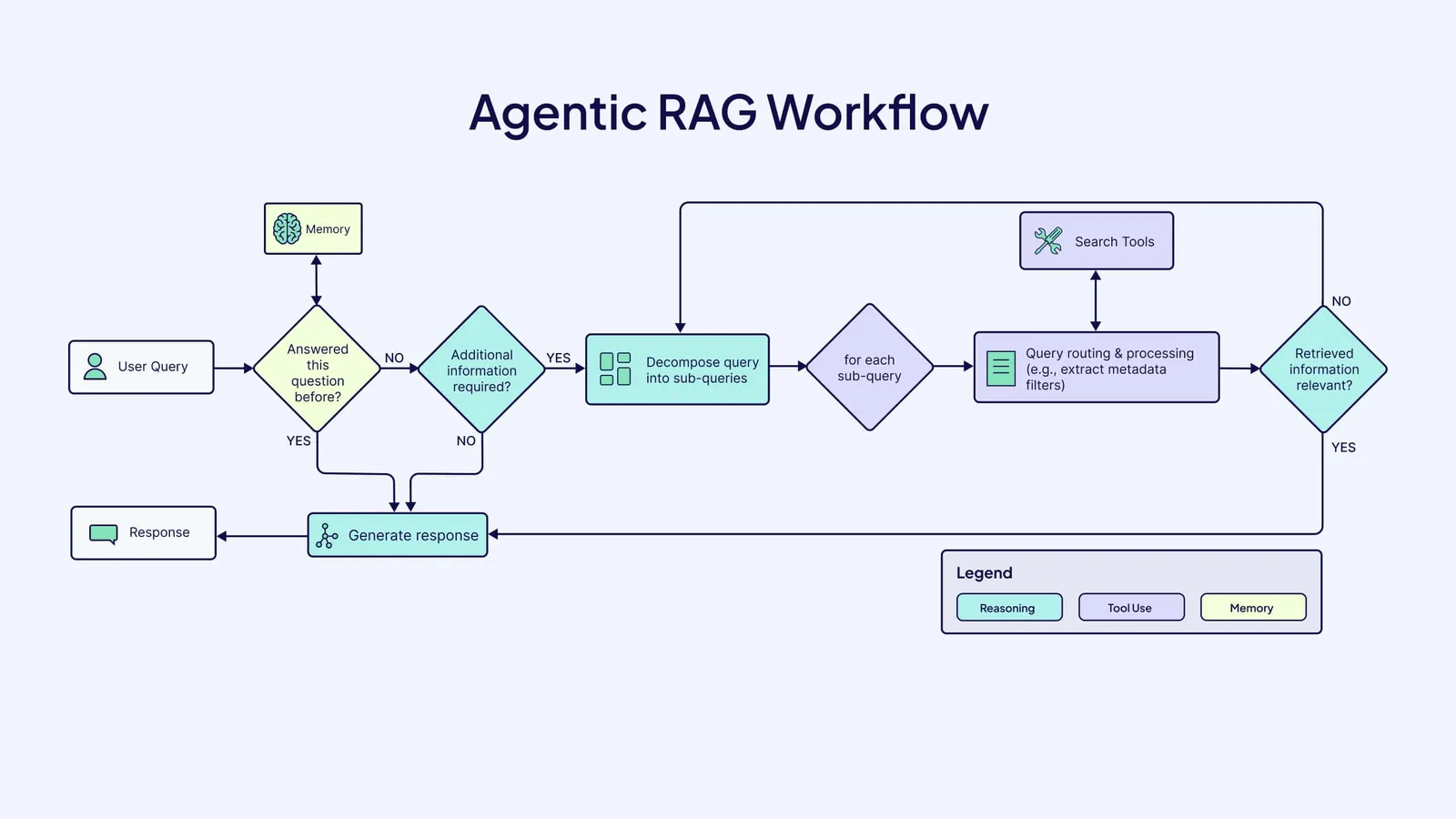
An example of an Agentic RAG Workflow, illustrating how AI agents decompose queries, retrieve information, and generate responses.
Real-World Applications: Agentic RAG as a Prime Example
One standout example from Femke's post is the agentic RAG workflow. RAG enhances AI models by combining retrieval from external data sources with generation, reducing hallucinations and improving accuracy. In an agentic context, this workflow becomes dynamic:
- Query Decomposition: Break down complex user queries into sub-tasks.
- Retrieval and Processing: Use tools to fetch and filter relevant data, often incorporating metadata for precision.
- Reasoning and Response: The agent reflects on retrieved information, iterates if needed, and generates a final output.
This can be implemented via a single-agent architecture for straightforward tasks or a multi-agent setup for collaborative problem-solving, where specialized agents handle retrieval, analysis, and synthesis.
At T10, we've implemented similar agentic RAG systems for clients in industries like finance and healthcare. Using tools like N8N for orchestrating workflows, we create automated pipelines that integrate LLMs with vector databases (e.g., Weaviate or Pinecone) for real-time data retrieval. Our AI agents are built to handle memory persistence, ensuring context is maintained across sessions – perfect for long-running processes like personalized recommendations or compliance checks.
Why T10 Consulting is Your Partner in Agentic AI
Understanding the interplay between workflows and architectures isn't just academic; it's key to unlocking AI's potential without unnecessary complexity. As Femke notes, this clarity helps in designing flexible systems and communicating effectively about builds.
At T10, our enterprise architects specialize in tailoring these elements to your business:
- AI Agents: Custom agents that autonomously handle tasks, from data analysis to decision support.
- N8N Workflows: Low-code automation for agentic processes, integrating APIs, databases, and ML models.
- RAG Implementations: Advanced retrieval systems that make your AI smarter and more reliable.
Whether you're excited about implementing agentic workflows for supply chain optimization or multi-agent architectures for collaborative AI in R&D, T10 can guide you through the process.
Inspired by Femke Plantinga's X post. Check out her recommended resources: Agentic Architectures free eBook and related blog posts for deeper dives.