As an enterprise architect specializing in AI engineering, I've spent considerable time evaluating frameworks that help organizations integrate intelligent systems into their operations. Recently, I came across a thought-provoking paper titled "Context Engineering 2.0: The Context of Context Engineering" by Qishuo Hua and colleagues from SJTU, SII, and GAIR. Published on October 30, 2025, this work provides a comprehensive lens on how machines process and utilize context to better align with human intent. It's particularly relevant for enterprises deploying AI agents, retrieval-augmented generation (RAG) systems, or workflows like those in N8N, where understanding situational nuances can make or break efficiency.
The paper argues that context engineering isn't a new fad tied to large language models (LLMs) but a practice dating back over two decades, evolving alongside machine intelligence. It frames context as the "ensemble of relations" shaping interactions, drawing from Karl Marx's ideas but applying them to human-machine dynamics. By reducing information entropy—transforming vague, high-entropy human inputs into structured, low-entropy formats—context engineering bridges the cognitive gap between carbon-based (human) and silicon-based intelligence.
In this post, I'll break down the paper's key insights, offering practical takeaways for enterprise AI implementations. My goal is to serve as a trusted advisor, helping you assess how these concepts might refine your systems without overhyping any specific tools or services.
A Historical Perspective: From Primitive Computers to Superintelligent Agents
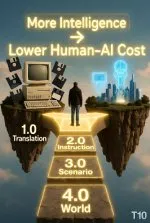
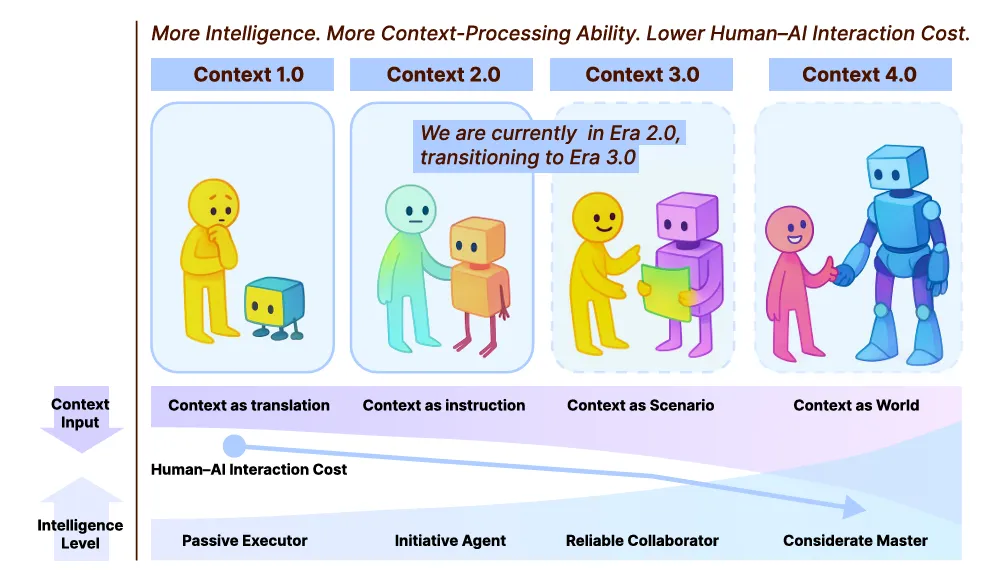
The authors trace context engineering through four eras, each tied to advancing machine intelligence levels. This progression illustrates how greater AI capabilities reduce the "cost" of human-AI interaction—less explicit guidance needed from users.
| Era | Intelligence Level | Context Role | Key Characteristics | Human-AI Interaction Cost |
|---|---|---|---|---|
| 1.0 (1990s–2020) | Passive Executor | Translation (structured inputs) | Ubiquitous computing, sensor-based systems; rigid formats like menus or rules. | High—humans adapt to machines via explicit, low-entropy inputs. |
| 2.0 (2020–Present) | Initiative Agent | Instruction (natural language) | LLMs and agents; handles ambiguity via prompts, RAG, tool calling. | Medium—machines infer intent from conversational inputs. |
| 3.0 (Future) | Reliable Collaborator | Scenario (multimodal, nuanced) | Human-level understanding; senses emotions, social cues. | Low—seamless collaboration like peers. |
| 4.0 (Speculative) | Considerate Master | World (proactive construction) | Superhuman insight; anticipates unstated needs, inverts roles. | Minimal—machines guide humans, revealing hidden intents. |
We're currently in Era 2.0, transitioning to 3.0, where agents like those in LangChain or AutoGPT interpret natural language but still require careful prompting. The paper contrasts Era 1.0's rule-based systems (e.g., Context Toolkit from 1999) with today's agentic designs, emphasizing how LLMs tolerate higher-entropy inputs like free-form text.
From an enterprise standpoint, this evolution underscores why early HCI principles remain relevant. For instance, when implementing RAG in a knowledge management system, drawing from Era 1.0's sensor fusion techniques can enhance multimodal data integration, ensuring agents don't just react but anticipate based on historical patterns.
Theoretical Foundations: Defining and Staging Context
The paper formalizes context as any information characterizing entities relevant to a user-application interaction. Entities include users, environments, tools, and memory modules; context aggregates their characterizations (e.g., user prompts, system configs, session history).
Context engineering is then defined as optimizing this information's collection, storage, management, and usage to boost machine performance. Mathematically, it's a function transforming raw context (C) for a task (T) into an optimized form via operations like compression or abstraction.
This framework is entropy-centric: Humans naturally reduce entropy in communication through shared knowledge; machines need engineered help. As AI intelligence grows, less preprocessing is required, lowering interaction costs.
For practical application, consider an N8N workflow automating customer support. Here, context engineering involves defining entities (e.g., user query, CRM data) and applying operations like RAG retrieval to create low-entropy inputs for the agent, ensuring accurate responses without overwhelming the model.
Core Practices: Collection, Management, and Usage
The bulk of the paper dives into design considerations across three pillars, comparing Eras 1.0–2.0 with future outlooks.
Context Collection and Storage
Early systems relied on single-device sensors (e.g., GPS, keyboards); today, it's distributed across smartphones, wearables, and cloud APIs, capturing multimodal data like text, images, and biometrics.
Key principles:
- Minimal Sufficiency: Collect only what's needed for the task—value in relevance, not volume.
- Semantic Continuity: Preserve meaning over raw data continuity.
In Era 2.0, storage uses layered architectures: short-term (e.g., in-memory caches) for fast access, long-term (e.g., SQLite, cloud databases) for persistence. For lifelong context in Era 3.0+, expect unified digital memories with human-like "forgetting" and "recalling."
Advice: In enterprise RAG setups, adopt hybrid storage—local for low-latency queries, cloud for scalability—to balance cost and performance. Tools like vector databases (e.g., for embeddings) align well with semantic continuity.
Context Management
This encompasses processing textual/multimodal inputs, organization, and abstraction.
- Textual Processing: Strategies include timestamping, functional tagging, QA compression, or hierarchical notes. Trade-offs: Timestamps are simple but lack semantics; hierarchies aid reasoning but risk rigidity.
- Multimodal Processing: Map inputs to shared vector spaces, combine via self-attention, or use cross-attention (e.g., in Qwen2-VL). Challenges: Heterogeneity across modalities; future needs flexible integration like the human brain.
- Organization: Layered memory (short-term vs. long-term) with transfer functions; context isolation via subagents (e.g., Claude Code) to prevent pollution.
- Abstraction ("Self-Baking"): Compress raw context into summaries, schemas, or vectors for scalability. Hierarchical memory is key, evolving from raw storage to semantic graphs.
In AI agents, this means using subagents for modular tasks—e.g., one for planning, another for execution—to manage context without bloating the primary window.
Context Usage
Focuses on sharing, selection, inference, and lifelong handling.
- Intra-System Sharing: Embed in prompts, exchange structured messages, or use shared memory (e.g., graphs in G-Memory).
- Cross-System Sharing: Adapters for format conversion or shared representations like JSON/APIs.
- Selection: Factors like semantic relevance (vector search), logical dependency, recency. Strategies: RAG with reranking.
- Proactive Inference: Learn preferences from history; infer goals from query sequences; offer help on detected struggles.
- Lifelong Preservation: Challenges include storage bottlenecks, processing degradation, instability, evaluation. Future: Semantic OS for dynamic memory.
For workflows, proactive inference can automate escalations in support agents, inferring urgency from patterns without explicit flags.
Real-World Applications
The paper highlights CLI tools, deep research agents, and BCIs as exemplars.
- CLI (e.g., Gemini CLI): Uses file hierarchies for context inheritance; compresses histories into summaries.
- Deep Research (e.g., Tongyi DeepResearch): Cycles through search-extract-generate; compresses histories to handle long horizons.
- BCIs: Capture neural signals for richer, implicit context—attention, emotions—though noisy and underdeveloped.
These align with enterprise needs: CLIs for dev tools, research agents for analytics, BCIs for future immersive interfaces.
Challenges and Pathways Forward
Key hurdles:
- Inefficient collection—shift to multimodal, proactive methods.
- Scalable storage/management for lifelong context.
- Model limitations in understanding complex/multimodal inputs.
- Performance with long contexts (e.g., quadratic attention).
- Precise selection amid noise.
Future directions: Brain-like architectures, semantic OS for memory, better evaluation frameworks.
As an advisor, I recommend starting with audits: Map your AI systems' context flows, identify entropy hotspots (e.g., vague prompts), and prototype abstractions like hierarchical memory in RAG. This can yield measurable gains in agent reliability without massive overhauls.
Wrapping Up
"Context Engineering 2.0" reminds us that effective AI isn't just about model size—it's about intelligently curating the information they process. By viewing context as a bridge across intelligence eras, enterprises can design more adaptive systems. If you're building AI agents or workflows, this framework offers a solid foundation to evaluate and iterate. Feel free to reach out for tailored guidance on implementation.