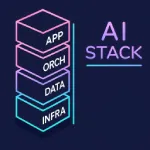
Why the AI Stack Matters
Inspired by the IBM Expert Insights video “The AI Stack Explained”
AI systems today are capable of remarkable things — generating content, analyzing data, even reasoning across complex domains. But when the goal is to build AI that solves real-world problems, success depends on more than just choosing a powerful model.
At T10 Consulting, we approach AI as an engineering discipline — one that requires balance between architecture, infrastructure, data, and design. Whether you’re building a prototype or scaling a production-grade system, understanding the full AI technology stack is essential to creating solutions that are reliable, explainable, and sustainable.
1. Infrastructure: The Foundation of Intelligent Systems
Every AI project begins with infrastructure — the compute environment that determines how fast, scalable, and cost-effective your solution can be.
Large Language Models (LLMs) often require specialized GPU-based hardware, and deployment options vary:
- On-premise, for organizations that need full control and compliance.
- Cloud, for flexibility and elastic scaling.
- Local or edge, for lightweight inference close to the user or device.
Good infrastructure design isn’t just about performance — it’s about matching technical choices to business realities, from data governance to sustainability.
2. Models: Choosing the Right Intelligence for the Job
The model layer defines the cognitive core of your system. With thousands of models now available — open-source and proprietary, large and small — model selection is a strategic decision.
Key factors to consider:
- Model size and specialization: Larger isn’t always better; smaller models can excel when tuned for specific domains.
- Open vs. proprietary: Open models allow transparency and control; proprietary models can offer performance or security advantages.
- Fine-tuning and evaluation: Aligning the model’s reasoning with your data and goals is critical for reliability.
At T10, we emphasize model fit over model hype — helping teams choose architectures that perform well in context, not just in benchmarks.
3. Data: The Fuel That Keeps AI Relevant
AI models learn from data, but they also age with it. Since most foundation models have a knowledge cutoff, they require additional data layers to stay current.
This is where the data layer of the AI stack comes in:
- Data sources: Documents, APIs, or databases that provide updated or domain-specific information.
- Pipelines: Pre- and post-processing flows that clean, structure, and optimize data.
- Vector databases and retrieval systems (RAG): Tools that let AI systems reference external knowledge efficiently.
We often recommend Retrieval-Augmented Generation (RAG) and emerging hybrids like GraphRAG to ensure your AI remains grounded in truth and contextually aware.
4. Orchestration: Turning Intelligence into Process
Most valuable AI systems don’t stop at generating an answer — they reason, plan, and act. The orchestration layer coordinates this process.
This layer handles:
- Task decomposition: Breaking complex user requests into manageable steps.
- Reasoning and tool use: Allowing the AI to plan and execute actions.
- Review and refinement: Enabling self-critique and feedback loops for quality control.
Modern orchestration frameworks like LangChain, CrewAI, and N8N make it possible to design AI workflows that behave more like teams than tools.
5. Application: Where AI Meets People
At the top of the stack sits the application layer — the interface between human users and AI systems.
While text-based chat is common, effective AI solutions often include:
- Multimodal inputs: Combining text, image, audio, or numerical data.
- Revision and transparency features: Giving users control over outputs.
- Integrations: Embedding AI directly into enterprise systems or workflows.
This is where usability and trust converge. The goal isn’t just to make AI accessible — it’s to make it accountable and useful in daily work.
Designing the AI Stack Thoughtfully
Understanding the interplay between infrastructure, models, data, orchestration, and application layers helps organizations make better architectural choices. It’s the difference between an AI system that merely generates responses — and one that reasons, retrieves, and adapts to your domain.
At T10, we believe that thoughtful architecture is what turns AI from experimentation into impact. Our role is to help teams design systems that are technically sound, ethically grounded, and aligned with their long-term strategy.