How a standby generator works
When a tree takes down the line, a standby generator has the house running again in seconds. Cut the power and watch the transfer switch do its job, decide what the generator has to carry, then break it the ways it fails in a storm.
Right now
- Utility power
- On
- Generator
- Ready, set to Auto
- Transfer switch
- On utility
- House
- Powered by the utility
- Load
- 6.5 kW of 22 kW
- Propane at this load
- About 7 days
What just happened
Cut the power or run the weekly exercise to start.
From dark to powered in about 15 seconds.
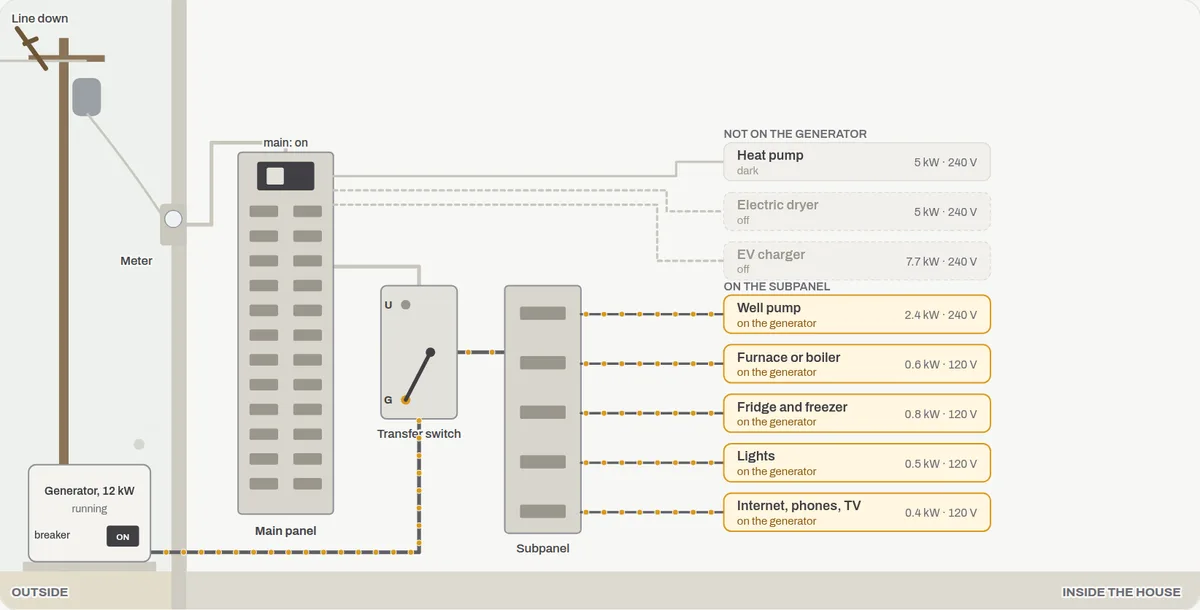
The automatic transfer switch runs the show. It watches the utility power, starts the generator, and makes sure the house is connected to one source or the other and never both. Feeding generator power back onto the utility's lines could electrocute a line worker fixing them.
- 0 s
Power fails
The transfer switch sees the utility voltage drop and starts counting.
- 3 s
Start signal
The outage is real, not a flicker, so the switch tells the generator to start.
- 5 s
Engine runs
The controller cranks the engine off the battery and it starts on propane or natural gas.
- 10–20 s
Power back
Once the engine is up to speed, the switch moves the house to the generator.
When the utility comes back, it runs in reverse: the switch waits a minute to be sure the power is steady, moves the house back, and the generator runs a little longer to cool down before it stops. Once a week it also starts itself for a short exercise run, which is how most owners find out about a problem before a storm does.
What does it have to run?
Lights, outlets, fridge and freezer
The basics. A few kilowatts.
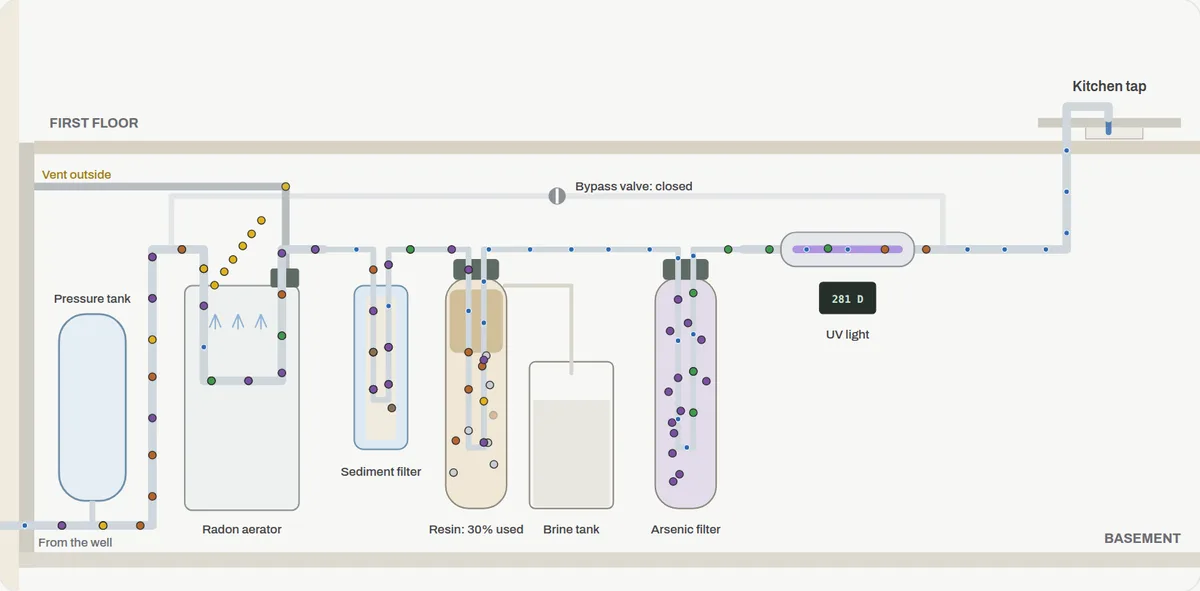
Well pump
No power means no water on a well, so it's always on the list. It also pulls a big surge for a moment as it starts.
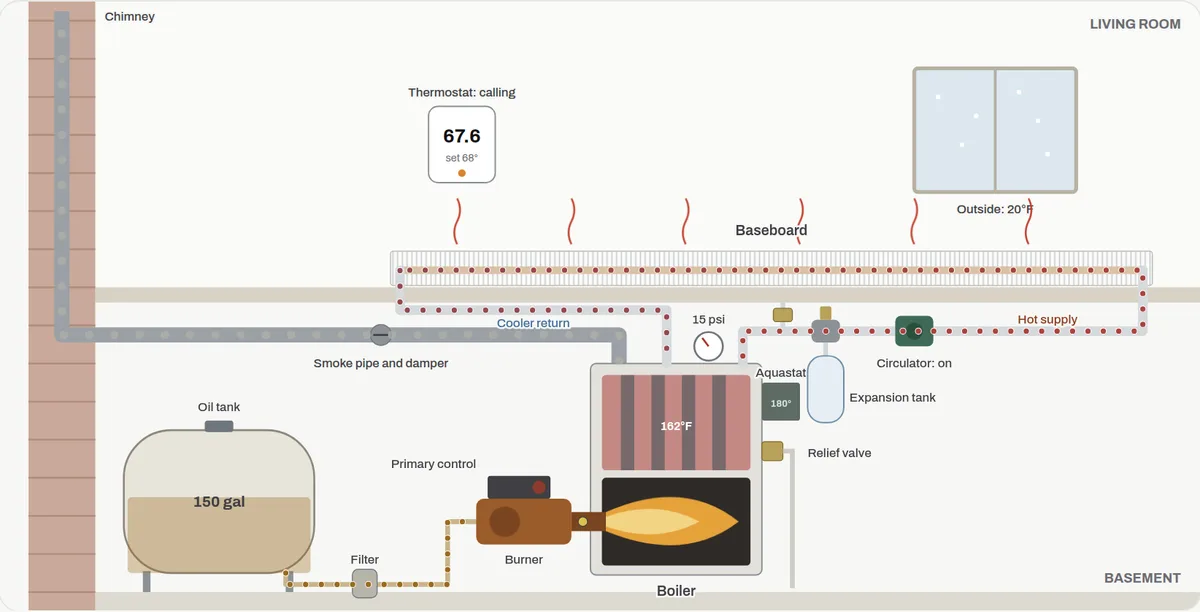
Boiler or furnace
The burner and circulators take little power, but nothing heats without them.
Heat pump, dryer, range, EV charger
The big loads. They decide whether a 14 kW unit is enough or it takes 22 kW or more, or a load manager that switches them off while the generator is carrying the house.
If you use a portable instead.
Run it outside, well away from the house, never in a garage or basement or on a porch near a window. Its exhaust carries carbon monoxide, which you can't see or smell, and every storm season people die from it. Keep a battery CO alarm on every floor.
Never plug a portable generator into a dryer outlet to power the house. Connect it through a transfer switch or a panel interlock an electrician has installed, so it can't send power back out onto the utility lines.
Six ways a generator lets you down in a storm.
Most of them show up on the controller's display or in the weekly exercise before the storm, if someone is looking. Pick one to watch it happen during an outage.
Weak battery
"The power went out and the generator didn't come on. There's a red light on it."
The generator starts from a 12-volt battery, like a car. It sits outside through every New Hampshire winter, and after three or four years it may not have enough left to turn a cold engine over. It's the most common reason a standby generator doesn't start.
Left switched to Off
"The generator didn't start in the storm, but there are no alarms on it."
After a service visit, a battery swap or a homeowner poking at it, the controller gets left in Off or Manual instead of Auto, or the generator's breaker is left open. Everything looks fine until the power goes out.
Low oil shutdown
"It ran all night and then just stopped. The display says something about oil."
Air-cooled generators burn some oil, and a long outage runs them for days. When the oil gets low the engine shuts itself down to avoid damage, usually hours into an outage, when the owner is counting on it most.
Propane runs low
"The generator died after two days. We just had the tank filled in the fall."
A generator in a long outage burns a lot of propane, several gallons an hour at a heavy load. With a small or low tank it runs dry partway through the outage, and in deep cold a low tank can't vaporize enough gas to keep up either.
Transfer switch doesn't transfer
"I can hear the generator running, but the house has no power."
The generator starts and runs, but the transfer switch never moves the house onto it. A failed control board, a blown fuse in the switch, or a problem with the control wires between the two can all cause it.
Too much load
"The generator comes on, then the power cuts out again whenever the heat pump starts."
A generator can only make so much power. If the heat pump, the well pump and the dryer all run on a 14 kW unit, the house asks for more than it can give, the generator's breaker trips, and the house goes dark. A load manager that sheds the big loads prevents it.
Where AI helps the office and the trucks.
A generator business is quiet until a storm, and then every customer calls on the same day. The work that pays off is done before that: batteries replaced, oil changed, alarms followed up. Software is good at keeping track of all of it.
Alarms that turn into work orders
Many newer generators report their alarms online. An agent reads an overcrank alarm, sees the battery is four years old, and drafts the battery swap for the office to schedule before the next storm.
Custom AI agentsStorm calls sorted in minutes
When a storm takes out half the county, the phones light up at once. Intake asks what the controller says and whether it's set to Auto. A generator switched to Off gets fixed on the phone, and the trucks go to the ones that won't start.
Custom AI agentsService plans that keep up
Oil changes, battery ages, run hours and last service dates by customer, with reminders that go out before storm season and visit notes drafted from the tech's photos.
AI Cowork training
This page shows a typical air-cooled home standby generator on propane with a whole-house automatic transfer switch, simplified for learning. Delays, loads and fuel use are typical values, not specifications for any model. Installing a generator and transfer switch takes a licensed electrician and a permit, and the gas connection a licensed gas fitter.