
The AI Pyramid: Unlocking Outcomes Through Data and Technology
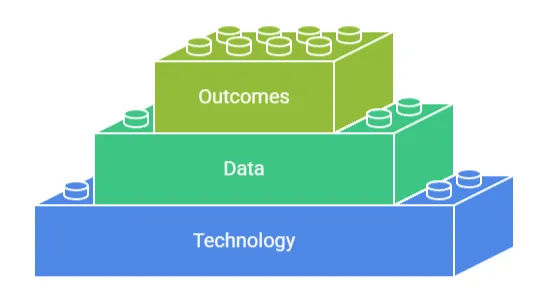
In the rapidly evolving world of artificial intelligence, it's easy to get lost in the hype surrounding cutting-edge models, massive datasets, and futuristic applications. But at its core, successful AI isn't about chasing the latest buzzword—it's about building a solid structure that delivers real value. That's where the concept of the AI Pyramid comes in. Imagine a pyramid with three key layers: Technology at the base, Data in the middle, and Outcomes at the pinnacle. To reach those desired outcomes—whether it's boosting business efficiency, solving complex problems, or driving innovation—you need data and technology working in harmony. Without one, the other falters, and the entire structure collapses.
In this blog post, I'll break down the AI Pyramid, explain each layer, and show how they interconnect to create meaningful AI success. Whether you're a business leader, developer, or AI enthusiast, understanding this framework can help you prioritize and strategize effectively.
The Foundation: Technology
At the bottom of the pyramid lies Technology, the sturdy base that supports everything above it. This layer encompasses the tools, infrastructure, and methodologies that make AI possible. Think of it as the hardware and software backbone:
-
Hardware: GPUs, TPUs, cloud computing resources, and specialized chips designed for parallel processing. Without powerful computing power, even the best algorithms would crawl at a snail's pace.
-
Software and Algorithms: Machine learning frameworks like TensorFlow or PyTorch, neural network architectures (e.g., transformers for language models), and optimization techniques. This is where the "intelligence" gets engineered.
-
Infrastructure: Scalable systems for training, deployment, and inference, including APIs, edge computing, and security protocols.
Technology is essential because it provides the raw capability to process information. However, on its own, it's like having a high-performance engine without fuel—it might look impressive, but it won't take you anywhere. That's why technology must be paired with the next layer to truly shine.
The Fuel: Data
Rising above technology is Data, the middle layer that acts as the lifeblood of AI systems. Data isn't just numbers and text; it's the raw material that trains models, refines predictions, and enables learning. High-quality, diverse, and abundant data is what separates mediocre AI from transformative ones.
-
Types of Data: Structured (like databases), unstructured (text, images, videos), and semi-structured (JSON, logs). In AI, variety matters—think sensor data for autonomous vehicles or user interactions for recommendation engines.
-
Data Management: Collection, cleaning, labeling, and storage. Tools like data pipelines and warehouses ensure data is accessible and ethical (e.g., anonymized to protect privacy).
-
Challenges: Issues like bias, scarcity, or poor quality can undermine AI. For instance, if your dataset is skewed, your model will perpetuate those flaws.
Data amplifies technology by providing context and patterns. A sophisticated algorithm trained on garbage data yields garbage results (the classic "garbage in, garbage out" principle). Conversely, even basic tech can produce decent outcomes with exceptional data. But to climb to the top of the pyramid, these two layers must integrate seamlessly—technology processes data efficiently, while data informs and evolves the technology.
The Pinnacle: Outcomes
At the top of the AI Pyramid sit Outcomes, the ultimate goal of any AI initiative. This is where the magic happens: tangible results that solve real-world problems, create value, and drive progress. Outcomes could be:
-
Business Gains: Increased revenue through personalized marketing, cost savings via predictive maintenance, or enhanced customer service with chatbots.
-
Societal Impact: Advancements in healthcare (e.g., early disease detection), environmental monitoring (e.g., climate modeling), or education (personalized learning paths).
-
Innovation: New products, like generative AI for content creation or autonomous systems for logistics.
Outcomes aren't accidental; they're the direct result of aligning technology and data strategically. For example, a company like Netflix uses advanced recommendation algorithms (technology) trained on vast user viewing histories (data) to achieve high engagement and retention (outcomes). If either base layer is weak—say, outdated tech or incomplete data—the outcomes suffer, leading to missed opportunities or failures.
Why the Pyramid Matters: Integration is Key
The beauty of the AI Pyramid lies in its interdependence. You can't skip layers or treat them in isolation. Technology without data is potential unrealized; data without technology is untapped knowledge; and pursuing outcomes without both is wishful thinking.
To build a strong pyramid:
- Start at the Base: Invest in robust technology that scales with your needs.
- Layer Wisely: Ensure data is relevant, ethical, and integrated into your tech stack.
- Aim High: Define clear outcomes from the outset and iterate based on feedback loops—use outcomes to refine data collection and upgrade technology.
In practice, this means adopting agile AI development: prototype with available tech and data, measure outcomes, and adjust. Tools like MLOps (Machine Learning Operations) help bridge these layers, ensuring smooth deployment and continuous improvement.
Conclusion: Building Your Own AI Pyramid
The AI Pyramid isn't just a theoretical model—it's a practical roadmap for anyone venturing into AI. By focusing on technology as the foundation, data as the enabler, and outcomes as the north star, you can avoid common pitfalls like overhyped projects that fizzle out. Remember, the strongest pyramids endure because every layer supports the next.
If you're starting an AI project, ask yourself: Do I have the tech to handle my data? Is my data primed to deliver the outcomes I want? With both in place, the sky—or rather, the pinnacle—is the limit. What's your take on the AI Pyramid? Contact us —we'd love to hear how you're stacking your own layers!