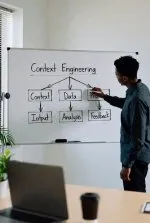
Leaders, the conversation around Artificial Intelligence has fundamentally shifted. For the past few years, the focus was tactical—centered on finding the perfect phrase, or "prompt," to coax a good answer from a Large Language Model (LLM). This era of Prompt Engineering is over.
We are now entering the age of Context Engineering, a rigorous, systematic discipline that determines whether your AI applications are reliable, scalable, and trustworthy—or merely expensive demonstrations. As Andrej Karpathy wisely noted, Context Engineering is "the delicate art and science of filling the context window with just the right information for the next step".
If your company is committed to leveraging AI for core business processes—from customer support and research analysis to software development and financial due diligence—understanding this shift is no longer optional; it is a strategic imperative.
The Strategic Imperative: Moving Beyond the "Cheap Demo"
The difference between an unhelpful, "cheap demo" AI and a genuinely transformative, "magical" product lies entirely in the quality of the context provided.
An LLM is only as good as the information it receives at the moment of reasoning. When AI agents fail in production, it is most often not due to the underlying model's lack of intelligence, but because they lacked the appropriate operational environment—the context—needed to execute reliably. This leads to hallucinations, poor decision-making, and inconsistent outputs that erode customer and employee trust.
Context Engineering transforms the AI development process from a tactical craft into a disciplined approach to systems architecture. It involves designing and optimizing dynamic systems that provide the LLM with everything it needs: the right information, the right tools, and the right format, delivered precisely when required.
The Four Pillars of a Context-Driven Ecosystem
To build robust, production-ready AI applications, your teams must architect an ecosystem composed of multiple interconnected components, all feeding the model's "context window" (its active working memory).
- System Instructions (The Role Definition): This foundational layer sets the AI's boundaries, capabilities, and behavioral guidelines. It clearly specifies the AI's role (e.g., senior software architect), communication style, and how it should handle uncertainty or errors.
- RAG & Knowledge (The Institutional Memory): Retrieval-Augmented Generation (RAG) is fundamental. It connects the isolated LLM brain to your vast, up-to-date, domain-specific knowledge bases (documents, databases, APIs). This is how you ground responses in facts and eliminate the static knowledge problem inherent in pre-trained models.
- Memory Systems (The Coherence Engine): To move beyond single-turn queries, systems need memory. Short-term memory maintains conversation history for immediate relevance. Long-term memory persists learned user profiles, preferences, and successful interaction patterns across sessions.
- Tool Integration (The Hands and Feet): Tools extend the AI's capabilities beyond text generation, allowing it to perform actions, execute code, and retrieve real-time data from external services (like calendars, financial APIs, or email systems).
Critical Executive Awareness: The Context Failure Bottleneck
Relying solely on models with ever-larger context windows will not solve your core reliability challenges. Even with massive token capacity, models suffer performance degradation due to cognitive overload. You must actively manage context quality to mitigate four major failure modes:
| Context Failure | The Business Risk | Strategic Mitigation |
|---|---|---|
| Context Poisoning | Incorrect or hallucinated information (e.g., a false game state or error log) enters and persists in the context, compounding errors over time. | Context Validation and Quarantine: Implement systems to check retrieved information for consistency and usefulness before it enters long-term memory. |
| Context Distraction | The AI is burdened by excessive history, leading it to repeat past behaviors or patterns instead of reasoning freshly, often dropping in correctness far below the maximum token limit. | Context Summarization and Compaction: Continuously compress accumulated history into shorter, high-fidelity summaries, removing low-signal or redundant content (like raw tool outputs). |
| Context Confusion | Providing too many irrelevant tools or pieces of information distracts the model, causing it to use the wrong tool or ignore core instructions. | Dynamic Tool Loadout Management: Use Retrieval-Augmented Generation (RAG) principles to select and present only the most relevant tools for the current task, avoiding the temptation to simply "dump" everything into the prompt. |
| Context Clash | Conflicting information—often generated during iterative reasoning steps—resides in the context, leading the agent to become stuck between contradictions and generating poor final responses. | Context Pruning and Offloading: Actively remove outdated or conflicting data, or use a separate "scratchpad" (like Anthropic’s "think" tool) for processing information without cluttering the main context window. |
Actionable Roadmap for Executive Leadership
Successful context engineering is defined by execution and measurement. To integrate this discipline effectively within your organization, focus on these strategic imperatives:
- Demand Holistic, Iterative Design: Implement Context Engineering not as a one-time deployment, but as an iterative refinement discipline. Begin with simple context configurations (System Instructions and basic RAG) and gradually increase complexity as organizational needs become clear. Consider all context elements as interconnected components.
- Prioritize Workflow Engineering: For complex, multi-step tasks, insist on Workflow Engineering to define explicit step sequences. This breaks down hard problems into manageable steps, each with its own optimized and focused context window, rather than attempting to cram everything into a single massive prompt.
- Establish Measurement and Validation: You cannot manage what you do not measure. Implement clear metrics, such as response relevance, user satisfaction scores, and task completion rates, to objectively evaluate the effectiveness of your context strategies. Use version control for context configurations to track changes and roll back when necessary.
- Embrace Standardization Protocols: To manage the complexity of integrating diverse data sources and tools, consider protocols like the Model Context Protocol (MCP). MCP offers a standardized interface, acting as a universal adapter, reducing the need for custom, bespoke integrations and simplifying security and data flow management across your enterprise systems.
- Foster a Culture of Context Hygiene: Mandate that teams treat context as a precious, finite resource. Implement rigorous practices for keeping context fresh, maintaining context isolation (e.g., separating planning from implementation in different chat modes), and auditing documentation regularly to remove stale information.
Conclusion
The future of AI engineering is not about building bigger models; it is about building better context-aware ecosystems. Context Engineering provides the architectural foundation necessary for agents to understand, remember, and act with purpose in the complex, dynamic environments of your business.
By shifting investment and focus toward this discipline, you transform your AI applications from generic tools into intelligent assistants that deliver consistent, reliable, and high-value results. This strategic move ensures your company unlocks the full potential of AI while mitigating the critical risks of hallucination and unpredictability.
Watch - Context Engineering: