SpendFlow: Removing the Friction from Switching Banks
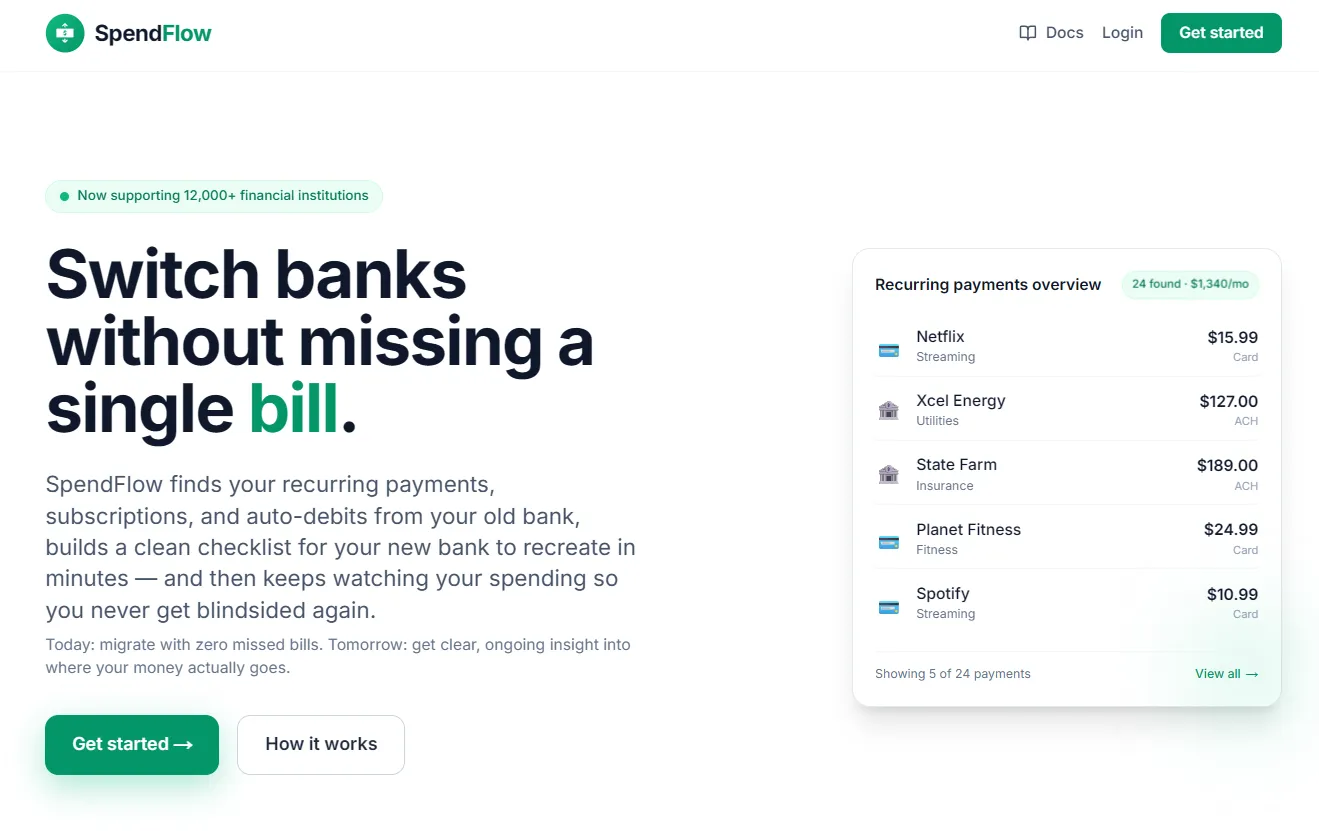
SpendFlow is an AI-powered financial workflow platform designed to help banks reduce onboarding friction by empowering their customers to confidently migrate recurring payments when switching accounts.
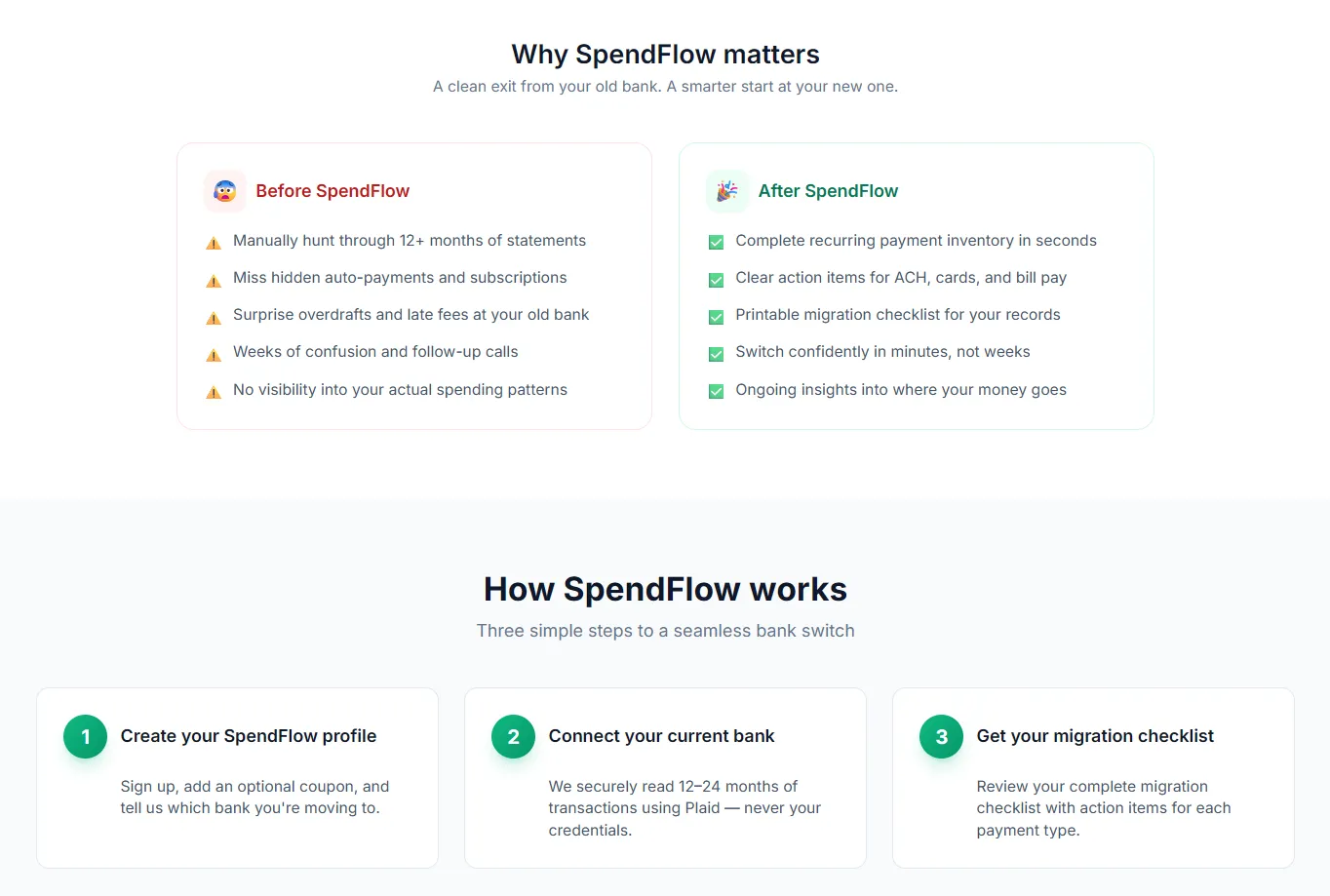
Switching banks is one of the highest-friction experiences in consumer finance. The primary blocker is not rates or features. It is fear. Fear of missed bills, failed ACH debits, surprise overdrafts, and forgotten subscriptions. SpendFlow removes that fear by helping customers generate a complete, actionable migration checklist derived from 12–24 months of transaction history at their old bank.
The result is a cleaner onboarding experience, higher funded-account conversion, and faster path to primary account status without adding operational burden to bank staff.
The Problem
Consumers rarely switch banks because they are overwhelmed by the complexity of moving their existing financial obligations. Most people cannot recall every bill, subscription, ACH debit, or auto-renewal tied to their old account.
Banks feel the downstream effects:
- Customers hesitate to fully fund new accounts
- Missed payments lead to fees, frustration, and early churn
- Onboarding staff spend time answering ad-hoc questions without complete information
- There is no digital system to guide customers through the migration process
This friction directly impacts deposit growth and new-account conversion.
The SpendFlow Solution
SpendFlow creates a customer-led, self-service migration experience that banks can offer as part of their onboarding journey. The bank is never required to access customer data, view transactions, or participate in the migration process.
SpendFlow delivers three core capabilities.
1. Automated Recurring Payment Detection
Using secure, read-only Plaid connections, SpendFlow analyzes up to 24 months of transaction history from the customer’s existing bank to identify:
- ACH debits
- Bank bill pay items
- Debit card auto-charges
- Subscriptions and memberships
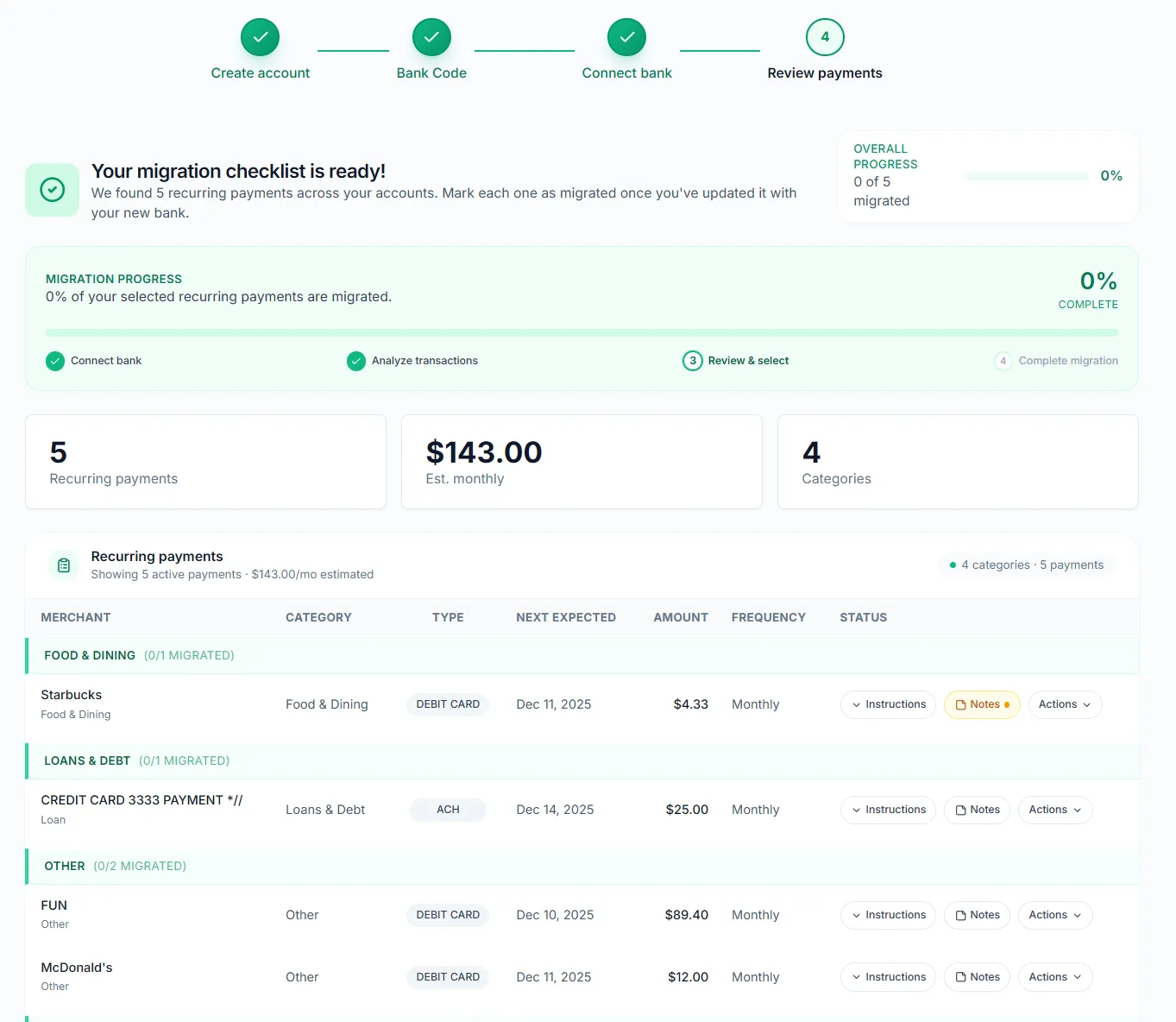
Each recurring payment is categorized, normalized, and enriched with:
- Recurrence pattern
- Average and predicted amount
- Next expected date
- Clear, customer-facing action instructions (for example: update ACH details, recreate bill pay, update card on file)
2. A Consumer-Friendly Migration Workflow
Customers complete the migration independently through a guided flow:
- Create an account
- Apply a bank-provided code (optional)
- Connect their current bank securely via Plaid
- Review and confirm detected recurring payments
- Track progress as payments are updated
The result is a clean, accurate checklist of all recurring obligations, organized by category and payment type.
No bank staff involvement is required.
3. A Self-Service Migration Checklist
Once analysis is complete, the customer receives a structured migration checklist they can use to:
- Recreate bill pay at their new bank
- Update ACH debits with merchants
- Update card-on-file subscriptions once their new debit card arrives
- Track progress and ensure nothing is missed
SpendFlow does not transmit customer data to the destination bank, expose transactions, or create shared access links. The experience is entirely customer-controlled and private.
Key Capabilities
- High-accuracy recurring payment detection using deterministic logic and AI enrichment
- Structured migration checklists with categories, due dates, and recommended actions
- Support for 12,000+ financial institutions via Plaid
- Optional progress tracking, reminders, and rewards
- No credential storage, no transaction sharing, no bank-side workflows
Security is built into the core architecture. SpendFlow never stores bank credentials, encrypts access tokens using AES-256-GCM, and isolates all customer data.
Why It Matters for Banks
SpendFlow addresses the single biggest psychological barrier to switching banks: uncertainty around recurring payments.
Banks benefit through:
- Higher funded-account conversion
- Faster time to primary checking relationship
- Reduced early-life churn
- A differentiated, modern onboarding experience
- Zero core integration and no new back-office workflows
SpendFlow layers on top of existing digital onboarding flows via a simple link or code-based access model.
Why It Matters for Consumers
For customers, SpendFlow eliminates guesswork and anxiety during a bank switch. They get:
- A complete inventory of recurring financial commitments
- Clear, step-by-step guidance for each payment type
- Progress tracking and confidence that nothing was missed
- Optional ongoing visibility into spending patterns
Technology Under the Hood
SpendFlow is built on a modern, production-grade stack engineered by T10:
- Next.js and React for the application experience
- Node.js and TypeScript backend services
- PostgreSQL with Prisma ORM
- Plaid for secure, permissioned bank connectivity
- AES-256-GCM encryption for token handling
The platform includes a guided onboarding wizard, a recurring-payment analysis engine, and a scalable architecture designed for white-label deployment.
What T10 Delivered
SpendFlow showcases T10’s end-to-end capabilities across product strategy and engineering:
- Product ideation, workflow design, and UX architecture
- Secure Plaid integration and financial data analysis
- AI-assisted transaction categorization and enrichment
- Enterprise-grade backend engineering and encryption
- White-label theming and configurable onboarding journeys
- A robust documentation and extensibility foundation
Strategic Expansion Opportunities
Beyond migration, SpendFlow forms the foundation for a broader account-switching platform, including:
- Direct-deposit switching
- Subscription monitoring and management
- Spending insights and analytics
- Optional APIs for deeper integration when banks choose
- Competitive positioning against Atomic and Pinwheel
SpendFlow demonstrates how banks can materially improve onboarding outcomes by empowering customers rather than adding internal complexity.
Explore the product at https://spendflow.us
Have a workflow like this one?
Book a free AI planning call