Colleen Whitlow for Mayor: A Campaign Website and Film
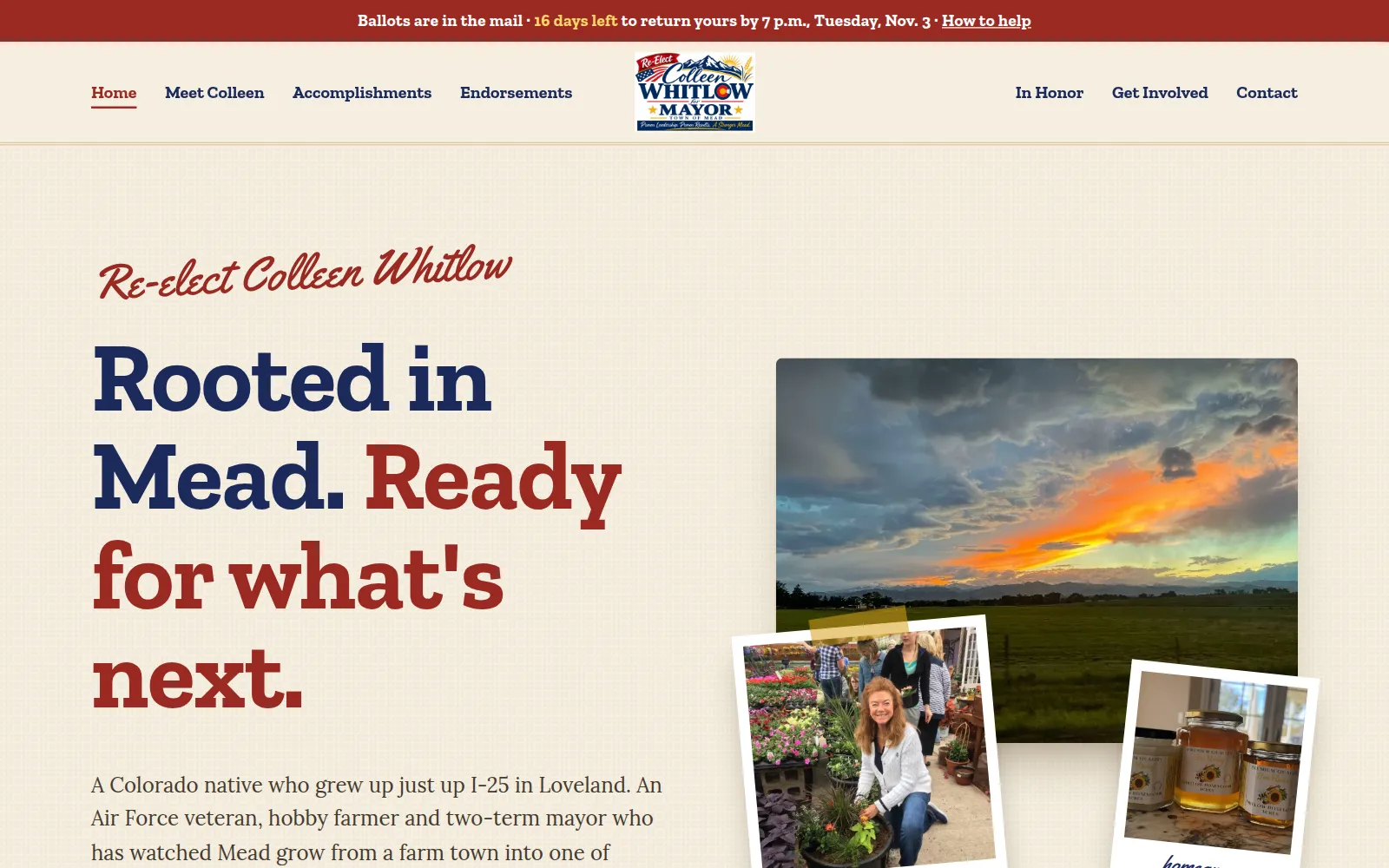
Colleen Whitlow is the mayor of Mead, Colorado, a town north of Denver that has grown from 456 people in 1990 to about 7,000 today. She's running for re-election on November 3, 2026. We rebuilt her campaign website, redesigned it, made a one-minute film for its home page, and host it on our own servers. It's live at colleenwhitlowformayor.com.
The problem
The campaign's site lived on a hosted website builder with no way to export it, so the campaign was tied to that builder's plan and its templates. Mead's ballots go out about three weeks before election day, so the new site had to be live before then, at the same address people already had on yard signs and mailers, with nothing lost from the old one: the endorsements from mayors across Colorado, the list of accomplishments and the biography.
What we built
We copied every page, image and endorsement off the old site and rebuilt it as plain HTML and CSS served by nginx, with no site builder and no monthly plan. Every old address forwards to its matching new page, so existing links keep working. We drew up three design concepts, the campaign picked one, and it went live on October 12.
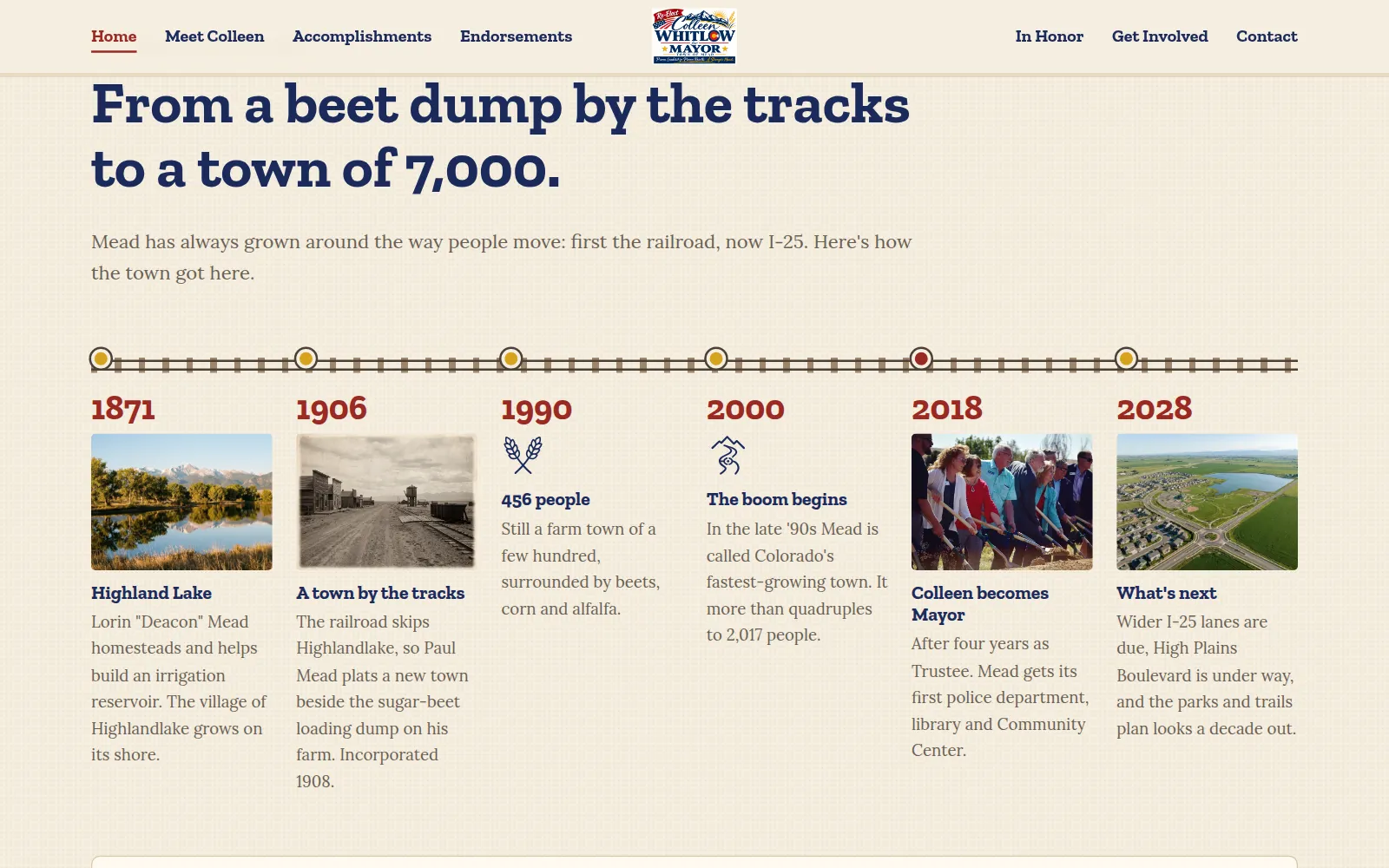
The home page has a countdown to the ballot deadline, a timeline of Mead from its 1871 homestead to the projects due by 2028, a population chart, the five priorities of the campaign's plan, a short record of what the town has done since 2018, and answers to the questions voters ask most: when ballots are due, how to register and how to get a replacement ballot.
Where the grants went
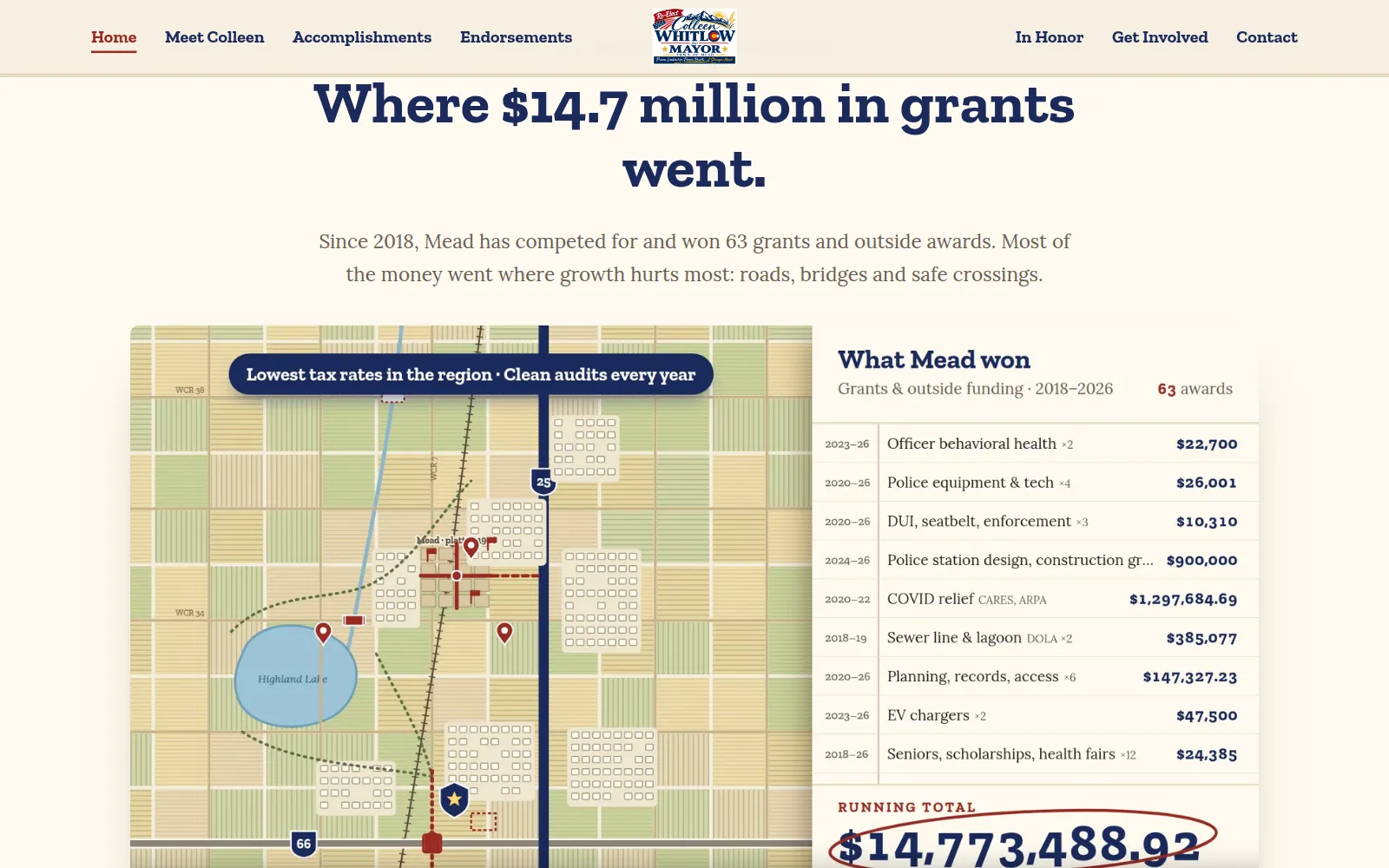
Since 2018 the Town of Mead has won 63 grants and outside awards worth $14.7 million. Colleen sent us her year-by-year list, and we turned it into a map and a ledger on the home page and a one-minute voiced film. In the film a farm photo turns into a plat map of Mead, and each ledger line lights up the road, bridge or building it paid for. The script that builds the film refuses to render if the ledger stops adding up to the list's total or to 63 awards, and projects that were only funded or designed are labeled that way, never as built.
The film comes in a wide cut for the page and Facebook and a tall cut for phones and Reels, with captions. We sent Colleen both files and step-by-step instructions for posting them to the campaign's Facebook page, including what changes once a video post is boosted as a political ad.
Behind the pages
- Contact form: requests for yard signs, volunteering and meet-and-greets go to the campaign's inbox through Resend, so its email address isn't published on the site. A simple math question, a hidden field and a per-visitor limit keep spam out, and the form works with JavaScript turned off.
- Testimonials: a password-protected admin page lets the campaign add, edit and remove testimonial cards, with photos, on the endorsements page. A change is live as soon as it's saved.
- Search and AI assistants: each page has its own title and description, structured data for the campaign, Colleen and the FAQ, a sitemap, and a plain-text copy for AI assistants. New pages are sent to Bing through IndexNow.
What changed for the campaign
The campaign has a site it owns, at the address voters already know. The grants story that took a page of figures to explain is now a one-minute video the campaign can post anywhere, and the volunteer and yard sign requests come in through one form.
Have a workflow like this one?
Book a free AI planning call